



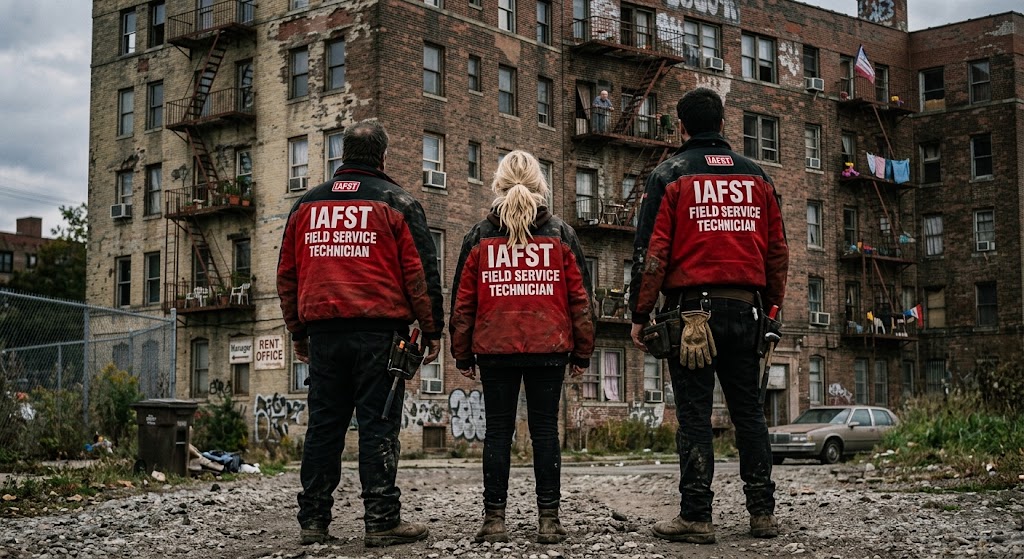
The can has stopped rolling. And it came to rest in Texas.
What was once whispered about in boardrooms and brokered in quiet loan modifications has now exploded into public view. The Texas multifamily market—once the darling of yield-chasing investors—has become the epicenter of a commercial real estate collapse that is sending shockwaves through the entire financial ecosystem. The numbers are staggering, the human cost is mounting, and the pattern of distress reveals something far more troubling than simple market correction.
The Numbers Tell the Story
In May of this year alone, the total value of commercial properties flagged for foreclosure across the Texas Triangle surged past $1 billion—the first time it had done so since industry trackers began monitoring the data . Forty-three commercial properties were scheduled for auction across seven counties that include the state’s five largest metros. The vast majority were apartment complexes.
This wasn’t a one-month anomaly. Over the past year, 120 multifamily loans transferred to special servicing nationwide, and 37 of them—30.8 percent—were tied to Texas . The activity has accelerated dramatically, with 29 of those Texas loans transferring in just the past six months. What looked like a temporary surge now appears to be the leading edge of a structural breakdown.
The Borrowers Beneath the Collapse
The distress isn’t random. It traces back to specific sponsors, specific strategies, and a specific moment in time when cheap money met aggressive underwriting.
Morningstar Credit identified a significant bankruptcy involving sponsor Rao Polavarapu that triggered at least five loan transfers. Another cluster of distress centers on S2 Capital, a firm that has been frantically trying to shore up its REIT through a capital call. Without sufficient investor support—the firm raised only $30 million of a targeted $70 million—it indicated it may need to sell assets. Morningstar’s review of 13 S2 properties that have transferred to special servicing paints a devastating picture: not a single reporting period across any of the properties showed a net cash flow that met or exceeded original underwriting.
The firm known for its aggressive acquisition strategy is now emblematic of a broader failure in underwriting discipline. “It’s notable that not a single reporting period across the 13 properties shows a net cash flow that meets or exceeds the original underwriting,” Morningstar wrote. For an industry built on projected returns, that’s an indictment.
The Ashland Greene Portfolio: A Case Study in Overreach
One of the month’s largest distressed loans tells the story in stark terms. Shakti C’Ganti’s Ashland Greene is facing foreclosure on a four-property portfolio totaling 1,530 units across the Dallas-Fort Worth Metroplex. The firm allegedly defaulted on a $177 million loan from Blackstone.
The portfolio wasn’t a single bad bet—it was a concentrated exposure to a market that turned against the borrower. When interest rates rose and cap rates expanded, the math simply stopped working. The properties couldn’t generate enough income to service the debt, and Blackstone—one of the world’s largest asset managers—chose to pull the trigger rather than extend and pretend.
The Fraud Factor: Fannie Mae Takes Aim
Beyond the financial failures, a darker pattern has emerged. Fannie Mae filed suit in May against two Houston apartment owners over nearly $47 million in soured loans, alleging a pattern of deception that reads like a roadmap of bad behavior.
The borrowers, Falls of Point West, LP and Falls of Gessner, LP, allegedly stacked the properties with junior debt without Fannie Mae’s consent. Between October 2023 and September 2025, the partnerships signed five separate deeds of trust in favor of third parties, adding roughly $11.3 million in hidden debt across the two properties. Fannie Mae says it never agreed to any of it—a clear violation of the transfer and single-asset rules baked into standard multifamily loan agreements.
Then the payments stopped. The Gessner borrower stopped making monthly payments in January, and the Point West borrower followed in February. Around the same time, Fannie Mae alleges, the Gessner borrower swapped out the property’s management company without permission and kept the new manager in place even after a written warning from the servicer.
Then there was the fire. On or about March 12, a blaze spanning two stories damaged multiple residential units at Falls of Point West. Loan documents require immediate notice to the servicer. Fannie Mae says it never got the call.
The Nitya Capital Struggle: Buying Time at a Million Dollars a Month
For every foreclosure that goes through, there’s a borrower frantically trying to stop it. Swapnil Agarwal, CEO of Houston-based Nitya Capital, has become the public face of this desperate rearguard action.
Agarwal paid his lender, One William Street Capital Management, $1 million on June 1 to forestall auction proceedings against three North Texas properties—The Interlace Apartments in Dallas, The Palace Apartments in Arlington, and Chaparral Apartments in Fort Worth. He then had to add $1 million in two installments that month. After that, Agarwal could receive monthly extensions for three additional months—each costing another $1 million. The all-in payment to avoid foreclosure: $5 million.
“I have bought myself four more months,” Agarwal told Multifamily Dive . He claims to be in the final stages of placing longer-term debt through Morgan Stanley to pay off the existing lender.
But Agarwal’s problems are far from isolated. Last month, Morningstar reported that the Domain at Waco and NTX Denton entered special servicing after Agarwal was unable to secure a property tax exemption due to a change in Texas law that closed the Public Financing Corporation loophole. The terms of the loan required a paydown to meet a debt yield hurdle, and Agarwal has set up a plan to pay the lender in $1.5 million installments.
Yet doubts remain. The McLennan Central Appraisal District, which covers Waco, confirmed that “there is no tax exemption in place on the account for the Domain at Waco property” and could not confirm any agreement to that effect. Agarwal currently has 52 properties in his portfolio, including 10,000 apartments and roughly 5,000 student housing units, primarily across Texas and Florida. He made his last conventional apartment purchase in September 2021—just before the market turned.
The Residential Spillover: Homeowners Crushed by Rising Costs
The crisis isn’t confined to commercial real estate. Texas homeowners are drowning in the same rising tide of insurance premiums and property taxes that are crushing apartment owners.
In July, Texas led the nation in foreclosure starts with 3,306, according to ATTOM data . The state also led the nation in completed bank repossessions, with banks taking over ownership of 1,265 foreclosed residential properties. The cities of Houston and Dallas recorded the most foreclosure completions of any large metropolitan areas, with 405 and 223, respectively.
The cause is brutally simple: insurance premiums and property taxes have skyrocketed while incomes have stagnated. The average homeowner’s insurance premium in Texas rose from $1,987 a year in 2020 to a preliminary $3,969 in 2025—an increase of roughly 76 percent. In some areas, premiums have doubled in a single year.
For FHA borrowers—first-time buyers with thinner credit and smaller down payments—the impact is devastating. About 6 percent of FHA-insured loans in Texas fell into serious delinquency in April, meaning borrowers were at least 90 days past due. That’s up sharply from 3.7 percent a year earlier.
The mechanics are insidious. Insurance premiums are typically added to monthly payments through escrow accounts. When premiums spike, the lender advances the shortage to keep the insurance current. At the next adjustment, the borrower must pay the new higher premium plus repay the lender’s advance. As one industry expert explained, it’s like two cost increases hitting at once.
Levi Rodgers, owner of LRG Realty in San Antonio, described the pressure on homeowners: “We’ve had property taxes increase 20% to 40% across many of our counties since 2021. Insurance premiums rose statewide… and builder buydowns from 2022 to 2024 are ending for many borrowers, causing their payment to reset up”.
“In many of the new-construction subdevelopments surrounding San Antonio, I’m watching escrow shortages range from $600 to $1,200 per month,” Rodgers continued. “This is the difference between current and 90 days late”.
The Human Cost: Displaced Tenants and Vanishing Affordable Housing
Behind the billion-dollar loan modifications and foreclosure auctions are real people losing their homes. The Baxter, a 239-unit complex in far northeast Dallas, was sold at an April foreclosure auction after its prior owner, Fundamental Partners, defaulted on a $120 million loan. The buyer, Oconee Real Estate Holdings, paid about $78 million—a steep discount that reflected the distressed nature of the sale.
Residents were told they had 30 days to vacate or transfer to a sister property. Tenants who moved to the sister property faced higher rents. One resident, Jo Summers, toured a unit that cost $865 a month—$120 more than her current rent. She ended up paying just under $1,100 to move.
The displacement is part of a broader crisis in affordable housing. The city of Dallas has lost more than half its supply of apartments renting for less than $1,000 a month since 2021, dropping from more than 98,000 units to just over 47,000 . For tenants displaced by foreclosure, the search for affordable housing grows more desperate by the day.
Texas law requires only three days’ written notice before an eviction filing, a standard that has drawn increasing scrutiny . Residents of the nearby Bonnie apartments received just three days to vacate earlier this month before the city intervened.
The Market’s Verdict
The Texas crisis isn’t a bad economy story—it’s a story of overleverage, underwriting failures, and cascading costs that were always going to catch up with borrowers. As Morningstar noted, the underlying causes are “only tangentially related” to geography. Instead, the distress traces back to borrower-specific issues: aggressive acquisition strategies, hidden debt, and assumptions about rent growth that never materialized.
Whether the Texas concentration reflects coincidence or something more structural remains an open question . Morningstar suggested it could be a temporary surge or “if healthy population growth is pulling so much capital into the state that there were bound to be pitfalls”.
Whatever the cause, the result is the same: a wave of distress that is reshaping the Texas real estate landscape, displacing tenants, and exposing the fragility of the extend-and-pretend era. The can has stopped rolling. Now we’re counting the wreckage.