



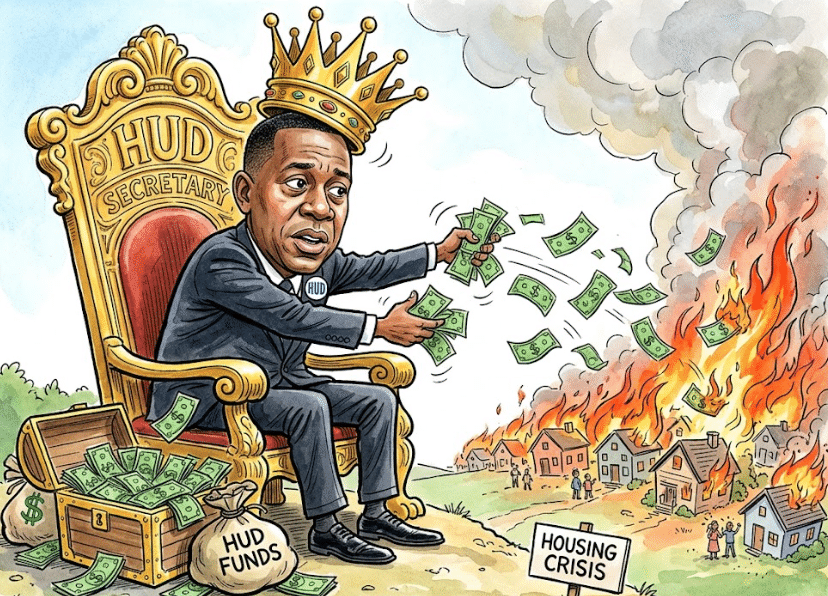
Every day brings another headline, another controversy, and another crisis under the failed leadership of Secretary Scott Turner on the HUD M&M FSM as his henchman Paul Olin, Acting Deputy Secretary, scrambles to bury his head in the sand. Impeachment may be in the wind for Secretary Turner and only the midterms will tell.
HUD’s own Justification and Approval admits that unpaid vendors, liened houses and Congressional inquiries ended its Field Service Management contracts. It never admits that HUD ran the program that produced all three.
One Paragraph. Every Failure HUD Hoped You Would Not Add Up.
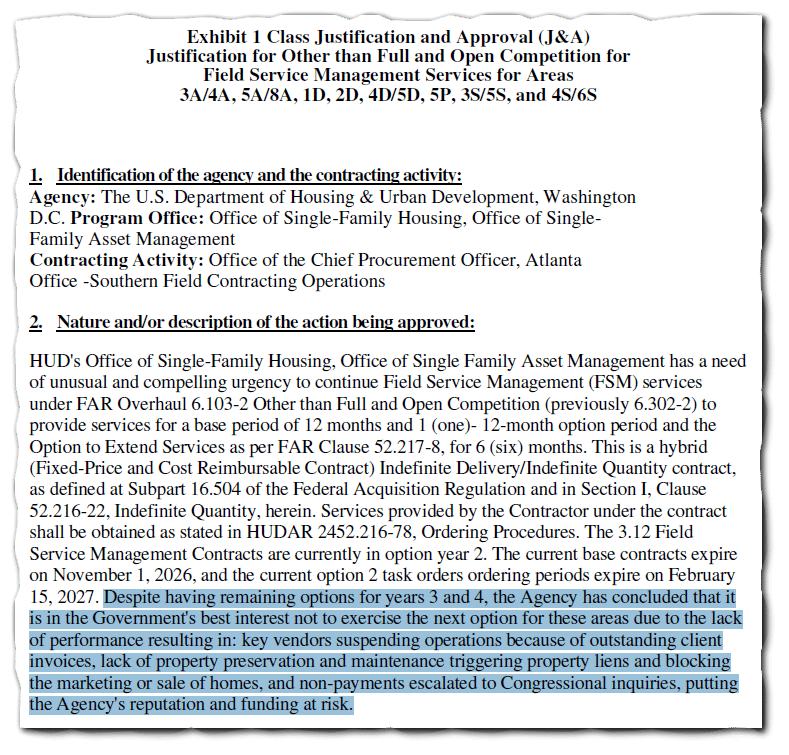
Buried in Section 2 of a class Justification and Approval covering eight Field Service Management areas, HUD wrote a sentence that deserves to be read aloud in a hearing room. HUD says it will not exercise the next option on the 3.12 contracts “due to the lack of performance resulting in: key vendors suspending operations because of outstanding client invoices, lack of property preservation and maintenance triggering property liens and blocking the marketing or sale of homes, and non-payments escalated to Congressional inquiries, putting the Agency’s reputation and funding at risk.”
That is HUD describing HUD’s program. HUD picked the awardees. HUD wrote the contracts. HUD approved the invoices. HUD collected the complaints. HUD now announces that the result is a threat to its own funding, and it files the confession as a procurement formality.
The sentence does not name a contractor. It does not name a dollar amount. It does not say who failed to pay, who failed to preserve, or who failed to oversee. It assigns the blame to “lack of performance” and moves on to the shortlist, as if the agency that ran the contracts for years had been a bystander.
The Ledger HUD Left Out
Foreclosurepedia has monitored HUD’s Management and Marketing Field Service Management program for decades. The public record, including a federal decision HUD itself appeared in, tells the story of an agency that cannot plan, cannot award cleanly, and cannot supervise what it awards.
HUD planned to issue the 3.12 solicitation in October 2018. According to the Government Accountability Office, it could not post it until February 2021. The delay followed an appeal by the Small Business Administration of HUD’s own competition decision and protests, sustained by GAO, over a sister solicitation that failed to reflect the pandemic. That is twenty-eight months lost before a single 3.12 contractor was chosen.
In May 2021, Alpine Companies protested HUD’s interim “bridge” competition, and HUD canceled it rather than defend it. HUD then offered sixty-day sole-source extensions at existing prices and hoped every contract holder would say yes.
They did not. Five days before the final 3.10 task orders expired, HUD learned that Innotion Enterprises would not extend two areas and that holders of three others would not extend either. GAO counts that as two business days. HUD had not posted the replacement solicitation until three months before the old orders ran out. It had no fallback and never asked what would happen if the incumbents walked.
On May 30, 2021, HUD extended DGG RE Investments’ existing task orders and added the five areas. No competition, no proposals and no evaluation covered them. GAO denied the protest, citing the pandemic and the legal standard that an agency’s planning need not be error-free. That sentence describes the law. It was never praise for HUD, and HUD should not wear it as a medal.
HUD did give a reason for DGG. It told GAO that DGG was already performing similar work at a satisfactory or higher level and already had a presence in three of the Homeownership Centers. Agree with it or not, that is a reason an agency can point to. HUD had watched DGG work inside the program.
The eleven-area 3.12 awards then went to three companies and drew protests from the firms that lost. On July 27, 2022, HUD told GAO it would cancel all eleven awards, reevaluate proposals and decide again. Days later it posted another urgency justification to keep services running. The pattern repeats. HUD loses the calendar, claims an emergency, and skips competition.
Now it is October 2026 and HUD is doing it a third time. The Federal Acquisition Regulation says contracting without full and open competition may not be justified by a lack of advance planning. Eight years is not an emergency. It is a management record.
At Least $353,679.50 Owed. The Number Is Climbing.
Foreclosurepedia’s running tally of unpaid Field Service Technicians and Inspectors on 24 Asset Management work stands at no less than $353,679.50. It is a floor, not an audit, and it approaches $400,000.
The paper behind it includes $42,900.00 in Puerto Rico audits, a $29,286.50 Illinois sheet, a $45,458.00 claim covering 1,023 invoices and a $37,035.00 Central Florida list. The rest comes from vendors who reported what they are owed. Foreclosurepedia is not naming them.
HUD did not discover this in a headline. Craig Karnes, a senior HUD official wrote in 2023, to Foreclosurepedia, that HUD “is aware of the relationship between 24 Asset Management and Assero.” Assero is the predecessor firm whose own vendors went unpaid. Aware. That is HUD’s word. Foreclosurepedia has seen no referral to HUD’s Office of Inspector General in the years since. HUD was aware, and the debt grew.
Labor Is Paying HUD’s Penalties
Foreclosurepedia has reported that HUD assesses liquidated damages against its prime contractors, a feature carried from the 3.10 contracts into 3.12. HUD takes its money first, for missed quality control and similar failures. Labor is last in line.
The prime contractor being docked has fewer dollars to pay the people who did the work. HUD keeps its penalty and writes a procurement document about vendors going unpaid. Nobody tells a Field Service Technician or Inspector whether the work order they completed will ever turn into money.
That is the snowball. Field Service Technicians and Inspectors cannot pay their own subcontractors. Trucks, insurance and fuel go on credit cards. Small firms miss payroll. Bankruptcies begin. Families lose homes while the homes HUD owns sit with overgrown grass and liens attached. HUD’s own Justification says so.
HUD’s Answer To Unpaid Vendors: A Debtor, A HUD OIG Audit And Two Insecure Websites
Having confessed that non-payment ended the old contracts, HUD turned to the replacements. The Justification names Alpine Companies, P.K. Management Group and A2Z Field Services as “uniquely capable” of running contracts worth an estimated $170,829,743.00. HUD says it reached that finding through capability matrices and past performance data.
Foreclosurepedia’s files name 24 Asset Management, Spectrum and JGM as the 3.12 incumbents. None of the three shortlisted firms is on that list. Altisource Solutions and Vendor Resource Management answered the same Sources Sought Notice in writing and were not shortlisted. HUD has not said why.
A2Z: The Debtor
A2Z Field Services is a Chapter 11 debtor in Case No. 2:26-bk-52098, in the Southern District of Ohio. Its sworn August report shows $1,979.31 in the bank, zero full-time employees and $261,065.19 in past-due vendor bills with approximately 600 vendors owed.
HUD’s Justification says the work requires “a fully staffed and equipped office.” A2Z told a federal bankruptcy court it has no full-time employees. The docket is public and anyone can pull it in minutes. HUD either never pulled it or pulled it and shortlisted the debtor anyway. Both answers are an indictment.
PKMG: The HUD OIG Audit And The Website
P.K. Management Group has a history with HUD’s own Office of Inspector General. A 2016 HUD OIG audit of its Illinois work found that PKMG did not always provide property preservation and protection services as its HUD contract required. The auditors also found that it billed HUD for properties it had not serviced.
The Inspector General recommended that PKMG repay more than $19,000 for 105 properties that were not adequately maintained and more than $2,300 for properties it never serviced. The auditors projected that HUD could pay more than $2.5 million over the following year in fees for work not done to contract standards.
Foreclosurepedia reported in 2018 that every award PKMG held at that time drew a protest, and that the awardee entity was under a Service Contract Act pay investigation. HUD’s Justification mentions none of this.
The public face of the firm HUD calls “uniquely capable” does not support a secure connection. Browsers with HTTPS protection turned on stop visitors with a full-page warning before the page loads. Click through, and the site still describes PKMG as prime on HUD’s old M&M 3.6 and 3.8 programs. It never mentions 3.12.
Alpine: The Template
Alpine Companies has already been awarded three areas worth $51,568,665.00. Its website runs on plain, unencrypted HTTP, consists of two pages built on a GoDaddy template, and carries a 2022 copyright.
A website proves nothing about performance, and Foreclosurepedia does not claim it does. It shows what “uniquely capable” did not require, which is anything the public can check. A firm holding a $51.5 million federal award has published no capability statement, no team and no past-performance reference where Labor can read it.
Two of the three firms HUD trusts with $170,829,743.00 run public sites that do not support a secure connection. The third is in bankruptcy court.
Nobody On The List Has Current Experience. The Firms That Were Cut Never Got The Same Pass.
Alpine has not performed HUD M&M Field Service Management work for some years. PKMG’s own website still lists the 3.6 and 3.8 programs, which are generations old. A2Z is in bankruptcy court with no full-time employees. None of the three can claim current experience running these contracts.
Then “current experience” cannot be what separated the three from the two. Altisource Solutions and Vendor Resource Management answered the same Sources Sought Notice in writing. HUD cut both and kept a debtor, a HUD OIG audited contractor and a firm that has sat out the program for years.
HUD owes the public the criteria. If past performance was the test, show the data. If capability was the test, show the matrix. If it was neither, say so.
A limited sources competition is supposed to narrow the field to firms that can do the work. HUD’s version narrowed it to firms that answered, and then it kept the weakest of them. Foreclosurepedia expects Altisource and VRM to ask HUD the same question and protest the J&A if there is a path still remaining to do that.
Same Habit, Worse Facts
In 2021, HUD had five days and a pandemic to explain itself. In 2026, HUD’s own Justification says it will decline options for years 3 and 4 that it still holds. It has known the November 1, 2026 expiration since it signed the contracts. It had months, not days.
HUD sole-sourced DGG with a reason. It now shortlists a debtor, a HUD OIG-audited contractor and a firm that has been out of the program for years, and it calls the result “uniquely capable.” HUD should have to defend that phrase under oath, one firm at a time.
The Solicitation Is Already Falling Apart
HUD has already amended its own solicitation. Amendment 0001 partially cancels four of the eight areas, 1D, 2D, 4D/5D and 5P. Those four areas carry $96,622,154.00 of the $170,829,743.00. The amendment gives no reason.
Foreclosurepedia will not guess at the reason. HUD should say what changed, and whether anyone looked at the A2Z bankruptcy docket before pulling half the work off the table.
Alpine’s three areas are worth $51,568,665.00. Five areas remain unassigned, and HUD has told the public nothing about which firm it intends for them.
Congress Is Already In The Room, By HUD’s Own Admission
No critic invented the Congressional inquiries. HUD wrote that they happened and that they put its “funding at risk.” Foreclosurepedia has not seen the inquiry letters themselves; however, we are sure that Secretary Scott Turner has been sweeping the issues under the rug as quick as he can.
What did HUD do about it? It did not recover the money for Labor. It did not publish a debt list. It refuses to release information on the performance bond for Labor to file against including a recent FOIA filing. It sent no referral to the Inspector General that Foreclosurepedia has seen. It drafted a procurement document and named a bankrupt firm among the three it trusts.
If HUD believes its funding is at risk, the way to protect that funding is to pay the people who did the work and explain where the money went. Shortlisting a Chapter 11 debtor does the opposite.
Who Signs This
Secretary Scott Turner commands this department. The Justification passed through senior procurement officials and carries their approvals, and Paul Olin’s name sits in that chain. Turner was in position to ask what HUD checked before it shortlisted A2Z. He was in position to ask why unpaid vendors were still unpaid. Foreclosurepedia has seen no sign that he did.
Why he did not is immaterial. The signatures are on the page, and every one of them was a chance to stop.
What HUD Must Do Now
HUD should withdraw A2Z Field Services from the shortlist today. It should explain in writing why a debtor with no full-time employees was found “uniquely capable.” It should say what it knew about 24 Asset Management’s unpaid vendors, and when.
HUD should publish the criteria and scoring that kept Alpine, PKMG and A2Z on the list and dropped Altisource and VRM. It should open every remaining area to full and open competition. It should publish the liquidated damages it has withheld from its Field Service Management prime contractors, and what Labor has received in return. And it should refer the matter to its Inspector General in writing and say so publicly.
Congress should do what HUD’s own document says it is already doing. Ask questions, put them in writing and demand answers on the record.
What Labor Does Now
If A2Z owes you money, file your proof of claim in Case No. 26-52098 and call the office of Subchapter V Trustee Donald W. Mallory to confirm you were listed. If 24 Asset Management owes you, document every unpaid work order by property, service, date and amount, and send it to the HUD Office of Inspector General.
Then call your Representative and your Senator. HUD wrote that Congressional inquiries put its funding at risk. Call the media in your hometown. And file litigation against the appropriate parties that owe money including 24 Asset Management.
HUD put its reputation and its funding at risk in writing. A2Z has $1,979.31. Labor is still waiting.
Meanwhile The A2ZFS Debt Keeps Getting Worse
 Loading...

 Reload document
 Open in new tab