
Blog

HUD Says Unpaid Vendors Killed Its Old Contracts. Then It Shortlisted Bankrupt A2Z Field Services: $2,025.81 In The Bank, $261,065.19 In Past-Due Vendor Bills

Paul Olin

24 Asset Management, the former HUD M&M FSM awardee owes Labor at least $353,679.50, by Foreclosurepedia’s tally. The firm HUD called “uniquely capable” to replace that work is a Chapter 11 debtor with zero employees.

HUD never opened the docket on the Chapter 11 debtor it shortlisted for a $170.8 million federal contract, or it opened the docket and shortlisted the debtor anyway. Both answers are an indictment of the agency that just blamed non-payment for ending its own contracts.

Justification and Approval 26-30 names Alpine Companies, P.K. Management Group, and A2Z Field Services as “uniquely capable” of running Field Service Manager contracts across eight areas, estimated at $170,829,743. A2Z is Debtor-In-Possession in Case No. 26-52098, Southern District of Ohio, a Subchapter V case that began May 1, 2026. We caution the Foreclosurepedia Nation that both Alpine Companies and PK Management are insecure and may expose you to hacking.

Think about that for just a moment. Labor, whom rarely if ever interacts with humans on a HUD M&M FSM site, must pay to have a background check to even cut the grass. Apparently, anyone with a pulse clears the hurdles with HUD Secretary Scott Turner. No money? Check. Bankruptcy? Check. Potentially a target of foreign nationals wanting to hack the HUD P260? Check. That is just A2Z Field Services and we include their current bankruptcy balance sheet below. PK Management? Don’t even get me started on the fraud there. A simple search on Foreclosurepedia will tell the tale!

The bigger problem is that Alpine Companies, currently a HUD M&M FSM awardee, and PK Management both have insecure sites with PK Management not even allowing access.


What HUD Wrote About Unpaid Vendors

In the same document, HUD explains why it will not exercise the next option on the current 3.12 contracts. It cites “key vendors suspending operations because of outstanding client invoices, lack of property preservation and maintenance triggering property liens and blocking the marketing or sale of homes, and non-payments escalated to Congressional inquiries.”

HUD wrote that its own contractors’ non-payment drove vendors to stop work, put liens on homes, and put the agency’s “reputation and funding at risk.” Those are HUD’s words, in a federal procurement record.

What HUD Did Not Write

The Justification never names the contractor behind that language. It does not name 24 Asset Management, and it puts no dollar figure on what Labor is owed. Foreclosurepedia will supply both.

Foreclosurepedia has reported that HUD moved some of 24 Asset Management’s work to Alpine Companies. Foreclosurepedia’s running tally of money owed to Labor by 24 Asset Management stands at $325,679.50, plus a further $28,000 from an Indiana vendor, for at least $353,679.50. The upper end of the range is $358,679.50.

Of the $325,679.50, $154,679.50 sits on paper. That is $42,900.00 from Puerto Rico audits, $29,286.50 from an Illinois invoice sheet, $45,458.00 from a 1,023-invoice claim, and $37,035.00 from a Central Florida work order list. The other $171,000 to $176,000, and the Indiana $28,000, rest on vendors’ accounts.

That is a sum of separate claims, not an audited figure, and each claim is counted once. It is also a floor. Every number exists because a Field Service Technician or Inspector decided to say it out loud.

Add A2Z’s own sworn figure, $261,065.19 in past-due vendor payables, and the two firms stand at no less than $614,744.69 owed to Labor. One lost the work. The other made the shortlist.

What HUD Certified

The Justification says the work requires a “fully staffed and equipped office.” It says the three firms have the access to staffing and resources to perform immediately. It says HUD reviewed every respondent for conflicts of interest, financial securities, staffing, and ability to recruit. The Contracting Officer certified all of it as accurate and complete. None of them have staffed offices and even worse A2Z Field Services swears, under penalty of perjury, they do not even have employees. A simple Google search would have documented that should HUD Contracting Officer Charles Hoyle Jr or HUD General Acting Deputy Secretary Paul Olin ever found themselves around a keyboard instead of on a golf course.

Thirty Months Without An Open Bid

HUD did not open this $170,829,743.00 to the market. It sent a Sources Sought Notice to five companies it chose, cut them to three, and wrote that it would conduct a limited sources competition among the three.

Altisource Solutions and VRM Mortgage Services answered the notice in writing and were not shortlisted. A2Z Field Services answered it too, and A2Z is the debtor in bankruptcy that HUD kept.

The shortlist is not a bridge to 2027. The J&A sets a 12-month base period starting October 1, 2026, one 12-month option, and a six-month extension. HUD’s own J&A counts that as 30 months, which runs to roughly March 2029.

HUD says it “intends” to hold full and open competition in Fiscal Year 2027. The J&A promises only that HUD “anticipates” finishing planning, solicitation, and award during the performance period. HUD can decline the options, but nothing in the J&A says it will.

The J&A puts the cost of a 30-month gap in service at “approximately $126.3 billion in holding costs.” That is about 739 times the $170,829,743.00 contract value.

What The Court Record Shows

A2Z’s sworn monthly operating report for August, signed by Amie Sparks, lists zero full-time employees, both today and on the day the case began. HUD’s Justification calls that company fully staffed.

The same report shows cash falling from $19,390.56 to $2,025.81 in thirty-one days. That is a drop of $17,364.75, or 89.55 percent. The Chase statement confirms the closing balance to the cent. HUD certified that a company with about two thousand dollars in the bank can begin immediately.

Then look at where the money went. On the last day of August, four transactions took $22,293.26 out of the account, which is 90.45 percent of everything A2Z spent all month. Two wires totaling $10,000 went to law firms. An ACH of $8,448.26 went to a technology vendor. An ACH of $3,845.00 went to OnDeck, a lender A2Z lists among its creditors.

A2Z took in $7,283.30 for the entire month and wired $10,000 to lawyers in one afternoon. The bank statement shows no payment to any vendor on the debtor’s own aging schedule.

The Vendors Are On The Page

That aging schedule runs four pages. It lists $261,065.19 in past-due payables, which the debtor’s report labels postpetition. Not one dollar is under 31 days old. $71,337.34 sits in the 31-to-60 column. $189,727.85, or 72.67 percent, is at 61 days and over.

Those are vendors, and many of them are the Field Service Technicians and Inspectors who did the work. A2Z owes them 128.87 times what it has in the bank. The largest single balance is $21,912.75. They worked for a company already in bankruptcy court and they are still waiting.

Lawyers, Meanwhile

The report shows $75,570.00 paid to the debtor’s lead bankruptcy counsel since the case began, and $8,000.00 more to a second firm. That is $83,570.00 in professional fees, 41.25 times the cash left in the account.

The Balance Sheet HUD Did Not Read

The accrual balance sheet carries $794,532.91 in assets. Of that, $662,578.73 is a line labeled “Interco Receivable – Black Dome,” a claim against the company that acquired A2Z in late 2025. That is 83.39 percent of stated assets. Strip it out and $131,954.18 remains.

The same balance sheet lists $1,392,825.51 in total liabilities, including five short-term lenders and a $575,945.55 shareholder line of credit. Equity is negative $598,292.60. The report’s summary page lists total liabilities at zero. A federal contractor whose own schedules disagree is what HUD called uniquely capable.

The receivables tell the same story. $109,528.48 of the $123,234.60 owed to A2Z, or 88.88 percent, comes from two Progress Residential accounts. No HUD receivable appears.

The Docket Shows A Fight Over Whether The Case Survives

Black Dome Services, the company that bought A2Z, is a creditor in the case. It filed an amended motion to dismiss the Chapter 11 for lack of authorization and lack of standing. The court set a trial on that motion for December 11, 2026, with discovery closing December 4. The docket does not say why Black Dome wants the case gone, and Foreclosurepedia will not guess.

The court also extended A2Z’s use of cash collateral under a final order, which means someone holds a lien on the cash. The Justification mentions none of this. HUD certified that it reviewed financial securities.

HUD’s Own Paper Trail

The amendment that partially cancels the solicitation dates the solicitation to September. The signatures on the Justification that authorizes it run from late September to mid-October. At more than $90 million, the deal needed the Senior Procurement Executive, and that signature came in mid-October.

By then A2Z’s July and August operating reports had been on the public docket for weeks, and the bankruptcy itself for more than five months. HUD’s top procurement official approved the shortlist with all of it in plain view.

HUD Cannot Get The Name Right

The Justification lists A2Z’s contact as “Arnie Sparks-Beebe, CEO & President.” The sworn filing is signed by Amie Sparks. If HUD cannot confirm the name of the executive it plans to negotiate with, it did not confirm the finances behind her signature.

Karnes Knew In 2023. Ford And Washington Got The Same Record.

Foreclosurepedia put the 24 Asset Management non-payment record in writing before three HUD officials: Craig Karnes, former Assistant Chief Procurement Officer, LaShura Ford, Assistant Chief Procurement Officer for Field Operations, and HUD’s Sharon Washington.

Karnes did not merely receive the notice. In 2023 he answered it, in writing, and acknowledged that HUD “is aware of the relationship between 24 Asset Management and Assero.” He added that any continuing award would require 24 Asset Management to “mitigate any identified Conflicts of Interest.”

That is HUD admitting, three years ago, that it knew who stood behind the contractor leaving Field Service Technicians and Inspectors unpaid. The awards continued anyway. Foreclosurepedia then sent the stopped $21,000 check, the National Field Network warning, and the unserviced Illinois assets to the same procurement office.

Ford and Washington received the same record. None of the three has answered Labor, and Foreclosurepedia has seen no referral to HUD’s Inspector General. HUD then wrote unpaid vendors into a J&A as its emergency and shortlisted a debtor in bankruptcy.

The Solicitation Is Already Coming Apart

HUD has already cancelled part of its own competition. Amendment 0001 partially cancels the solicitation for areas 1D, 2D, 4D/5D, and 5P. Those four areas carry $96,622,154 of the $170,829,743 estimate, or 56.56 percent. The amendment gives no reason.

The remaining four areas carry $74,207,589. HUD should say whether the bankruptcy docket had anything to do with the cancellation, and which areas A2Z was ever meant to receive.

The Emergency Is Fiction

HUD invoked unusual and compelling urgency to skip full and open competition. It has known when these contracts expire since the day it signed them. It has known about the vendor non-payment it now cites for the entire period it says it needed to act.

HUD also admits it will hold a full and open competition in Fiscal Year 2027. The agency can compete this work. To avoid doing so, it claims a lapse would cost approximately $126.3 billion in holding costs, against a contract value of $170.8 million. That is 739 times the contract. No method accompanies the number.

What This Means for Labor

The Justification states that the follow-on contracts involve “no changes to the core services performed under the current contracts.” That means no escrow, no direct-pay safeguard, and no payment protection for Field Service Technicians and Inspectors. HUD is renewing the structure that left Labor holding unpaid invoices.

If A2Z owes you money, know the deadlines. The general deadline to file claims in Case No. 26-52098 was July 17, 2026. The government deadline is October 28, 2026. If you have not filed, call the office of the Subchapter V trustee, Donald W. Mallory, and ask whether A2Z listed your debt.

If 24 Asset Management owes you, file with HUD’s Office of Inspector General. File liens. Hire a lawyer. Report it to your Congressional Representative and Senator. Finally, contact the local media and feel free to cite this article! This is federally funded work, and a documented pattern is harder to dismiss than one vendor’s invoice.

The Bottom Line

HUD wrote that unpaid vendors, liens on homes, and Congressional inquiries are why the old contracts are ending. The old contractor owes Labor at least $353,679.50. HUD then shortlisted a debtor with $2,025.81 in the bank, zero employees, and $261,065.19 in past-due vendor bills. The reason is on the page. The remedy is not. Neither is the due diligence.

The Docs No One Wants You To See


Loader Loading...
EAD Logo Taking too long?

Reload Reload document
| Open Open in new tab

Loader Loading...
EAD Logo Taking too long?

Reload Reload document
| Open Open in new tab

Loader Loading...
EAD Logo Taking too long?

Reload Reload document
| Open Open in new tab

Loader Loading...
EAD Logo Taking too long?

Reload Reload document
| Open Open in new tab


A Record El Niño, A Winter That Looks Mild On The Map, And One Hard Freeze That Will Burst Every Pipe Nobody Drained

Winterization

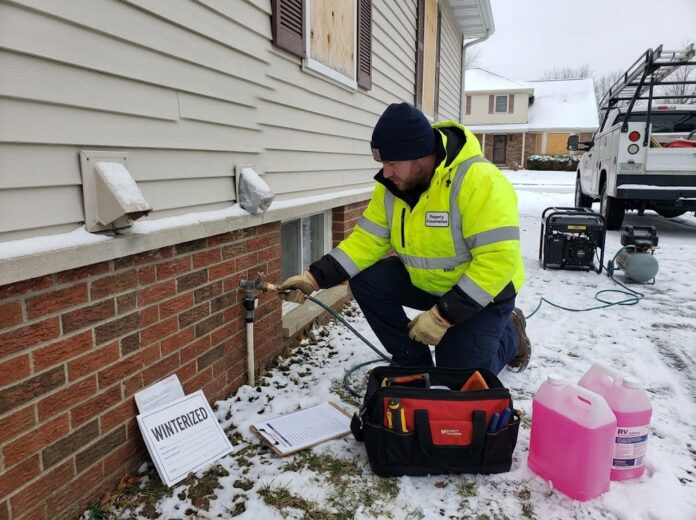
The temperatures are dropping and the winterization orders are starting to move. This is the month the work shifts from grass cuts to pipes, and this year the weather is not ordinary.

NOAA’s Climate Prediction Center says El Niño is strengthening. Its September 10 diagnostic discussion put the chance of a very strong event this fall and winter above 90 percent. It also put the chance of a historic event, stronger than any El Niño on record since 1950, at 75 percent for October through December.

Seasonal average sea surface temperature anomalies in the central-eastern equatorial Pacific are forecast to peak at approximately +3.7°C above normal for the October–December period. This is the super El Niño Foreclosurepedia has been watching, and it is no longer a forecast. It is happening.

What A Super El Niño Does To The Map

A strong El Niño shifts the Pacific storm track south. The Southwest, Texas, the Gulf Coast, and the Southeast sit in the path of that track and should expect a wetter and stormier winter than usual.

The Pacific Northwest usually goes warmer and drier, with weak mountain snowpack. The northern Plains and Upper Midwest can run drier at times when the southern track dominates, but clippers and sudden cold snaps remain on the table.

The Northeast gets the most complicated pattern. Inland areas can take rounds of heavy, wet snow while the coast sees rain or mixed precipitation.

NOAA’s temperature outlook leans above normal across much of the West, the northern tier, and parts of the East. The Farmers’ Almanac, which uses its own formula and not NOAA’s science, calls the Southeast cool and wet. The two disagree there, and Foreclosurepedia is reporting both.

Why A Mild Winter Is The Dangerous One

Forecasters say it plainly: even the strongest El Niño does not deliver the textbook outcome everywhere. A seasonal outlook tells you the odds over three months. It does not tell you what the thermometer reads on one January night.

A warm-leaning winter is exactly when servicers and order mills slow-walk winterization orders, because the weather looks forgiving. Then a single Arctic push arrives and the lines freeze in houses that were never drained.

The South is the real exposure. Properties in Texas, Georgia, Alabama, and the Carolinas are routinely skipped because freezes are rare. A stormier southern track means more rain, more roof leaks, and more water intrusion in vacant houses, with a hard freeze still possible on top of it.

Foreclosurepedia expects that when those pipes burst, the damage will be blamed on Labor and not on the order that never came. Field Service Technicians and Inspectors should document every property they touch.

Who Does What

Field Service Technicians perform the physical work of draining, blowing out, and treating the plumbing. Inspectors do the assessment work: occupancy checks, condition reports, and documenting freeze damage when they find it. The two jobs carry different pay, different liability, and different legal treatment, and they should never be run together.

A winterization typically pays $45 to $50. They should be around $180. That number does not change because the gear costs more or the house is bigger. Every tool on this list comes out of that payment, so buy right and buy once.

The Gear That Belongs On The Truck

Air compressor. This is the heart of the job. A portable compressor with a tank and a built-in regulator lets you blow out the lines at a controlled pressure. Set it to whatever the work order specifies. Most residential plumbing does not need the compressor’s maximum, and over-pressurizing old pipe is how a winterization turns into a flood.

Air hose. Carry at least 50 feet with quick-connect fittings, plus a short whip hose. Vacant houses rarely have an outlet where you want it, and a short hose forces you to drag the compressor through the house.

Pressure gauge. A gauge in the 0 to 100 psi range is non-negotiable. The gauge is how you prove the system holds, and photographing it at the end is how you prove the job was done. Carry a spare, because a cracked gauge ends a job.

Garden hose and adapters. Keep a short garden hose and a set of male and female hose-thread adapters. You will use them to connect your air source to an exterior hose bib or an interior fitting. You will also use them to run water for a pressure check when the house has none.

Pink solution. This is RV and marine antifreeze, a propylene glycol product rated for burst protection. It goes into every trap, toilet tank, and toilet bowl after the lines are blown out. Never use automotive ethylene glycol in a drain line. Buy by the case, because a three-bathroom house with a washer and dishwasher eats more than one jug.

Shutoff and fitting tools. Bring a water meter key and curb stop key, a pipe wrench, channel locks, and an assortment of caps, plugs, and PEX and copper fittings. You cannot drain a house you cannot shut off, and many properties arrive with a seized or missing main valve.

Water heater tools. Carry a drain hose and a short length of tubing. The heater must be isolated and drained, and the electric or gas supply must be handled according to the work order. In the South, we carry a piece of metal coat hanger to run up the tank nozzle due to calcification.

Support gear. Bring a wet-dry vac for the water you will spill, towels, a headlamp, gloves, and safety glasses. Add hearing protection if you run a loud compressor in a closed house.

Power backup. Many vacant houses have no electricity. A small generator or a compressor with its own power source keeps a no-power property from becoming a rejected job.

Photos and documentation. Photograph the gauge, the shutoff, each trap treated, and the water heater drained. Winterization disputes are decided by pictures, and Field Service Technicians and Inspectors who cannot prove the work get chargebacks.

Do Not Take The Job Blind

Read the work order before you drive to the property. Specifications vary by client and by property type, and a wet heating system, a sprinkler system, or a well changes the procedure entirely. If the order does not fit the house, document it and ask before you start.

Do not accept a winterization at a rate that cannot cover your gear, your fuel, and your time. A bad rate on a hard job is how Labor ends up working for free.

The season is turning. The storm track is moving. The pipes are about to find out who prepared.

Vacant: One Word, Two Dead Field Service Technicians, And A Chain Of Companies That Refuse Responsibility

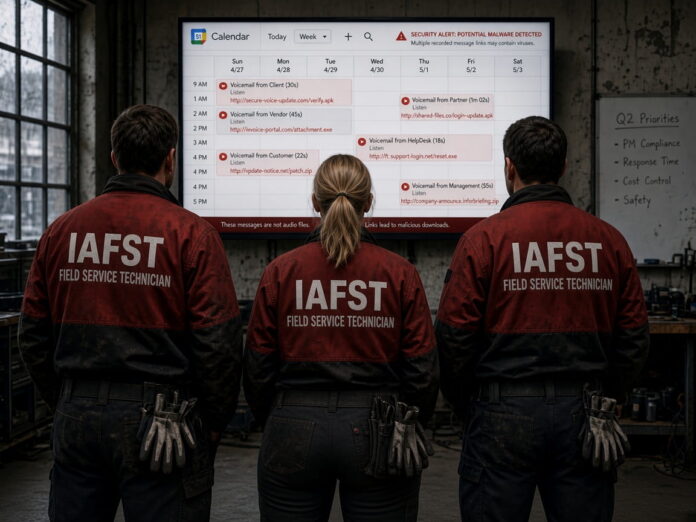
IAFST GC Virus

The word is typed at the curb for $7 to $9, priced by the order mill, and carried into a house that nobody upstream ever verified. Vacancies trigger more money and this will continue to happen.

Vacant is not a fact. It is a status code entered on a work order by people who will never stand at the door. In the last 353 days, that code has sat on two houses where a Field Service Technician was shot dead.

On October 21, 2025, Michael Dodge II drove to Mountain View Road in Stafford County, Virginia, to secure a property presumed vacant. A man who had refused to leave after foreclosure shot him. On Friday, October 9, 2026, Detroit police found a person unresponsive near the back door of a house at Helen Street and St. Paul Avenue. The 911 caller said a foreclosure or property preservation job was underway and that someone had entered the home.

According to sources familiar with the matter, the victim had finished the grass cut and could not open the front door. He went around to the back and was shot dead. Foreclosurepedia has been informed that the victim is Joseph Ludwig Wilden, 67, whose obituary was published by a Michigan funeral home and lists October 9, 2026 as his date of death. The obituary does not state how he died or what work he did. Police have not publicly confirmed his identity.

Foreclosurepedia has reported on both deaths. This article follows the single word that sent both men to those doors, and it names every hand that word passes through.

The Word Starts At The Curb And It Starts Cheap

Inspectors perform the occupancy check. They drive past a property, photograph it, and tell a platform whether anyone appears to live there. They are paid about $7 to $9 for the visit, and the pay assumes minutes, not judgment.

An Inspector cannot see through walls. Curtains, a parked car, a pile of mail, and a porch light left on are the only evidence available from the street. A person who is behind on a mortgage and hiding in a house will not look occupied from the curb.

Foreclosurepedia has no quarrel with the Inspector who made that call. The Inspector was paid for a glance and delivered one. The failure belongs to the companies that took a $8 glance and treated it as a verified fact about a human being’s home.

The Order Mill Turns A Guess Into Billable Work

A vacancy flag does something for the people above the Inspector. It unlocks the order. Lock changes, securements, winterizations, and debris removal all depend on the property being empty. The flag moves the work, speeds the invoice, and protects the margin.

An occupied house generates no preservation invoice. A vacant house generates several. Nobody has to intend harm for that structure to pull in one direction. The incentive to confirm occupancy is weak, and the incentive to accept the flag is strong.

The order mill sits between the servicer and the person with the tools. It takes a margin on every order and passes the physical risk to a 1099 worker with the least power to refuse. Nothing in the public record shows an order mill that verifies occupancy before a lock is touched.

The National Hands It Down

In Detroit, the named vendor is Cyprexx. Foreclosurepedia does not claim Cyprexx knew anyone was inside. The public record does not say what occupancy information the Helen Street order carried, and Cyprexx has not said.

Foreclosurepedia asks what any national should have to answer. Who issued the order? On what occupancy information? What did Cyprexx require before a crew touched a lock? Who decided the risk was worth less than the time it would take to check?

A national that sends a crew on an unverified flag has made a decision. It passes that decision down the chain to the Technician, who pays for it with his body, not with a margin.

The Owner Collects And Signs Nothing

At the top of the chain sits a servicer, and above the servicer sits the financial institution or investor that owns the loan. That owner is the reason the work order exists. The preservation spend protects the value of its collateral, and it is charged against its asset.

No document in hand names the owner of the Helen Street house. Wayne County property and deed records will. Foreclosurepedia expects to find a bank, a trust, or an investor whose name appears nowhere on the work order and nowhere in any statement about the death. Will it be the same as the one in Virginia? Time will tell.

That anonymity is the product. The industry sells servicers and owners distance from the person at the door. Every layer between them exists, in part, so that no name at the top ever has to answer for what happens at the bottom.

What The Industry Learned From Virginia, Which Was Nothing

After Dodge was killed, Sand Castle Field Services reduced his murder to an incident in a message to an Inspector. It did not name him and it did not say he was shot. The message said certain work would pause.

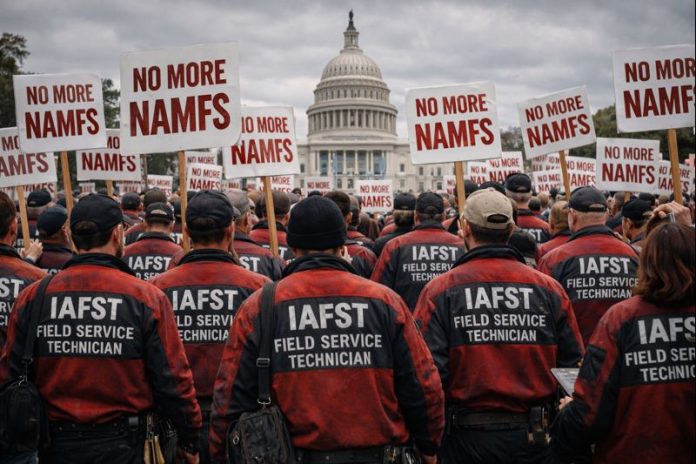
NAMFS Executive Director Eric Miller emailed members that Dodge was an employee. He was a 1099 Field Service Technician dispatched down a chain of subcontractors. NAMFS offered prayers. It did not offer a paired-crew rule, a duress protocol, a risk-disclosure requirement, or a dollar toward any of them.

The International Association of Field Service Technicians pushed identification tools and incident debriefs that name the dead and examine the failure. The industry declined. Eleven months later, another crew stood at another back door.

What This Is, And What It Isn’t

This is a fatal shooting under active homicide investigation. A 911 caller’s account is a claim, not a finding. Police have not said who fired, who was shot, or whether anyone will be charged. Michigan law allows force against an unlawful entry into a home, and whether that applies on Helen Street is for investigators and a prosecutor to decide.

Foreclosurepedia is not claiming the Detroit facts match Virginia, and it is not claiming that anyone upstream knew the house was occupied. What does not depend on the outcome is the structure. A work order existed. A vacancy status attached to it. A crew was assigned. A margin was taken.

What Labor Is Owed From Every Link

Every order mill and national must verify occupancy by something firmer than a curb photograph before any lock is touched. Verification must be documented on the order and available to the family of any worker who is hurt.

Every order must disclose known occupancy risk, prior complaints, and eviction status to the person assigned. No Technician should learn about a hostile occupant from the occupant.

Lock changes and securements on contested properties must use paired crews with real-time check-ins to dispatch. The cost of a second person is small next to the cost of a wrongful death case.

Every servicer and owner whose collateral was being preserved must say publicly who it is. Foreclosurepedia will publish the names as the records produce them.

To Field Service Technicians and Inspectors

Do not treat a vacancy flag as a fact. It is an assertion from people who will never stand at your door. If the property looks lived in, stop. If a neighbor challenges you, stop. If anyone says someone is inside, leave and document why.

Inspectors, the word starts with you, and you are paid to write it in minutes. Note anything that suggests a person lives there. Put it in writing and keep a copy. If the platform has no field for doubt, say so in the comments anyway.

Field Service Technicians, the order can be reassigned and you cannot be replaced by a phone call. Say Michael Dodge II’s name to every dispatcher who calls a killing an incident. Say the Detroit victim’s name, too, once police confirm it.

The word was cheap. The risk was handed down. The owner is still unnamed, and the chain is still intact.

Cyprexx Field Service Technician Murdered On Lock Change In Detroit

Eleven Months Between Industry Murders

On October 21, 2025, Michael Dodge II drove to a house on Mountain View Road in Stafford County, Virginia, to secure a property presumed vacant. He was shot dead. Foreclosurepedia called it what it was, a workplace execution, and we named the people who tried to bury it.

On Friday, October 9, 2026, Detroit police were called to Helen Street and St. Paul Avenue in the 7th Precinct. Officers found one person unresponsive near the back door. The 911 caller said a foreclosure or property preservation was taking place and that someone had entered the home. The victim had cut the grass and could not open the front door and went to the back door and was shot dead according to sources familiar with the matter.

That is 353 days. Same job category. Same kind of door. Same kind of order. One dead person in Virginia, and now one in Detroit.

What The Industry Said The Last Time

After Dodge was killed, Sand Castle Field Services sent an inspector a message that reduced his murder to an “incident.” It did not name him. It did not say he was shot. It told the recipient that certain work would pause.

NAMFS Executive Director Eric Miller emailed members on October 23, 2025, and described Dodge as an “employee.” Foreclosurepedia reported then that this was wrong. Dodge was dispatched down a chain of subcontractors as a 1099 Field Service Technician.

NAMFS offered prayers. It did not offer a safety standard, a paired-crew rule, a duress protocol, or a dollar toward any of them. The industry’s grief arrived as an inbox notice and a rerouted order.

The Same Question, Asked Twice

Foreclosurepedia asked after Virginia who knew the property’s status, who assessed the risk, and who sat upstream collecting a margin. Nobody with a servicer’s name on the door answered.

We ask the same questions of Detroit. Who issued this order, and on what occupancy information? What did Cyprexx require before a crew touched a lock? Did anyone upstream ever confirm whether a person lived in that house?

We are not claiming the Detroit facts match Virginia, but they are pretty damn close. Police have not said who fired, who was shot, or whether anyone will be charged. We are saying the system that produced the first death had a full year to change, and the record shows no change.

The Math That Never Changed

A Field Service Technician is paid about $25 for a grass cut and inspection. Foreclosurepedia reported last year that grass cuts pay $25 to $35, before fuel, tools, insurance and the truck. A shooting costs more than every one of those line items combined. And the damage lasts forever.

That price assumes an empty house. The vacancy flag moves the order, speeds the invoice, and protects the margin. When it is wrong, the cost lands on the one person standing at the door. So, where was the ball dropped? Those are questions that the family will most certainly pursue going forward.

A national that sends a crew on an unverified vacancy flag has made a decision. It has decided the risk is worth less than the time it would take to check. Then it passes that decision down the chain to the person with the least power to refuse it.

What The Industry Had Instead Of A Fix

The International Association of Field Service Technicians has pushed identification tools and incident debriefs that name the dead and examine the failure. Foreclosurepedia has called for paired crews on high-risk sites, real-time check-ins with dispatch, and risk disclosure in every order. NAMFS and the Industry as a whole have refused all.

None of that is expensive next to what a wrongful death case costs. It is expensive next to a $25 grass cut priced to the penny, and that is the only comparison the order mills make.

Vendors chose throughput. Sand Castle chose a euphemism. NAMFS chose silence and a misclassification. A year later, another crew stood at another back door.

What This Is, And What It Isn’t

This is a fatal shooting under active homicide investigation. A 911 caller’s account is a claim, not a finding. Michigan law allows force against an unlawful entry into a home, and whether that applies on Helen Street is for investigators and a prosecutor.

It also is not proof that Cyprexx knew anyone was inside. The public record does not say what occupancy information the order carried. We are reporting what has been verified and asking about the rest.

What does not depend on the outcome is the structure. A work order existed. A crew was assigned. A margin was taken. Whatever a prosecutor decides, those facts were fixed before anyone reached that door.

To Field Service Technicians and Inspectors

Do not treat a vacancy flag as a fact. It is an assertion from people who will never stand at your door. If the property looks lived in, stop. If a neighbor challenges you, stop. If anyone says someone is inside, leave and document why.

The order can be reassigned. You cannot be replaced by a phone call. Say Michael Dodge II’s name to every dispatcher who calls it an incident. And soon, we will name this latest victim, as well.

One year ago the industry called a killing an incident. This year it has a second back door to explain. The order was cheap. The risk was handed down. The names are still the same, and so is the silence.

Secretary Scott Turner’s $400,000 Crisis: Two Years, Six Contracts, A Debt HUD Will Not Discuss

HUDSEC Turner Throne

Many are asking where HUD Secretary Scott Turner is these days. With nothing much to show for his term in office other than ~$400,000 owed to Labor in a time they can least afford it, it appears to be yet another nail in the coffin of the upcoming mid-terms.

HUD awarded 24 Asset Management six Field Service Management vehicles in November 2023. The work did not actually roll out until 2024. Every one of those vehicles stops taking new orders on November 1, 2026, and the people who performed the work are still waiting to be paid.

Field Service Technicians and Inspectors did the work. HUD paid its contractor the awarded rate for that work. At least $353,679.50 of it never reached them, and Foreclosurepedia’s running figure approaches $400,000.

The Penalty Comes First

HUD’s contracts allow liquidated damages against a prime contractor for failing quality control, missing deadlines and misreporting property conditions. HUD introduced that structure in the 3.10 cycle and carried it into 3.12. Every contractor signed it knowing what it meant.

When HUD assesses those damages, it recovers them out of money it owes the contractor. Whatever 24 Asset Management intends, the cash that would have paid Labor is the cash HUD keeps. A penalty does not cancel a debt to Labor. It cancels the money to pay it.

Foreclosurepedia has learned that HUD is withholding on a broad range of grounds. HUD wrote the penalty and HUD collects it. Labor sits behind the department in line and has never been told where the line ends.

HUD Was Warned, And HUD Went Quiet

In 2023, HUD’s procurement office wrote that it was aware of the relationship between 24 Asset Management and Assero Services. Foreclosurepedia kept sending evidence, including a stopped check after six months of completed work, then vendor ledgers and complaints. HUD stopped replying months ago.

The silence did not end the awards. The contracts ran until they were lost, and the people who performed them kept working, then stopped working unpaid.

The Money Nobody Can See

A HUD procurement official told Foreclosurepedia that M&M contracts are paid from FHA fund obligations through a legacy system that feeds no public record. Obligations appear in federal contract data. Outlays do not. Even HUD’s contracting officers cannot see them.

HUD built a system in which the money it pays out cannot be traced by the public, by Labor, or by the officers who manage the work. Its invoices are fixed unit rates, the contract price times services ordered, and they say nothing about whether the people performing the services were paid.

The Arithmetic

Documented, non-overlapping vendor debt includes 2,145 unpaid Puerto Rico properties at $20 each, or $42,900, and 250 Illinois work orders across 27 HUD case numbers totaling $29,286.50. At the $20 rate, $400,000 is 20,000 properties.

That is the first layer. A Field Service Technician or Inspector who is not paid cannot pay the dumpster company, the supplier, the fuel bill or the insurance premium. Diesel passed $6.50 a gallon in September. Foreclosurepedia expects the missed payments to move down the chain, then bankruptcies, then households.

The Replacement

HUD ordered $30,311,207 on 24 Asset Management’s 5A/8A vehicle, which had a $68,001,505 ceiling, or 45 cents on each ceiling dollar. Alpine Companies has now been awarded $51,568,665 for three replacements, signed on the last night of the fiscal year.

HUD can recompete the work in a night. It has not said how Labor gets paid for the work already done.

On Secretary Turner’s Watch

Secretary Turner sat in the chair while Labor remained unpaid, when HUD was asked to act, and when the work was awarded again. He had the authority at every step to intervene, and the buck stopped with him.

What Labor Should Do Right Now

Document every unpaid work order by property, service, date performed and amount. Send written demand. File a complaint with the HUD Office of Inspector General today if you ever hope to get your money back. Ask Alpine, in writing, how and when Labor will be paid before accepting any work. Foreclosurepedia will keep counting.