
Blog

Fast Eddie Loses The HUD M&M FSM. HUD Was Warned For Years. Labor Is Still Waiting To Be Paid.

Rosy IAFST

The Contract Is Gone. The Debt Is Not.

Eduardo “Fast Eddie” San Roman’s 24 Asset Management has lost its HUD Management and Marketing Field Service Manager 3.12 contract, according to sources with direct knowledge. The loss follows years of documented non-payment to Labor. It does not end the debt. We are also advised that Spectrum Solutions Acquisitions are gone, as well.

Foreclosurepedia warned in August that 24 Asset Management was on the precipice of losing its awards. That precipice is now behind us. The company held six awards across ten geographic areas, with first-year contract value reported at ~$51,045,736. The elephant in the room is the massive amount of liquidated damages allegedly being forced upon Fast Eddie by HUD.

We already know the new Awardees; however, we are waiting for their ramp up to begin before disclosing their names. One, though, reached out to us and had some great input that included far more rapid timelines and an increase in pay. So, that is a bonus.

The transition is happening now, and Labor is standing in the middle of it. New vendors report unpaid work as 24 Asset Management closes up shop. There is no bankruptcy filing, no creditor list, and no orderly process. That is the same exit Assero took. Listen here and listen well: If you have not filed a lawsuit and are not working on a judgement, you will not be able to claim a penny from the performance bond. Depending upon the amount owed, you may file in either small claims or your regular court (District, Superior, etc.). Get a lawyer, file pro se, it doesn’t matter because that is the only way you may be able to get paid.

HUD Knew. In Writing. For Years.

As early as January 2023, HUD was aware of the fraud. Foreclosurepedia did not find it quietly and sit on it. We put it in front of HUD procurement officials directly, repeatedly, and in writing.

HUD’s own reply is on the record. Craig Karnes, HUD’s Assistant Chief Procurement Officer for Field Operations, then wrote he was not at liberty to discuss the 3.12 corrective action. His title has changed since. Sharon Washington and LaShura Ford, both working in the HUD M&M FSM are well aware of the debts owed and would be on my first list for counsel to contact.

Then came the sentence that matters most. Karnes wrote that HUD “is aware of the relationship between 24 Asset Management and Assero.” He added that any continuing award would require 24 Asset Management to “mitigate any identified Conflicts of Interest.”

That is HUD acknowledging, in its own words, that a corrective action existed and that Assero and 24 Asset Management were linked. The awards continued anyway. The fraud continued anyway. And ultimately the US taxpayer is going to foot the bill.

The notices did not stop. Foreclosurepedia sent HUD a contractor’s account of a $21,000 check from Assero, covering six months of completed work after eight months without pay, that was stopped after the contractor deposited it and paid bills against it.

Foreclosurepedia then published the allegations and named Karnes. We warned him that Assero and 24 Asset Management carried “all the original hallmarks” of the National Field Network collapse, an involuntary bankruptcy now in its eighth year.

Foreclosurepedia also told HUD that the industry’s trade association, the International Association of Field Services (IAFST) had issued black list notices for HUD post-conveyance work once it was taken over by 24 Asset Management. They didn’t care; Karnes, Washington, and Ford never once replied to the plight of Labor.

More recently, a Field Service Technician and Inspector covering Central and South Illinois was owed about $30,000. Foreclosurepedia referred that vendor to Karnes, noting that HUD’s own assets were going unserviced because Labor had stopped working unpaid.

That vendor had stopped routine inspections, lawn maintenance, initial services, and winterizations. HUD stopped replying months ago. Silence did not end the awards. The contract ended only when it was lost.

As recent as several days ago, Foreclosurepedia moved yet another victim over to HUD. And they are victims. They performed the work, they carried the cost, and they are still waiting. From Puerto Rico to Illinois, the HUD M&M FSM 3.12 is probably the largest HUD backed fraud operation in recent memory. And those very same names of staff at 24 Asset Management and Spectrum Field Services will soon move to the new firms holding the Awards. Remember that. When you see those names that you begged to pay you, call them out when the recruitment begins. Hold their proverbial feet to the fire! And if you do not have their names feel free to reach out as we kept a list of them as they attempt to crawl back into the shadows only to reappear like a bad penny.

What Labor Is Actually Owed

Foreclosurepedia has tracked this debt case by case. The figures below come from separate ledgers and sources. They are not an audited total, and overlapping claims are not added twice.

Puerto Rico audits show 1,087 unpaid properties in 2025 and 1,058 in 2026, after removing cancelled orders and an invoice already counted elsewhere. At $20 per property, that is 2,145 properties and $42,900.

An Illinois invoice sheet lists 250 work orders across 27 HUD case numbers, performed over roughly three months. The job cost is $29,286.50. Of that, $23,536.50 is approved, $2,000 is completed, and $3,750 is pending approval.

Together those two ledgers document $72,186.50 in unpaid work. The Illinois vendor’s own aging puts more than $15,000 past due and $10,000 beyond 90 days, with the balance growing about $2,000 a week.

A Field Service Technician reported $38,674 outstanding in August, including $19,350 more than 45 days past due. That balance tracks the Puerto Rico debt, so it is not added. Counting one debt twice would only give 24 Asset Management something to dispute.

Other vendors report roughly $33,000 outstanding since April on a separate account, a balance of $3,000 or more from a logistics vendor, and further claims in the $13,000 to $21,000 range. Those are sourced, not documented, and Foreclosurepedia treats them that way.

The honest range runs from $72,186.50 documented to well over $100,000 once sourced claims are included. Foreclosurepedia will publish more only as the paper arrives. Sources put the current total above $100,000 and climbing.

The Pattern In Labor’s Own Words

The numbers are only half of it. The vendors describe the same sequence again and again. Net 45 terms stretch to 60, then 90. Checks arrive monthly, then late, then printed weeks before delivery. Questions go unanswered. Then the work orders stop being paid at all.

One Field Service Technician reported that payments fell into the 90-plus day window and that a check dated in June did not arrive until late July, 46 days after it was printed. The Technician said Fast Eddie and his son Zach knew.

A minority contractor reported that 24 Asset Management owed it for Hurricane Helene and Milton debris work in early 2025. The contractor made four written demands. A check was promised by FedEx and never arrived.

Late in 2025, vendors reported nonpayment across multiple states, including Illinois and Indiana. Foreclosurepedia has also reported that 24 Asset Management stopped paying Labor for months, and that staff knew the checks were not coming.

One contractor wrote to Foreclosurepedia that Assero’s unpaid work led to roughly $38,000 in liens. The contractor said Fannie Mae ignored the liens and was selling properties for cash with the liens still attached. Another vendor with about $40,000 in liens was offered half, then heard nothing.

The Better Business Bureau shows the same pattern under both names. 24 Asset Management’s own Miami profile is unaccredited and rated one star out of five. Every review on it is a one-star complaint, and the company has not responded to any of them.

One vendor reported months of completed work unpaid and said the company operates under multiple business names, some of them bankrupt, to avoid paying vendors. Another reported more than $5,000 owed since mid-August 2025 for trash-out inspections and a pool drain job, with no response to email or phone.

A third vendor completed three jobs and was paid for one, after three months on Net 30 terms. A fourth called the company the biggest scam in the industry and criticized how it treats its workers.

Both 24 Asset Management and Assero’s separate BBB profile carries five more vendor reviews from late 2023 and early 2024. They describe unpaid Fannie Mae work, including two claims of more than $15,000 each, and zero payment on eleven jobs at three West Virginia properties.

One reviewer reported spring inspections unpaid after ten years of reliable payment. Those reviews call 24 Asset Management the current name for the same operation.

Public comments on LinkedIn follow the same line. Vendors there describe balances unpaid since March, work completed and never paid, and promises that did not hold. Another vendor company reached out to Foreclosurepedia seeking to connect with other unpaid vendors and compare notes.

These are Field Service Technicians and Inspectors, small contractors, and family businesses. They bought the fuel, paid the crews, and carried the risk.

Liquidated Damages Put HUD At The Front Of The Line

Liquidated damages are the penalties a federal contract sets in advance when a contractor fails to perform. Sources report that HUD is now assessing enormous liquidated damages against 24 Asset Management. Foreclosurepedia has not seen the amounts and will not guess at them.

Here is the problem for Labor. A contractor that owes HUD a large sum and also owes Field Service Technicians and Inspectors for months of work has a creditor with leverage. The government is not waiting in line behind anyone.

If HUD withholds or offsets what it still owes 24 Asset Management, every dollar it recovers is a dollar that never reaches Labor. Labor deserves an answer to one question. Did anyone at HUD weigh the unpaid invoices of Field Service Technicians and Inspectors before collecting?

A company that owes HUD enormous damages, owes Labor six figures, and has filed no bankruptcy has every incentive to stop answering the phone. Labor has seen this before.

Assero Was Never Gone

Assero Services collapsed owing Labor close to a million dollars. It never filed bankruptcy. Fast Eddie San Roman kept the federal award under 24 Asset Management and kept dispatching work orders.

The public record shows how close the two companies were. A West Virginia Secretary of State record lists Eduardo San Roman and Lee Mertins as the managers of Assero Services, LLC, a Delaware company formed on October 31, 2014. And remember Eduardo San Roman, Lee Mertins, Jim Hillsman and Greg Seale. Say those names. Repeat those names. And never become involved with them for the rest of your career as Field Service Technicians and Inspectors.

Business-directory listings place Assero at the same Miami suite as 24 Asset Management, and its website was assero24.com. Foreclosurepedia reported in 2023 that Assero’s own LinkedIn page described the company as growing out of 24 Asset Management’s field services division.

Foreclosurepedia reported in 2022 that 24 Asset Management leaned on Assero’s past performance to win its first-year award. The same reporting counted hundreds of complaints about Assero refusing to pay, dating to December 2021.

The record points to one operation wearing two names. On this record, Assero looks like the field services arm of 24 Asset Management, abandoned while the parent kept the contract.

A source with direct knowledge tells Foreclosurepedia that Fast Eddie, not Lee Mertins, was the money behind Assero. The state record lists both men as managers. It does not say who funded the company, so Foreclosurepedia reports that detail as sourced, not documented.

HUD’s reasoning for keeping 24 Asset Management in the program was that San Roman may have controlled Assero without directing its finances. Foreclosurepedia answered that with a state filing naming him a manager of Assero. HUD’s own email then conceded the relationship.

LoanCare Put The Same Names In One Caption

LoanCare, LLC has sued Assero Services, LLC, 24 Asset Management Corporation, and Eddie San Roman personally for breach of contract. The case began in Virginia Beach Circuit Court as CL25-6432.

Starr Surplus Lines Insurance Company removed the case to federal court in December 2025. The federal court returned it to state court in June 2026, after the parties consented to remand.

The federal docket states no dollar amount. Foreclosurepedia has not yet reviewed the state complaint and will not characterize its allegations until it has. What the caption already shows is Assero, 24 Asset Management, and San Roman sued together.

What Labor Should Do Right Now

Build the claim before the transition buries it. Use a spreadsheet that lists the work order or asset number, the service performed, the date performed, and the amount owed. Keep every invoice, email, and text message that acknowledges the debt.

File that claim with HUD in writing and file a complaint with HUD OIG. Preserve mechanic’s lien rights property by property. Talk to a qui tam attorney about whether the documentation supports a False Claims Act filing. Most importantly, file your lawsuit NOW!

Stop accepting work orders from a company that is losing its contract, owes HUD damages, and owes you. Dispatch continues until Labor says no.

Whether a payment bond exists on these awards, and who the surety is, remains unanswered in the public record. If a bond exists, Labor may be able to make a claim against it without waiting on HUD.

If you are owed money by 24 Asset Management, send the details to the Foreclosurepedia tip line at [email protected]. Every claim documented now becomes leverage later.

The Playbook Has Not Changed

Fast Eddie San Roman has run this playbook since Assero. Bill the government, bank the payment, stall Labor, and walk away without a bankruptcy court. The contract is gone and the damages are coming. Labor is still owed.

HUD’s procurement office knew, wrote that it knew, and kept the awardee in the program while victims kept arriving. Silence from a federal agency is a decision, and Labor is paying for it.


Foreclosurepedia will keep documenting who knew, who profited, and who still has not paid. If 24 Asset Management owes you, send your records to [email protected].

The Bond Market Just Called the Administration’s Bluff

Wednesday morning, the Treasury market stopped cooperating. Yields from the 2-year through the 10-year jumped between 12 and 14 basis points before lunch. The 7-year pushed past 5 percent. The 10-year touched 5.10 percent. The trigger was S&P Global’s flash PMI, which showed an economy running hot with inflation baked into both services and manufacturing. Treasury also announced another buyback auction for Thursday. The market ignored it.

The 10-year is the number that matters most to anyone downstream of a mortgage. It rose 13 basis points to 5.10 percent, a level not seen since 2007. For two weeks it had pressed against 5 percent and fallen back. This morning it went through. The last time the benchmark sat this high, the subprime collapse was already underway. Foreclosure field services was about to become the biggest growth industry in the country.

What the data said

S&P Global’s services PMI climbed to 58.7 in September, its highest reading in nearly five years. Manufacturing hit 56.7, a level not seen in more than four years. The composite reached 58.4, and input costs rose at the fastest pace in nearly four years. Rising input costs carry the real warning. Businesses are paying more, and they will pass those costs on.

The afternoon brought worse news. A 5-year note auction cleared at 5.033 percent, far above the recent average of 4.186 percent. Indirect bidders, a group that includes foreign central banks, took only 54 percent against a typical 65 percent. Global buyers of U.S. debt were offered higher yields and still stayed home.

The administration’s tools are not working

Treasury Secretary Scott Bessent’s answer was another buyback. Treasury said it would repurchase up to $6 billion at face value in 20- and 30-year bonds. That matches the cap on the September 11 buyback, after which yields climbed further. Analysts told CNN the buybacks are too small to matter in a Treasury market worth more than $30 trillion. Six billion dollars is a gesture. The bond market recognized it as one.

The pressure is not coming only from the data. Brent crude pushed back toward $100 a barrel after Trump voiced support for a U.S. diesel export ban, feeding the inflation fears. Brent settled up 3.86 percent at $103.08. Bloomberg measured the 10-year’s intraday move as the biggest since the April 2025 “Liberation Day” tariffs. That comparison should alarm the White House. The last time the bond market moved this hard, it was reacting to this administration’s own policy.

The Federal Reserve is not offering relief either. The Fed raised rates by 25 basis points last week and signaled more hikes are coming. Governor Michael Barr suggested further hikes may be needed, and CME FedWatch put the odds of an October hike at 64 percent. Markets are not pricing a soft landing. They are pricing an administration that talks about lower rates while its tariff, energy and borrowing decisions push rates higher.

Where the bill lands

The consequences run straight downhill to Labor. Thirty-year fixed mortgage rates climbed to 7.12 percent on the same day. Higher borrowing costs strain adjustable-rate borrowers, HELOC holders and second-lien homeowners first. That strain eventually becomes delinquency. Delinquency becomes work orders for Field Service Technicians and Inspectors.

More work orders do not mean better pay. Inspections still pay $7 to $9. Grass cuts still pay $25 to $30. Winterizations still pay $45 to $50. None of those rates move when the 10-year moves. The margin expands at the order mill and the servicer. It does not expand at the truck.

Fuel runs the other direction, and it is running at a record. AAA puts today’s national diesel average at $6.52 a gallon. The all-time high was set yesterday at $6.53. A year ago, diesel averaged $3.69. The price has nearly doubled in twelve months.

Diesel is the fuel of the trailer hauls, the debris runs and the trucks that move a crew between properties. The war with Iran has disrupted the world’s flow of fuel. The President blamed Ukrainian strikes on Russian refineries for the record, even as he floats the export ban that spooked oil markets this week. Field Service Technicians and Inspectors buy their own fuel. No national has announced a fuel adjustment. None is likely to.

The tariff tax on the truck bed

Fuel is only half of what Labor pays out of pocket. The other half is materials, and the administration has taxed nearly all of them. Items made entirely or mostly from steel, aluminum or copper carry a 50 percent tariff. Derivative metal products carry 25 percent. Softwood lumber carries 10 percent, and derivative wood products carry 25 percent.

That list reads like a preservation crew’s supply run. The plywood that boards a broken window is lumber. The hasps, padlocks, hinges and screws that secure a door are steel. The copper that patches a line before a winterization is copper. Kitchen cabinets and bathroom vanities picked up their own tariffs too, with scheduled increases to 30 and 50 percent that took effect January 1. Those are the replacement parts for the work that follows a vandalized REO.

Contractors across the building trades have already felt the result. An AGC-NCCER survey found 43 percent of general contractors had a project canceled, postponed or scaled back because of tariff-driven material costs. General contractors can write escalation clauses into their bids. Field Service Technicians and Inspectors cannot. The price grid a national hands Labor has no tariff line. A preservation bid approved at last year’s pricing gets built with this year’s plywood and this year’s steel. Labor eats the difference.

This is the policy stack the bond market priced Wednesday. Tariffs raise material costs. War and export-ban talk raise fuel costs. Both feed the inflation data that pushed yields to their highest level since 2007. For Labor, each of those costs arrives as a line item on a job that pays the same as it did before any of them.

Credit gets expensive at the top

Order mills that operate on float and lines of credit now pay more to borrow. Foreclosurepedia has already documented what happens when money gets tight at the top of the chain. At NMFS and 24 Asset Management, both flagged NON-PAY in our Firm Registry, the pattern was identical. Insiders and operating bills got paid first. Labor got paid last, or never. A rate environment built for more hikes is an environment built for more of that.

The Fed’s rate hikes are also designed to cool hiring. Factory hiring in September rose at the fastest pace since February 2021. The Fed means to slow that. When the labor market softens, W-2 workers have unemployment insurance. Most Field Service Technicians and Inspectors are paid on 1099s. They have nothing.

The bottom line

The bond market delivered a verdict Wednesday. It does not believe the administration’s buybacks, its energy improvisation or its promises of cheaper money. Wall Street will hedge that risk. The servicers will pass it along. Labor will absorb it at $8 an inspection, with a tank of diesel that has never cost more.

Six Federal Filings Six Years The Same False Statement Signed by Eric Miller Every Time

A trade association whose own sitting president is embroiled in the same non-payment litigation crippling the Labor force it claims to represent. A three-year accounting-fee spike that briefly exceeded the entire membership’s dues. A legal name change filed mid-scandal. A board that, by its own admission, never sees the document before it goes to the IRS. And at the center of all of it, a federal tax filing — signed under penalty of perjury, transmitted electronically — that has named the wrong president for six straight years.

Every Form 990 carries the same declaration above the signature line: “Under penalties of perjury, I declare that I have examined this return, including accompanying schedules and statements, and to the best of my knowledge and belief, it is true, correct, and complete.” That declaration has been signed, year after year, on a document transmitted electronically to the IRS — confirmed directly by the “efile” designation ProPublica’s Nonprofit Explorer attaches to each filing, not an assumption.

For years, it was signed correctly. Then it wasn’t.

The President Who Isn’t

Treasurer Paul Magaha signed NAMFS‘s returns through at least FY2018, and while he did, the officer table tracked reality. The FY2016 return correctly lists Adam Miles as President. The FY2017 and FY2018 returns correctly list Justis Smith as President, following her actual succession to the role.

Then, starting with the FY2019 return — the first signed not by Magaha but by Executive Director Eric Miller — the roster stopped moving. Every filing since, through FY2025, lists Justis Smith as President, 8 hours a week, $0 compensation. Six consecutive years, under one man’s signature, while the actual presidency changed hands twice.

Archived snapshots of namfs.org’s own leadership page, captured independently by the Internet Archive’s Wayback Machine, show what should have replaced her:

  • July 21, 2019: Justis Smith, President, 2017–2019.
  • September 20, 2019: Matt Zoldowski, President, 2019–2021.
  • April 1, 2023: Matt Zoldowski, President, 2022–2024.
  • March 23, 2025: Chad Rulo, President, 2024–2026.

NAMFS’s own October 2022 newsletter corroborates the middle of that timeline directly: “The Officers for the 2022-24 term are: Matt Zoldowski – President.” This publication’s own reporting called Zoldowski “NAMFS President” in October 2023, and called Rulo “the latest NAMFS President” by April 2025 — independent, real-time confirmation the website’s timeline was accurate the whole time.

Treating FY2019 as the genuine transition year, six tax years — FY2020 through FY2025, all signed by Miller — are unambiguously wrong. At the 8 hours a week the return itself claims: 8 × 52 × 6 = 2,496 hours of board service attributed to a woman who left the role in 2019, on a federal document sworn true under penalty of perjury, signed by the same man, every single year, without correction.

Meanwhile, the Real President Is in Court

The man NAMFS’s own website says actually holds the presidency is not a bystander to this industry’s worst pattern. Chad Rulo is CEO of First Rate Field Services — and, per this publication’s own prior reporting, an active plaintiff in federal and state litigation (E.D. Mo. 4:2025-cv-01316) against Black Dome and A2Z Field Services President Amie Sparks over money allegedly owed to Rulo’s own firm. Rulo is simultaneously NAMFS President and a party to litigation arising from exactly the kind of member-on-member non-payment NAMFS claims to police.

That litigation sits inside a much larger pattern this publication has tracked for years. A2Z Field Services, sold by Amie Sparks to Black Dome in November 2025 rather than completing a deal already in motion with First Rate, collapsed into months of non-payment to Field Service Technicians and Inspectors. Spectrum Solutions Acquisitions allegedly had moved to acquire Black Dome, reportedly offering unpaid Labor a below-face settlement. Foreclosurepedia’s own Firm Registry — a standing tracking system covering 47 active and historical firms across the mortgage field services industry — carries a NON-PAY flag on multiple NAMFS-member national firms simultaneously.

Then there’s the National Field Network involuntary bankruptcy: an eight-year involuntary proceeding, filed April 2018, still unresolved as of this writing, with zero distribution to Labor — not even from the estate of NFN’s own late CEO. NAMFS existed, organized, and collecting dues throughout the entire eight years that case has ground on without a single dollar reaching the Field Service Technicians and Inspectors it displaced.

This is the environment in which a trade association’s own tax filing has spent six years unable to correctly name its own president.

The Accounting Fees Nobody Will Explain

NAMFS’s Form 990 has a second problem, verified line by line against the primary filings, not estimated:

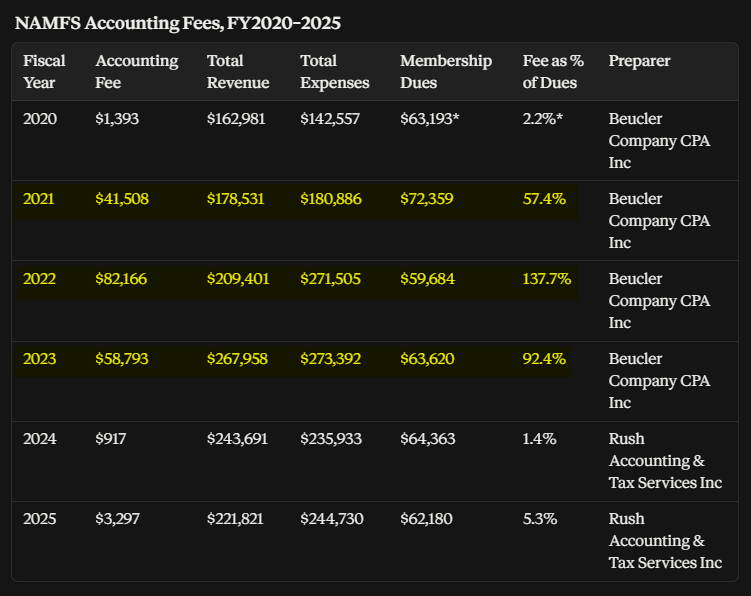
Fiscal Year Accounting Fee Membership Dues Fee as % of Dues
2020 $1,393 ~$63,193 2.2%
2021 $41,508 $72,359 57.4%
2022 $82,166 $59,684 137.7%
2023 $58,793 $63,620 92.4%
2024 $917 $64,363 1.4%
2025 $3,297 $62,180 5.3%

In FY2022, NAMFS paid its accountant more than it collected from its entire dues-paying membership that year. Across the three-year spike — FY2021 through FY2023 — NAMFS paid $182,467 to a single accounting firm, Beucler Company CPA Inc, against $195,663 in total dues collected over the same span: 93 cents of every membership dollar, gone to accounting fees alone. No Schedule O explanation. No itemized statement. No named engagement. The fee is roughly 44 to 92 times the organization’s own historical baseline, depending on which low-fee year it’s measured against. And this against the backdrop of minimal gross income increase. Many we spoke with called it a COVID slush fund.

The spike ends the exact year NAMFS switched preparers, to Rush Accounting & Tax Services Inc, for the FY2024 return — the fee falling from $58,793 to $917 in a single year, a 98.4% drop, with the switch itself as unexplained as the spike.

A Name Change, Mid-Scandal

NAMFS’s FY2025 return is the filing of record for a legal name change: the “Name change” box on Line B is checked, and the organization appears for the first time as the National Association of Asset Management & Field Services Inc — a rebrand NAMFS’s own website attributes to a 2025 board initiative for “higher ROI” and “broadening outreach.” That filing was submitted June 9, 2026, roughly three weeks past the standard deadline, well inside the extension window, but the latest-running of any year this investigation reviewed.

The rebrand lands in the same window as the Black Dome/A2Z collapse, Rulo’s own litigation as sitting NAMFS President, the tail end of the NFN bankruptcy’s eighth year, and the accounting-fee anomaly’s aftermath. Nothing in NAMFS’s own filings or public statements connects the timing of the rebrand to any of it. Whether that’s coincidence or convenience is a question this publication cannot answer from the public record — but it is a question the timing itself raises, unprompted.

A Board That, By Its Own Admission, Never Sees What It Signs Off On

Nonprofit tax-exempt status is not a formality. It is a public trust granted in exchange for a specific promise: that an organization exempt from federal income tax will conduct its affairs honestly, disclose its finances accurately, and submit to the IRS’s Form 990 precisely because the public cannot otherwise verify who is actually running the organization collecting their dues. The entire disclosure regime under IRC § 6104(d) exists because the law does not trust nonprofits to self-report only when convenient. It requires them to.

NAMFS’s own governance answers, filed on the same returns that misstate its presidency, help explain how the error survived six years without anyone catching it. Form 990’s Part VI asks every filer directly: “Has the organization provided a complete copy of this Form 990 to all members of its governing body before filing the form?” NAMFS’s answer, filed year after year: No.

NAMFS reports 15 voting board members, all designated “independent,” with a written conflict-of-interest policy and an annual disclosure requirement for officers, directors, and key employees. On paper, that is a governance structure built to catch exactly this kind of error. In practice, by the organization’s own sworn admission, the people sitting on that board — including, until 2019, Justis Smith herself — have never been shown the completed return before it goes out under Eric Miller’s signature. It is worth noting that switching from the Treasurer’s signature, who has no financial incentive, to the paid Executive Director Eric Miller who is the only paid NAMFS Board member, is sure to raise a few eyebrows. A board that never reads the document has no mechanism to notice the document is wrong. That is not a defense. It is the description of a board that has outsourced its most basic fiduciary obligation — knowing what the organization is telling the federal government about itself — to the one person signing it.

What This Is, and What It Isn’t

The relevant federal statute is 26 U.S.C. § 7206(1), which makes it a felony to willfully sign a federal return “which he does not believe to be true and correct as to every material matter.” The willfulness requirement is the entire question, and it is not one a tax filing answers on its own. There is a real difference between a genuine, repeatedly-uncaught clerical error — the same stale officer table copied forward, year after year, never flagged internally, never reviewed by a board that admits it doesn’t see the return before filing — and something else. Proving which one this is requires more than the public record provides.

This publication is not in a position to make that determination, and won’t pretend to.

What isn’t in dispute: a federal document, sworn true under penalty of perjury and filed electronically with the IRS, has misstated who ran this organization for six consecutive years, while the correct information sat on NAMFS’s own website the entire time — filed by a board that structurally never reviews what it’s signing off on, at an organization whose sitting president is embroiled in the same non-payment litigation crippling the Labor force it claims to represent, whose accounting fees briefly exceeded its entire membership base, and which changed its legal name in the same filing period as all of it. At minimum, that raises a serious question about whether NAMFS’s Executive Director, and its Board of Directors as a body, have fulfilled their fiduciary duty of care in reviewing what gets sworn true to the federal government in their name.

Foreclosurepedia is exploring formal options in response to these findings, including a Form 13909 referral to the IRS Exempt Organizations division and a complaint to the Ohio Attorney General’s Charitable Law Section, which holds oversight authority over nonprofit governance and fiduciary conduct for organizations domiciled in the state. Neither step guarantees a result — IRS complaints are confidential by law, and state charitable-oversight review is discretionary — but the underlying record, drawn entirely from NAMFS’s own federal filings and its own public statements, speaks for itself.


Sources: IRS Form 990, NAMFS/National Association of Asset Management & Field Services Inc, FY2016–FY2025 (ProPublica Nonprofit Explorer, EIN 34-1800707); Internet Archive Wayback Machine captures of namfs.org/about, July 2019–March 2025; NAMFS October 2022 newsletter; namfs.org current leadership page; prior Foreclosurepedia reporting on the Black Dome/A2Z collapse, the NFN bankruptcy, and Foreclosurepedia’s Firm Registry NON-PAY designations.

Signature Block History: NAMFS Form 990, FY2016–FY2025

Fiscal Year Signed By Title Date Signed President Listed Actual President (per NAMFS’s own site) Accurate?
2016 Paul W. Magaha Treasurer 11-13-17 Adam Miles Adam Miles ✅ Accurate
2017 Paul W. Magaha Treasurer 11-1-18 Justis Smith Justis Smith ✅ Accurate
2018 Paul W. Magaha Treasurer 11-13-19 Justis Smith Justis Smith ✅ Accurate
2019 Eric Miller Executive Director 2020-06-02 Justis Smith Smith (partial) / Zoldowski (partial) ⚠️ Transition year
2020 Eric Miller Executive Director 2021-05-11 Justis Smith Matt Zoldowski ❌ False
2021 Eric Miller Executive Director 2022-04-26 Justis Smith Matt Zoldowski ❌ False
2022 Eric Miller Executive Director 2023-05-02 Justis Smith Matt Zoldowski ❌ False
2023 Eric Miller Executive Director 2024-05-14 Justis Smith Matt Zoldowski ❌ False
2024 Eric Miller Executive Director 2025-05-14 Justis Smith Zoldowski → Rulo ❌ False
2025 Eric Miller Executive Director 2026-05-19 Justis Smith Chad Rulo ❌ False

What the table shows at a glance: every year Magaha signed, the perjury declaration matched reality. The switch to Miller’s signature is the exact point the declaration stops matching reality — and stays wrong for six consecutive years afterward, never once corrected.

Under Penalty of Perjury: NAMFS’s Federal Filings Say Justis Smith Runs an Organization She Hasn’t Led in Six Years

A trade association whose own sitting president is embroiled in the same non-payment litigation crippling the Labor force it claims to represent. A three-year accounting-fee spike that briefly exceeded the entire membership’s dues. A legal name change filed mid-scandal. A board that, by its own admission, never sees the document before it goes to the IRS. And at the center of all of it, a federal tax filing — signed under penalty of perjury, transmitted electronically — that has named the wrong president for six straight years.

Every Form 990 carries the same declaration above the signature line: “Under penalties of perjury, I declare that I have examined this return, including accompanying schedules and statements, and to the best of my knowledge and belief, it is true, correct, and complete.” That declaration has been signed, year after year, on a document transmitted electronically to the IRS — confirmed directly by the “efile” designation ProPublica’s Nonprofit Explorer attaches to each filing, not an assumption.

For years, it was signed correctly. Then it wasn’t.

The President Who Isn’t

Treasurer Paul Magaha signed NAMFS’s returns through at least FY2018, and while he did, the officer table tracked reality. The FY2016 return correctly lists Adam Miles as President. The FY2017 and FY2018 returns correctly list Justis Smith as President, following her actual succession to the role.

Then, starting with the FY2019 return — the first signed not by Magaha but by Executive Director Eric Miller — the roster stopped moving. Every filing since, through FY2025, lists Justis Smith as President, 8 hours a week, $0 compensation. Six consecutive years, under one man’s signature, while the actual presidency changed hands twice.

Signature Block History: NAMFS Form 990, FY2016–FY2025

Fiscal Year Signed By Title Date Signed President Listed Actual President (per NAMFS’s own site) Accurate?
2016 Paul W. Magaha Treasurer 11-13-17 Adam Miles Adam Miles ✅ Accurate
2017 Paul W. Magaha Treasurer 11-1-18 Justis Smith Justis Smith ✅ Accurate
2018 Paul W. Magaha Treasurer 11-13-19 Justis Smith Justis Smith ✅ Accurate
2019 Eric Miller Executive Director 2020-06-02 Justis Smith Smith (partial) / Zoldowski (partial) ⚠️ Transition year
2020 Eric Miller Executive Director 2021-05-11 Justis Smith Matt Zoldowski ❌ False
2021 Eric Miller Executive Director 2022-04-26 Justis Smith Matt Zoldowski ❌ False
2022 Eric Miller Executive Director 2023-05-02 Justis Smith Matt Zoldowski ❌ False
2023 Eric Miller Executive Director 2024-05-14 Justis Smith Matt Zoldowski ❌ False
2024 Eric Miller Executive Director 2025-05-14 Justis Smith Zoldowski → Rulo ❌ False
2025 Eric Miller Executive Director 2026-05-19 Justis Smith Chad Rulo ❌ False

Every year Magaha signed, the perjury declaration matched reality. The switch to Miller’s signature is the exact point the declaration stops matching reality — and stays wrong for six consecutive years afterward, never once corrected.

Archived snapshots of namfs.org’s own leadership page, captured independently by the Internet Archive’s Wayback Machine, confirm the actual sequence:

  • July 21, 2019: Justis Smith, President, 2017–2019.
  • September 20, 2019: Matt Zoldowski, President, 2019–2021.
  • April 1, 2023: Matt Zoldowski, President, 2022–2024.
  • March 23, 2025: Chad Rulo, President, 2024–2026.

NAMFS’s own October 2022 newsletter corroborates the middle of that timeline directly: “The Officers for the 2022-24 term are: Matt Zoldowski – President.” This publication’s own reporting called Zoldowski “NAMFS President” in October 2023, and called Rulo “the latest NAMFS President” by April 2025 — independent, real-time confirmation the website’s timeline was accurate the whole time.

Treating FY2019 as the genuine transition year, six tax years — FY2020 through FY2025, all signed by Miller — are unambiguously wrong. At the 8 hours a week the return itself claims: 8 × 52 × 6 = 2,496 hours of board service attributed to a woman who left the role in 2019, on a federal document sworn true under penalty of perjury, signed by the same man, every single year, without correction.

Meanwhile, the Real President Is in Court

The man NAMFS’s own website says actually holds the presidency is not a bystander to this industry’s worst pattern. Chad Rulo is CEO of First Rate Field Services — and, per this publication’s own prior reporting, an active plaintiff in federal and state litigation (E.D. Mo. 4:2025-cv-01316) against Black Dome and A2Z Field Services President Amie Sparks over money owed to Rulo’s own firm. Rulo is simultaneously NAMFS President and a party to litigation arising from exactly the kind of member-on-member non-payment NAMFS claims to police.

That litigation sits inside a much larger pattern this publication has tracked for years. A2Z Field Services, sold by Amie Sparks to Black Dome in November 2025 rather than completing a deal already in motion with First Rate, collapsed into months of non-payment to Field Service Technicians and Inspectors. Spectrum Solutions Acquisitions has since moved to acquire Black Dome, reportedly offering unpaid Labor a below-face settlement. Foreclosurepedia’s own Firm Registry — a standing tracking system covering 47 active and historical firms across the mortgage field services industry — carries a NON-PAY flag on multiple NAMFS-member national firms simultaneously.

Then there’s the National Field Network bankruptcy: an eight-year involuntary proceeding, filed April 2018, still unresolved as of this writing, with zero distribution to Labor — not even from the estate of NFN’s own late CEO. NAMFS existed, organized, and collecting dues throughout the entire eight years that case has ground on without a single dollar reaching the Field Service Technicians and Inspectors it displaced.

This is the environment in which a trade association’s own tax filing has spent six years unable to correctly name its own president.

The Accounting Fees Nobody Will Explain

NAMFS’s Form 990 has a second problem, verified line by line against the primary filings, not estimated:

Fiscal Year Accounting Fee Membership Dues Fee as % of Dues
2020 $1,393 ~$63,193 2.2%
2021 $41,508 $72,359 57.4%
2022 $82,166 $59,684 137.7%
2023 $58,793 $63,620 92.4%
2024 $917 $64,363 1.4%
2025 $3,297 $62,180 5.3%

In FY2022, NAMFS paid its accountant more than it collected from its entire dues-paying membership that year. Across the three-year spike — FY2021 through FY2023 — NAMFS paid $182,467 to a single accounting firm, Beucler Company CPA Inc, against $195,663 in total dues collected over the same span: 93 cents of every membership dollar, gone to accounting fees alone. No Schedule O explanation. No itemized statement. No named engagement. The fee is roughly 44 to 92 times the organization’s own historical baseline, depending on which low-fee year it’s measured against.

The spike ends the exact year NAMFS switched preparers, to Rush Accounting & Tax Services Inc, for the FY2024 return — the fee falling from $58,793 to $917 in a single year, a 98.4% drop, with the switch itself as unexplained as the spike.

A Name Change, Mid-Scandal

NAMFS’s FY2025 return is the filing of record for a legal name change: the “Name change” box on Line B is checked, and the organization appears for the first time as the National Association of Asset Management & Field Services Inc — a rebrand NAMFS’s own website attributes to a 2025 board initiative for “higher ROI” and “broadening outreach.” That filing was submitted June 9, 2026, roughly three weeks past the standard deadline, well inside the extension window, but the latest-running of any year this investigation reviewed.

The rebrand lands in the same window as the Black Dome/A2Z collapse, Rulo’s own litigation as sitting NAMFS President, the tail end of the NFN bankruptcy’s eighth year, and the accounting-fee anomaly’s aftermath. Nothing in NAMFS’s own filings or public statements connects the timing of the rebrand to any of it. Whether that’s coincidence or convenience is a question this publication cannot answer from the public record — but it is a question the timing itself raises, unprompted.

A Board That, By Its Own Admission, Never Sees What It Signs Off On

Nonprofit tax-exempt status is not a formality. It is a public trust granted in exchange for a specific promise: that an organization exempt from federal income tax will conduct its affairs honestly, disclose its finances accurately, and submit to the IRS’s Form 990 precisely because the public cannot otherwise verify who is actually running the organization collecting their dues. The entire disclosure regime under IRC § 6104(d) exists because the law does not trust nonprofits to self-report only when convenient. It requires them to.

NAMFS’s own governance answers, filed on the same returns that misstate its presidency, help explain how the error survived six years without anyone catching it. Form 990’s Part VI asks every filer directly: “Has the organization provided a complete copy of this Form 990 to all members of its governing body before filing the form?” NAMFS’s answer, filed year after year: No.

NAMFS reports 15 voting board members, all designated “independent,” with a written conflict-of-interest policy and an annual disclosure requirement for officers, directors, and key employees. On paper, that is a governance structure built to catch exactly this kind of error. In practice, by the organization’s own sworn admission, the people sitting on that board — including, until 2019, Justis Smith herself — have never been shown the completed return before it goes out under Eric Miller’s signature. A board that never reads the document has no mechanism to notice the document is wrong. That is not a defense. It is the description of a board that has outsourced its most basic fiduciary obligation — knowing what the organization is telling the federal government about itself — to the one person signing it.

What This Is, and What It Isn’t

The relevant federal statute is 26 U.S.C. § 7206(1), which makes it a felony to willfully sign a federal return “which he does not believe to be true and correct as to every material matter.” The willfulness requirement is the entire question, and it is not one a tax filing answers on its own. There is a real difference between a genuine, repeatedly-uncaught clerical error — the same stale officer table copied forward, year after year, never flagged internally, never reviewed by a board that admits it doesn’t see the return before filing — and something else. Proving which one this is requires more than the public record provides.

This publication is not in a position to make that determination, and won’t pretend to.

What isn’t in dispute: a federal document, sworn true under penalty of perjury and filed electronically with the IRS, has misstated who ran this organization for six consecutive years, while the correct information sat on NAMFS’s own website the entire time — filed by a board that structurally never reviews what it’s signing off on, at an organization whose sitting president is embroiled in the same non-payment litigation crippling the Labor force it claims to represent, whose accounting fees briefly exceeded its entire membership base, and which changed its legal name in the same filing period as all of it. At minimum, that raises a serious question about whether NAMFS’s Executive Director, and its Board of Directors as a body, have fulfilled their fiduciary duty of care in reviewing what gets sworn true to the federal government in their name.

Foreclosurepedia is exploring formal options in response to these findings, including a Form 13909 referral to the IRS Exempt Organizations division and a complaint to the Ohio Attorney General’s Charitable Law Section, which holds oversight authority over nonprofit governance and fiduciary conduct for organizations domiciled in the state. Neither step guarantees a result — IRS complaints are confidential by law, and state charitable-oversight review is discretionary — but the underlying record, drawn entirely from NAMFS’s own federal filings and its own public statements, speaks for itself.

Here are the NAMFS IRS tax filings spoken about today:

FY2019: https://projects.propublica.org/nonprofits/organizations/341800707/202031979349304828/full
FY2020: https://projects.propublica.org/nonprofits/organizations/341800707/202101459349301020/full
FY2021: https://projects.propublica.org/nonprofits/organizations/341800707/202211389349300131/full
FY2022: https://projects.propublica.org/nonprofits/organizations/341800707/202311369349300516/full
FY2023: https://projects.propublica.org/nonprofits/organizations/341800707/202421729349301112/full
FY2024: https://projects.propublica.org/nonprofits/organizations/341800707/202501509349300015/full
FY2025: https://projects.propublica.org/nonprofits/organizations/341800707/202601609349300905/full


Editor’s Note: We changed the title for clarity and length. We will continue updating this article as information becomes available and via other articles and podcasts.

The Obscene Math: Eric Miller Takes $110,000 While Inspections Still Pay $8

IAFST NAMFS

Diesel just hit $6.51 a gallon. Mortgages are pushing 7%. Tariffs are stacking onto every part, every truck, every tool a Field Service Technician needs to do the job. NAMFS’s Executive Director hasn’t felt any of it — and the paper trail behind his salary raises more questions than it answers.

AAA’s national average for diesel hit $6.51 a gallon today, September 20 — up from $3.71 a year ago, an increase of more than 75% in twelve months. A Field Service Technician running a 30-gallon tank now pays roughly $195 to fuel up. At $8 an inspection — the standard rate, unchanged for years — that single fill-up costs nearly 24 completed inspections before a dime goes toward rent, insurance, or food.

The 30-year fixed mortgage sits at 6.95%, per Freddie Mac, up from 6.26% a year ago. Every distressed property that rate pushes into foreclosure becomes another job on a Field Service Technician’s route. It does not become another dollar in their pocket. Tariffs on imported vehicle parts, equipment, and materials have layered on top of that, raising the cost of the truck, the mower, and the tools the job requires — while the rate paid for the job itself hasn’t moved.

Inflation ran 3.4% for the twelve months ending in August, per the Bureau of Labor Statistics, with energy up 16.3% and food up 2.7%. Grass cuts still pay $25 to $30. Winterizations still pay $45 to $50 — confirmed on a current ServiceLink rate sheet. Inspections still pay $7 to $9. None of it has moved. Everything around it has.

Eric Miller has not had that problem.

Four years unpaid, then the money started

Miller first appears in NAMFS’s own filings in 2007 — as unpaid Vice President, 3 hours a week, while Tim Doehner became the organization’s first-ever paid Executive Director at $36,000. Miller became unpaid President in 2009, still drawing $0, still logging hours on the side of whatever his actual job was. He held that unpaid post through 2010. Four years of volunteer board service before he ever saw a NAMFS paycheck.

In 2011, that changed. Miller became Executive Director at $100,625. It did not stay there.

Fiscal Year Eric Miller’s Compensation
2011 (first year as ED) $100,625
2012 $112,044
2013–2017 $120,215 flat
2018 $119,789
2019 $138,107 — his highest figure on record
2020–2023 $110,000 flat
2024 $114,231
2025 $110,000

The membership funding it has been shrinking the entire time

Fiscal Year Membership Dues Miller’s Comp Comp as % of Dues
2013 $192,210 $120,215 62.5%
2017 $129,375 $120,215 92.9%
2018 $120,141 $119,789 99.7%
2021 $72,359 $110,000 152.0%
2022 $59,684 $110,000 184.3%
2023 $63,620 $110,000 172.9%
2024 $64,363 $114,231 177.5%
2025 $62,180 $110,000 176.9%

Dues peaked in 2013 at $192,210. By 2025 they’d fallen to $62,180 — a two-thirds collapse. Miller’s pay didn’t follow it down. By 2018 his salary equaled essentially the entire dues base. Every year since 2021, it has exceeded it outright — meaning NAMFS now runs a structural deficit against its own core membership revenue every single year, just to keep one man paid six figures.

Put it in Labor’s terms: at $8 an inspection, Miller’s 2025 salary alone equals 13,750 completed inspections. That is more inspections than most individual Field Service Technicians and Inspectors will complete in a working lifetime — drawn by one man, at a desk, while dues shrink and diesel sets records.

The organization’s overall finances tell the same story from a different angle. Net assets sat at $271,263 in 2011, Miller’s first year as ED. By 2025 they had fallen to $62,540 — a decline of more than 75% over the same stretch his personal compensation was holding flat or climbing.

The filings don’t inspire confidence

NAMFS’s FY2024 return reports $114,231 in aggregate compensation to its officers and key employees — a figure this piece uses, since Miller is the organization’s only employee and the only plausible recipient. But that same return’s individual compensation table, Part VII, lists Miller’s personal line at $0. NAMFS’s own document does not agree with itself about whether its Executive Director was paid $114,231 that year or nothing at all. The organization has one employee. It should not be possible to get that wrong — then again the NAMFS CPA seemed to have been getting high on the COVID slush fund, err pricing. We do not know as NAMFS continues to refuse to provide their IRS 990, required by federal law, or reply to any questions submitted.

NAMFS’s FY2009 filing shows a nearly identical pattern under Doehner: his individual line reads $0 against $67,984 paid out in aggregate that year. Whatever else has changed at NAMFS over fifteen years, sloppy or evasive bookkeeping around executive pay apparently hasn’t.

Then there’s the accounting bill, and this one deserves its own accounting

For over a decade, NAMFS paid its accountant between $875 and $6,223 a year — the kind of number you’d expect from a trade association with one employee and a PO box for an address. Then, starting with FY2021, that number exploded: $41,508. The next year, FY2022, it nearly doubled again to $82,166 — confirmed directly off Part IX, line 11c of the primary filing, signed by Eric Miller himself on May 2, 2023. FY2023 came in at $58,793.

NAMFS FY2000 FY2025 Accounting Fees

Put that $82,166 next to what NAMFS actually took in that year. Total revenue for FY2022 was $209,401. The accounting fee alone consumed 39% of it. Total expenses were $271,505 — meaning accounting fees ate nearly a third of everything the organization spent, in a year it ran a $62,104 deficit.

Zoom out further. Across the three-year spike — FY2021 through FY2023 — NAMFS paid its accountant a combined $182,467. Across those same three years, total membership dues collected came to $195,663. Over that stretch, this trade association spent almost every dollar its own membership paid in dues on accounting fees alone — thirteen times its own historical high-water mark of $6,223, on an organization whose entire operation fits on a single Form 990-EZ in leaner years.

No Schedule O explanation. No itemized statement. No named engagement, no audit, no forensic review, no restatement — just a line item, three years running, from the same preparer (Beucler Company CPA Inc, Tiffin, OH), for an association with one employee and a PO box in Stow, Ohio. The fee dropped to $917 the moment NAMFS switched accountants for FY2024. Whatever justified tens of thousands of dollars a year in accounting work at Beucler apparently stopped being necessary the day Beucler stopped doing the accounting.

There is no version of a small 501(c)(6) trade association — one employee, sub-$300K in annual revenue, a membership that could fit in a hotel conference room — where a legitimate accounting engagement runs $82,166 in a single year. Either NAMFS was paying for something far beyond ordinary bookkeeping and compilation work, or the money went somewhere the filing doesn’t account for. NAMFS’s own return doesn’t say which, and nobody at the organization has explained it.

Accounting Fees NAMFS

Who’s actually running this thing is also an open question

None of this is new to the NAMFS Regime. It’s the same pattern #OpNAMFS has tracked for over a decade: a shrinking, aging membership propping up an Executive Director salary the industry can no longer justify, inconsistent paperwork nobody at NAMFS seems in a hurry to fix, and a leadership roster that doesn’t match its own public-facing website — all while the Field Service Technicians and Inspectors funding it eat diesel prices, mortgage rates, and tariff-driven equipment costs on a pay scale that hasn’t moved in years.


For the record: this publication spent years unable to confirm NAMFS’s actual tax status. NAMFS refused, repeatedly, to produce its Form 990 on direct request — despite IRC § 6104(d) requiring any 501(c) organization to make its return available to the public on demand. That stonewalling is the reason earlier Foreclosurepedia coverage treated NAMFS’s nonprofit status as an open question rather than a settled fact. Primary IRS e-file data, pulled directly rather than through NAMFS, now confirms the organization has held 501(c)(6) tax-exempt status throughout. The finding here isn’t that NAMFS lied about being a nonprofit — it’s that they hid the paperwork proving it, for years, from the Labor force paying their Executive Director’s salary at the pump.

Diesel at Historic Highs, Inflation Out of Control, and a War Half a World Away: How Labor Is Being Crushed While Our Industry Refuses to Raise Pricing

IAFST HUD HQ

Foreclosurepedia has documented the squeeze on Field Service Technicians and Inspectors for years. What is happening now is not a squeeze. It is a vice, and it is being turned by forces entirely outside the control of the people who actually do the work.

Diesel hit a national average of $6.50 a gallon, up from $3.70 a year ago. That is a 76 percent increase in twelve months. Regular gasoline sits at $4.47. Mid-grade at $4.96. Premium at $5.35. Field Service Technicians and Inspectors cannot defer fuel to reach a door an Order Mill ordered them to knock on. Every mile driven to a property, every trip to a hardware store for a lock change, every run to a UPS drop for a report that was due yesterday, all of it runs on diesel that now costs nearly twice what it did a year ago. Labor absorbs that difference out of pocket because the Order Mills have not adjusted a single fee schedule to account for it.

Inflation is not cooling. It is compounding. The cost of everything a Field Service Technician or Inspector needs to do the job: fuel, vehicles, tires, tools, locks, boards, tarps, PPE, insurance, licensing fees, software subscriptions, has climbed steadily for three years, and in some categories has doubled. Wages and fee schedules in this industry have not moved in over thirty years. That is not an exaggeration. The pricing structure that NAMFS Order Mills use today is materially the same structure they used in the early 1990s. A grass cut that paid $35 in 1994 pays $35 in 2026. A property inspection that paid $12 in 1994 pays $12 in 2026. The dollar has lost more than half its purchasing power since then. Labor has been asked to do more work, drive farther, carry more liability, and absorb more cost, for the same nominal fee, for three decades.

Now add a war. The conflict with Iran has rattled global energy markets, pushed crude higher, and sent diesel, already tight from refinery constraints and seasonal demand, into territory that makes the last record look like a waypoint rather than a peak. When diesel goes up, everything goes up. Freight costs rise. Goods cost more. Services cost more. The one thing that does not rise is what Order Mills pay Labor. The cost of the war is being passed down the chain until it lands on the independent contractor with a truck, a phone, and a route sheet.

Borrowing costs are climbing alongside it. The 30-year fixed mortgage is running between 7.04 and 7.20 percent APR. The 10-year Treasury yield touched 5.04 percent earlier this week, marking some of its highest levels since 2007, nearly two decades ago. For Labor carrying debt to cover fuel and equipment while waiting on Order Mills to pay, every one of those numbers compounds the hole. Higher rates mean fewer refinances, fewer originations, fewer loss mitigation workouts, and more foreclosures, which means more work dumped on the same Labor pool at the same thirty-year-old fee schedule.

Tariffs have crippled buying power on top of all of it. Imported goods cost more. Domestic goods cost more because their inputs cost more. Tools, parts, vehicles, tires, electronics, everything a Field Service Technician touches has a tariff-affected component in its supply chain. The dollar in Labor’s pocket buys less than it did last quarter, let alone last year, let alone 1994.

NAMFS Order Mills, the same firms Foreclosurepedia has catalogued and flagged in its Firm Registry, continue to treat Labor as an inexhaustible, disposable input. They cut pricing when volumes drop. They cut pricing when volumes rise, claiming scale. They cut pricing when a competitor underbids, then demand the same scope at the lower number. They pay late, pay short, or do not pay at all, and when Labor asks why, the answer is that the client has not paid them. As Foreclosurepedia has documented repeatedly, that answer is often not true.

The result is what you see across the industry right now: experienced Field Service Technicians and Inspectors leaving in numbers the Order Mills cannot replace. The ones who stay are running older trucks, deferring maintenance, skipping insurance, and working longer hours to make the same real income they made a decade ago. The ones who leave are not coming back. The Order Mills have no pipeline for replacements because no rational person enters this industry at $8 an inspection when diesel is $6.50 a gallon.

This is not a market correction. It is a structural failure, and it has been building for thirty years. Diesel at record highs, inflation compounding, a war driving energy costs, tariffs eroding buying power, mortgages above 7 percent, any one of these would be enough to strain Labor. Together, they are breaking it. And the industry’s response has been to keep paying 20th Century prices for 2026 work.

Foreclosurepedia will continue to document which firms are doing this, which ones are paying late, which ones are not paying at all, and which ones are hiding behind client non-payment excuses that do not hold up. The Firm Registry is public. The spreadsheets are public. Labor deserves to know who it is working for before it takes the assignment.


If you are a Field Service Technician or Inspector and you have documentation of non-payment, fee cuts, or scope creep without compensation, Foreclosurepedia wants to hear from you.