




Diesel just hit $6.51 a gallon. Mortgages are pushing 7%. Tariffs are stacking onto every part, every truck, every tool a Field Service Technician needs to do the job. NAMFS’s Executive Director hasn’t felt any of it — and the paper trail behind his salary raises more questions than it answers.
AAA’s national average for diesel hit $6.51 a gallon today, September 20 — up from $3.71 a year ago, an increase of more than 75% in twelve months. A Field Service Technician running a 30-gallon tank now pays roughly $195 to fuel up. At $8 an inspection — the standard rate, unchanged for years — that single fill-up costs nearly 24 completed inspections before a dime goes toward rent, insurance, or food.
The 30-year fixed mortgage sits at 6.95%, per Freddie Mac, up from 6.26% a year ago. Every distressed property that rate pushes into foreclosure becomes another job on a Field Service Technician’s route. It does not become another dollar in their pocket. Tariffs on imported vehicle parts, equipment, and materials have layered on top of that, raising the cost of the truck, the mower, and the tools the job requires — while the rate paid for the job itself hasn’t moved.
Inflation ran 3.4% for the twelve months ending in August, per the Bureau of Labor Statistics, with energy up 16.3% and food up 2.7%. Grass cuts still pay $25 to $30. Winterizations still pay $45 to $50 — confirmed on a current ServiceLink rate sheet. Inspections still pay $7 to $9. None of it has moved. Everything around it has.
Eric Miller has not had that problem.
Four years unpaid, then the money started
Miller first appears in NAMFS’s own filings in 2007 — as unpaid Vice President, 3 hours a week, while Tim Doehner became the organization’s first-ever paid Executive Director at $36,000. Miller became unpaid President in 2009, still drawing $0, still logging hours on the side of whatever his actual job was. He held that unpaid post through 2010. Four years of volunteer board service before he ever saw a NAMFS paycheck.
In 2011, that changed. Miller became Executive Director at $100,625. It did not stay there.
| Fiscal Year | Eric Miller’s Compensation |
|---|---|
| 2011 (first year as ED) | $100,625 |
| 2012 | $112,044 |
| 2013–2017 | $120,215 flat |
| 2018 | $119,789 |
| 2019 | $138,107 — his highest figure on record |
| 2020–2023 | $110,000 flat |
| 2024 | $114,231 |
| 2025 | $110,000 |
The membership funding it has been shrinking the entire time
| Fiscal Year | Membership Dues | Miller’s Comp | Comp as % of Dues |
|---|---|---|---|
| 2013 | $192,210 | $120,215 | 62.5% |
| 2017 | $129,375 | $120,215 | 92.9% |
| 2018 | $120,141 | $119,789 | 99.7% |
| 2021 | $72,359 | $110,000 | 152.0% |
| 2022 | $59,684 | $110,000 | 184.3% |
| 2023 | $63,620 | $110,000 | 172.9% |
| 2024 | $64,363 | $114,231 | 177.5% |
| 2025 | $62,180 | $110,000 | 176.9% |
Dues peaked in 2013 at $192,210. By 2025 they’d fallen to $62,180 — a two-thirds collapse. Miller’s pay didn’t follow it down. By 2018 his salary equaled essentially the entire dues base. Every year since 2021, it has exceeded it outright — meaning NAMFS now runs a structural deficit against its own core membership revenue every single year, just to keep one man paid six figures.
Put it in Labor’s terms: at $8 an inspection, Miller’s 2025 salary alone equals 13,750 completed inspections. That is more inspections than most individual Field Service Technicians and Inspectors will complete in a working lifetime — drawn by one man, at a desk, while dues shrink and diesel sets records.
The organization’s overall finances tell the same story from a different angle. Net assets sat at $271,263 in 2011, Miller’s first year as ED. By 2025 they had fallen to $62,540 — a decline of more than 75% over the same stretch his personal compensation was holding flat or climbing.
The filings don’t inspire confidence
NAMFS’s FY2024 return reports $114,231 in aggregate compensation to its officers and key employees — a figure this piece uses, since Miller is the organization’s only employee and the only plausible recipient. But that same return’s individual compensation table, Part VII, lists Miller’s personal line at $0. NAMFS’s own document does not agree with itself about whether its Executive Director was paid $114,231 that year or nothing at all. The organization has one employee. It should not be possible to get that wrong — then again the NAMFS CPA seemed to have been getting high on the COVID slush fund, err pricing. We do not know as NAMFS continues to refuse to provide their IRS 990, required by federal law, or reply to any questions submitted.
NAMFS’s FY2009 filing shows a nearly identical pattern under Doehner: his individual line reads $0 against $67,984 paid out in aggregate that year. Whatever else has changed at NAMFS over fifteen years, sloppy or evasive bookkeeping around executive pay apparently hasn’t.
Then there’s the accounting bill, and this one deserves its own accounting
For over a decade, NAMFS paid its accountant between $875 and $6,223 a year — the kind of number you’d expect from a trade association with one employee and a PO box for an address. Then, starting with FY2021, that number exploded: $41,508. The next year, FY2022, it nearly doubled again to $82,166 — confirmed directly off Part IX, line 11c of the primary filing, signed by Eric Miller himself on May 2, 2023. FY2023 came in at $58,793.
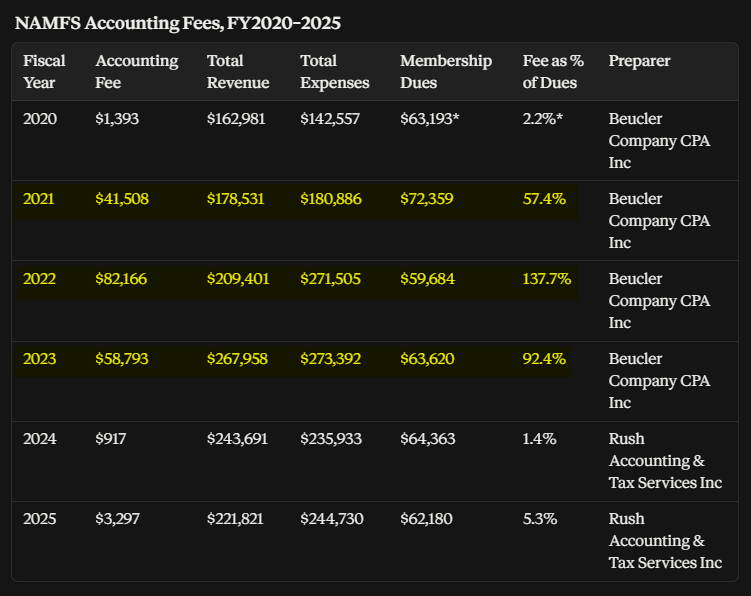
Put that $82,166 next to what NAMFS actually took in that year. Total revenue for FY2022 was $209,401. The accounting fee alone consumed 39% of it. Total expenses were $271,505 — meaning accounting fees ate nearly a third of everything the organization spent, in a year it ran a $62,104 deficit.
Zoom out further. Across the three-year spike — FY2021 through FY2023 — NAMFS paid its accountant a combined $182,467. Across those same three years, total membership dues collected came to $195,663. Over that stretch, this trade association spent almost every dollar its own membership paid in dues on accounting fees alone — thirteen times its own historical high-water mark of $6,223, on an organization whose entire operation fits on a single Form 990-EZ in leaner years.
No Schedule O explanation. No itemized statement. No named engagement, no audit, no forensic review, no restatement — just a line item, three years running, from the same preparer (Beucler Company CPA Inc, Tiffin, OH), for an association with one employee and a PO box in Stow, Ohio. The fee dropped to $917 the moment NAMFS switched accountants for FY2024. Whatever justified tens of thousands of dollars a year in accounting work at Beucler apparently stopped being necessary the day Beucler stopped doing the accounting.
There is no version of a small 501(c)(6) trade association — one employee, sub-$300K in annual revenue, a membership that could fit in a hotel conference room — where a legitimate accounting engagement runs $82,166 in a single year. Either NAMFS was paying for something far beyond ordinary bookkeeping and compilation work, or the money went somewhere the filing doesn’t account for. NAMFS’s own return doesn’t say which, and nobody at the organization has explained it.

Who’s actually running this thing is also an open question
None of this is new to the NAMFS Regime. It’s the same pattern #OpNAMFS has tracked for over a decade: a shrinking, aging membership propping up an Executive Director salary the industry can no longer justify, inconsistent paperwork nobody at NAMFS seems in a hurry to fix, and a leadership roster that doesn’t match its own public-facing website — all while the Field Service Technicians and Inspectors funding it eat diesel prices, mortgage rates, and tariff-driven equipment costs on a pay scale that hasn’t moved in years.
For the record: this publication spent years unable to confirm NAMFS’s actual tax status. NAMFS refused, repeatedly, to produce its Form 990 on direct request — despite IRC § 6104(d) requiring any 501(c) organization to make its return available to the public on demand. That stonewalling is the reason earlier Foreclosurepedia coverage treated NAMFS’s nonprofit status as an open question rather than a settled fact. Primary IRS e-file data, pulled directly rather than through NAMFS, now confirms the organization has held 501(c)(6) tax-exempt status throughout. The finding here isn’t that NAMFS lied about being a nonprofit — it’s that they hid the paperwork proving it, for years, from the Labor force paying their Executive Director’s salary at the pump.