




We spent an hour this week interviewing Anne Marie Duhon, National Mortgage Field Services (NMFS) former vendor manager, for want of better words. She oversaw the one of the Industry’s worst crash and burns in recent memory. The following is based upon that interview as well as documents from herself and InspectorADE whose system was used to push an extremely questionable narrative.
NMFS told its contractors on December 30, 2025, that ownership had passed to a new CEO named Clinton Penny via InspectorADE. NMFS dispatches work to hundreds of Inspectors across 42 states according to their website. What former NAMFS Board member Michael Evangelo’s announcement didn’t tell them: Penny is not a U.S. citizen, does not hold a Social Security number, and allegedly talked NMFS’s biggest clients into rerouting NMFS payments into the accounts of Penny’s wife. None of those clients ever asked Penny nor Evangelo to prove a single dollar would reach Labor. Evangelo was the previous and again current CEO of NMFS.
That account comes from Anne Marie Duhon, the former NMFS vendor manager who ran the company’s desk operations for roughly a year and a half. “Desk jockey” is how Duhon describes the job herself. She processed payments, trained new inspectors which NMFS brought on, recruited replacements when people left, and personally managed the company’s relationships with ServiceLink, Genstone Field Services, and Brookstone amongst others. Duhon spoke to Foreclosurepedia on the record and by name. She was fired by Penny on January 19, 2026, mid-shift, after pressing him for a straight answer on missing payroll. Six months later, Duhon still hasn’t been paid. She says NMFS owes her roughly $5,000 for that desk work — a flat weekly salary, not inspection pay — and that the company never issued her a 1099 for any of it. That final part is troubling when it comes to the potential for tax evasion if Duhon is correct.
The Pitch
According to Duhon, Penny made a personal trip to the United States in late 2025 and met individually with NMFS’s client base, alleging personal stops at many offices. His pitch, she says, was simple: he couldn’t legally hold a U.S. bank account because he wasn’t a citizen and had no Social Security number, so direct deposits needed to move to a new account.
“He proved that he bought the company. He bought the contract,” Duhon said. In response, I stated, “They knew he was a foreign national. That’s what I’m blown away by.”
And while one firm denies that account. The company has told Foreclosurepedia it has no record showing NMFS ever changed hands to Penny at all. Safeguard, Genstone Field Services, and Brookstone have not responded to requests for comment on whether they made the same switch Duhon describes.
Every account Duhon says switched over — Safeguard Properties, ServiceLink, Genstone Field Services (the firm formerly known as ZVN Properties), Brookstone and others — belonged to companies that, by her account, would have needed to background-check a new principal before letting him redirect interstate electronic payments under a new contract. That check never surfaced his immigration status, Duhon says, because nobody ran one. Either every company owner providing services must have their name on the contract and be background checked or the entire system is a lie.
Whose Money This Actually Is
The top tier providers are not independent shops making its own call on vendor vetting. And many have documented FDCPA misclassification exposure on their own. Safeguard Properties carries a Lakeview Loan Servicing investment behind it. ServiceLink answers to Fidelity National Financial — and ServiceLink is the current name for what was Lender Processing Services, the company FNF spun off in 2008 and reacquired in 2014, folding it back in under the ServiceLink brand. The federal civil money penalty on record from that era belongs to LPS specifically, the entity now operating as ServiceLink under FNF, not to some unrelated predecessor.
ServiceLink Already Has a Line in This Story
Foreclosurepedia has not independently verified that NMFS actually received payment from its clients — that Labor was owed money already collected is Duhon’s own presumption, not a confirmed accounting fact. But ServiceLink’s name has already surfaced once in this pattern. Inspector Lisa Thomas, reported on in August, said several of her own NMFS clients told her directly that they’d already paid NMFS in full for her work, contradicting the same “clients haven’t paid us” excuse Evangelo gave her and, per Duhon, gave staff before the Penny sale. That’s Thomas’s account of what those clients told her, not a confirmed accounting record. It’s enough to put ServiceLink on notice that this excuse has been made to more than one person and has been contradicted at least once already. We reached out to ServiceLink direct and requested that Ms Thomas be compensated and as of publication no reply was forthcoming.
Look, these are not small operators who missed a warning sign. They’re subsidiaries and portfolio companies of publicly traded financial institutions with compliance departments built for exactly this kind of vendor risk. None of it stopped this from happening anyway.
The Legal Problem Nobody’s Naming
Penny’s arrangement raises questions that go beyond immigration status. A foreign national directing the finances and daily banking of a U.S. company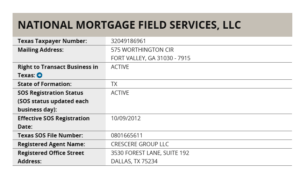 that touches federally-insured mortgage work sits inside beneficial-ownership disclosure rules under the Corporate Transparency Act, which require FinCEN reporting on exactly this kind of control change. Duhon says Penny traveled to the United States to meet clients and negotiate contracts in person — the kind of sustained business activity that raises its own questions if he was doing it on anything short of a proper work visa.
Evangelo has since told Duhon he clawed the company back from Penny through what both describe as a hostile or adverse takeover. That reversal doesn’t erase what happened while Penny controlled the money, and it doesn’t answer who, if anyone, ever verified his status in the first place. Of interesting note is the fact that Evangelo lives in Georgia and yet runs his license out of Texas. This is extremely important when it comes to legal standing and jurisdictional litigation.
He Knew He Was Broke — And Kept Sending People to Work Anyway
The more serious problem may not be Penny at all. It’s what Evangelo’s own words show he knew, and did anyway. In a text to Duhon on February 20, 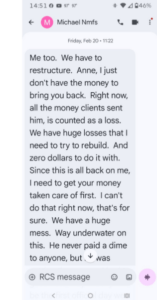 2026, Evangelo said NMFS had “huge losses” and “zero dollars” to rebuild with — his own description of insolvency, in writing, from him. NMFS did not pause operations. It did not disclose that status to the Inspectors it kept dispatching into the field on the promise of eventual payment. By March 10, Evangelo was still describing the company as underwater, still fielding client work, and still telling Duhon she was responsible for paying him under her old contract.
An Inspector who takes a work order operates on the understanding that the company issuing it can pay for it. Continuing to accept and dispatch that work for weeks after admitting insolvency in writing is a different order of problem than a late payroll run — it’s inducing Labor into the field under a promise the company’s own owner already knew, on paper, he couldn’t keep.
Nobody’s Watching the Order Mills
That failure sits on top of a second one. Genstone, Safeguard, ServiceLink and their peers routinely demand proof of insurance and licensing from the order mills they hire, but none of them appear to track whether those order mills are actually paying the Inspectors and Field Service Technicians doing the work. NMFS could operate insolvent, swap its banking to an unverified foreign national, and keep taking new orders throughout, without a single client pausing the pipeline to ask where the money was actually going once it left their books.
The False Claims Act Angle
The federal False Claims Act imposes treble damages on anyone who submits, or causes the submission of, a false claim for payment to the government, or who makes a false record or statement material to one. It carries a qui tam provision, meaning a private party with direct knowledge — an Inspector, a vendor manager, a desk manager — can file suit on the government’s behalf and share in the recovery.
Foreclosurepedia has raised this theory before, in the case of 24 Asset Management, where massive ongoing fraud spreading from CONUS to Puerto Rico raises a false certification of payment to Labor on federally-touched work created potential exposure independent of any state wage claim. The same question now applies to NMFS: if Evangelo or Penny represented to clients, insurers, or investors that field labor had been compensated on FHA, USDA, or VA-backed work while diverting that money elsewhere, or while known to be insolvent, the certification — not just the nonpayment — is the exposure.
This is not a claim that NMFS has been charged with anything. It is a question nobody with the authority to ask it appears to have asked yet. And to that point, we believe it is a fair point to raise as the Office of the Inspector General at multiple federal agencies may have questions of their own.
The Second Firm in Six Months — And 24AM Isn’t Standing Still Either
NMFS is not the first national to collapse this way in 2026. 24 Asset Management, operated by Eduardo “Fast Eddie” San Roman, has spent the year fending off documented non-payment claims across Delaware, Maryland, and Indiana while continuing to hold roughly ten active HUD Management and Marketing Field Service Manager (M&M FSM) 3.12 award areas. Foreclosurepedia reported this month that 24AM’s non-payment pattern has now spread into its Puerto Rico territory, with Labor there owed tens of thousands of dollars against a backdrop of water rationing and rolling blackouts, while former HUD M&M Director Craig Karnes and HUD’s Sharon Washington — both named in complaints filed by affected Field Service Technicians and Inspectors — have taken no action to revoke the award nor compensate Labor. Foreclosurepedia’s Firm Registry already carries a NON-PAY flag on both NMFS and 24AM.
The pattern repeats almost line for line: a principal facing mounting non-payment complaints, a predecessor entity — Assero Services, in San Roman’s case — that quietly goes bankrupt and defunct while a related entity keeps operating under the same ownership, and staff insisting the money simply hasn’t arrived from clients yet. That excuse Foreclosurepedia has now independently disproven twice: first with Inspector Lisa Thomas at NMFS in August, and again in Duhon’s account of the same “clients haven’t paid us” line being used at NMFS before the ownership swap.
Two firms buckling the same way in the same year, on portfolios that touch the same federal guarantee programs, is no longer a one-off HR problem. It’s a pattern Fidelity National Financial, Lakeview, and the rest of the servicer chain above them are choosing not to look at — the same way Karnes and Washington have chosen not to look at what’s happening in Puerto Rico.
“He Pays Himself First”
Duhon says the money problem at NMFS did not start with Penny. She describes Evangelo taking out personal loans against his own house to keep the company afloat, then prioritizing those loan payments, and NMFS’s InspectorADE hosting and platform fees, ahead of the Inspectors who generated the revenue in the first place.
“Whenever he gets money in, he’s paying himself first,” Duhon said. “He has to pay things like the website management. The bills for InspectorADE, to keep InspectorADE up and running so he can get the work in. So he was doing those things first before paying the people that made the money, legit, that did the work.”
For years, Foreclosurepedia has argued that while on the one hand SaaS outfits like Scott Nerdin’s InspectorADE and Verisk’s Property Preservation Wizard (PPW) assert they are simply third party service providers (TPSP), the reality is that they are far from that. Previous opinions of anti-trust and collusion aside, the reality is these platforms lock down Labor’s access to their copyrighted photo documentation at the whim of firms refusing to pay them. Moreover, these platforms are used to amplify messaging that is spurious, at best, and most assuredly is not covered by Section 230 of the Communications Decency Act of 1996. The length and breadth of the complaints — about lockouts and the such — have abounded for decades.
What’s Actually at Stake
Duhon worked for NMFS on what she was told was a 1099 basis, paid a flat weekly salary and required to work company hours and methods — the textbook fact pattern for employee misclassification under the Department of Labor’s Wage and Hour Division both as an Inspector and vendor manager. Six months after she was fired, that $5,000 is still sitting unpaid, and she still doesn’t have the 1099 she’d need to fight for it on her own. This is the tip of the iceberg. If you are owed money reach out to Foreclosurepedia today!