
Blog

Drought, Debt, and Fast Eddie: How 24 Asset Management Bleeds Puerto Rico Dry While HUD Looks Away

$40,000 owed by Fast Eddie San Roman and his son Zack at 24 Asset Management, a HUD M&M FSM awardee. $40,000 that the entire staff of 24 Asset Management is aware of, turn a blind eye to, and the new HUD M&M FSM awardee needs to ensure they do not hire. Their names will be listed in a forthcoming article. It is the tip of the iceberg with many wondering if HUD officials are on the take. Meanwhile, Puerto Rico is rationing water. San Juan and six surrounding municipalities have gone without running service for as long as 100 days, cycling through 48-hour blackouts while reservoirs sit at record lows. Field Service Technicians and Inspectors on the island are working through it — no water at the house, no water at the shop, and, as it turns out, no full paycheck either.

That last part is not weather. That is Eduardo “Fast Eddie” San Roman.

The Math HUD Won’t Do

Two Puerto Rico order files landed on our desk this week. The first covers January through August 2026: 125 properties carrying an outstanding balance, 939 more still owed since May 22, totaling $18,780. The second covers a full year, September 2025 through August 2026: 1,087 billable properties after cancellations and disapprovals are stripped out, at $20 a property, for $21,740 unpaid. Add them together and you land almost exactly where the contractor landed: an outstanding balance nearing $40,000.

Here is the part that should draw an Inspector General’s attention faster than the total. The checks never stop. They arrive every month, just never for the full amount owed. The remaining balance rolls forward, month after month, compounding against Labor while 24 Asset Management keeps the lights on with partial payments calibrated to keep people working without ever making them whole. It is not a missed payment. It is a business model.

Thank you so much for taking the time to help us. My brother is in a group chat with several other vendors going through the same situation with Asset Management and they also will be reaching out to Mr. Karnes and Ms. Washington. I offered to help because of the language barrier and will keep you updated. Thanks again!

The contractor’s family put it plainly: the money coming in is enough to keep employees paid. It is not enough for the owner to pay himself, or his mortgage. He is now weighing whether performing further work simply grows a balance he may never collect, against the risk that stepping back reads as abandoning a federal contract and costs him future work. That is not a cash flow problem. That is coercion with a HUD logo on it.

Fast Eddie’s Franchise

Foreclosurepedia has tracked Eduardo San Roman’s pattern for years, from Assero Services — which collapsed owing Labor close to a million dollars and never filed bankruptcy, it simply stopped — to its resurrection as 24 Asset Management at the same Miami address. Today 24AM holds roughly ten HUD Management and Marketing Field Service Manager 3.12 award areas, including Area 8A, which covers Florida, Puerto Rico, and the Virgin Islands, worth tens of millions of dollars in first-year obligations alone.

His son, Zachary San Roman, sits inside the operation running the family playbook. This is not an absentee owner losing track of a subsidiary. This is a family enterprise running the same non-payment playbook across two corporate names and two decades, with HUD’s signature on every award renewal.

Craig Karnes Knew

Craig Karnes has worn more than one HUD title while Fast Eddie San Roman kept collecting awards. He ran the agency’s Management and Marketing program as HUD M&M Director. He later moved up to Acting Deputy Chief Procurement Officer for Field Operations. He has since moved again — into a different HUD role, after his appointment failed to clear under the Trump administration. Three titles, one throughline: at every post, Karnes had the authority to pull 24 Asset Management’s awards, and at every post, he didn’t.

When Assero was accused of tax fraud, Karnes reasoned that San Roman may have controlled the company without personally directing its finances — a distinction that requires testimony under oath, not a procurement memo, to hold up. Our reporting has called this insulating an $18 million-plus investment in Fast Eddie San Roman, award cycle after award cycle, title after title.

And where is Sharon Washington while a Field Service Technician and Inspector in a drought zone debates whether he can afford to keep working? Nowhere Labor can find her. RE-Global, the mortgagee compliance manager tasked with policing exactly this kind of payment failure on federal contracts, has shown no appetite for oversight either. In fact they spent months partying it up before ever even rolling out on the HUD MCM contract. Foreclosurepedia asked the same question in April: it is not like Sharon Washington or HUD leadership are going to get involved. Nothing since has proven that assumption wrong.

A Pattern, Not an Incident

This is not an isolated Puerto Rico problem. Foreclosurepedia reported over $100,000 in fraud against Billy Masonet roughly a decade ago, committed by CWIS — a separate case, same island, same industry, same absence of consequence. A decade apart, two fraud cases out of Puerto Rico, and HUD’s field operations leadership has yet to remove a single award over either one.

Puerto Rico’s Field Service Technicians and Inspectors are already rationing water. They should not also be rationed pay by a contractor HUD has had a decade of documented reasons to cut loose, and refuses to. Here is what is owed and precisely where the houses are located as a public service to warn potential buyers about the fraud involved. FORTY PAGES of properties serviced and never paid in full. $40,000 owed. Avoid these properties like the plague as well as Fast Eddie San Roman and his son Zack!


Loader Loading...
EAD Logo Taking too long?

Reload Reload document
| Open Open in new tab


Evangelo Told Labor His Clients Weren’t Paying Him – Now One of Them Says They Already Paid

Foreclosurepedia first reported Lisa Thomas’s account of six unpaid months under Michael Evangelo’s National Mortgage Field Services on August 31, in “That’s What They Told Me.” Her explanation then, as she relayed it, was that NMFS was not paying her because NMFS’s clients were not paying NMFS. New documentation Thomas has provided contradicts that explanation directly.

What Changed

Thomas has now shared a spreadsheet — attached below — of individual NMFS work orders spanning Georgia, Mississippi, and Arkansas, run from November 2024 through June 2026. It shows roughly $1,313 outstanding against $1,691 billed. It is part and parcel what the former NAMFS Board of Directors representative is doing on a daily basis.

More significant than the total is what Thomas learned when she went to the clients directly. They told her they had already paid Evangelo in full. That account does not square with the excuse NMFS gave Thomas in August: that the company could not pay Labor because its own clients had not paid NMFS. Foreclosurepedia is reporting both accounts as told. We have not obtained a direct statement from Evangelo reconciling the two, and we sought comment from the client Thomas named before publication.

Thomas did what Labor is told to do when a firm stops paying. The U.S. Department of Labor and the labor departments of Arkansas, Mississippi, and Georgia each declined jurisdiction, bounced between a state that says the work happened elsewhere and states that say they only process unemployment claims, not contractor non-payment.

Forty Years of Standing, and Still No Reconciliation

Evangelo has run inspectors since 1983 and claims over 700,000 personal inspections before building NMFS into a 42-state, 69,000-zip-code operation dispatching more than 800 independent contractors. He sat on the board of the National Association of Mortgage Field Services and on the review committee Aspen Grove Solutions uses to vet contractor fitness across the industry. A failed sale of NMFS put him back in day-to-day control of the company earlier this year. Foreclosurepedia’s Firm Registry (FCPD-RPT-26Q2) lists NMFS under a NON-PAY flag and marks the firm FOR SALE, with Evangelo’s active pursuit of an exit and having now to return to a collapsed sale and company.

None of that standing changes what Thomas is owed, and none of it explains the gap between what NMFS told her in August and what a client has now told her directly.

The Backdrop Labor Is Absorbing

Foreclosurepedia has already documented the industry-wide squeeze in “Labor Foots The Bill As Management Cuts Pricing With $6 Gallon Diesel.” That backdrop is the same one Thomas is working against while she waits to be paid. Diesel hit an all-time national average high of $6.27 a gallon on September 11, according to AAA, up from $3.70 a year earlier, and Field Service Technicians and Inspectors cannot defer fuel to reach a door NMFS ordered them to knock on.

Borrowing costs are climbing alongside it. Freddie Mac’s weekly survey put the 30-year fixed mortgage at 6.76% as of September 10, and NerdWallet’s daily tracker showed the average 30-year rate crossing 7% by September 14. The 10-year Treasury yield, the benchmark underneath that pricing, climbed above 5% this week for the first time since 2007, nearly two decades ago. For Labor carrying debt to cover fuel and equipment while NMFS decides when to pay, every one of those numbers compounds the hole Evangelo left them in.

Foreclosurepedia Sought Comment

Foreclosurepedia contacted the client Thomas identified, seeking comment on the payment history and on the discrepancy between its account and the explanation NMFS gave her in August. That request is documented and pending response. This article will be updated if one is received.

Thomas is not the first Field Service Technician or Inspector to come forward about Evangelo’s National Mortgage Field Services, and her documentation is more specific than the last account Foreclosurepedia published. The explanation NMFS gave her has now been contradicted by the party it named. Michael Evangelo still owes Labor an answer.

Here is a list of the property owners, order mills, and lenders whom have overseen the failure to pay with the spreadsheet below.

Owens Insurance, Aremco, Service Link, SingleSource, First Allegiance, and Mr Cooper.


Wilkerson 82 Realty Llc, Mary Tackett, Angels Garden Revocable Living Trust, Patsy Sidio, Beatrice Wadlington, Katie Wilbert, Magnolia Rentals Llc, Herman & Patricia Carter, Bessie Brown, Joe Stout, Bonnie Westbrook, Virgie Taylor, Paul & Carla Sheffield, Patricia Dillon, William Dean, Phylicia Mcgee, Kimbriel Investments Llc, Tyler Griffin Dba: Tmg Farms, Willie & Takida Lomax, Doris Griggley, Glinda Thompson Walker, Josh & Alyssa Copeland, Perry Lee, Gerald Leatherman NST, Melvin Sullivan NST


Loader Loading...
EAD Logo Taking too long?

Reload Reload document
| Open Open in new tab


Labor Foots The Bill As Management Cuts Pricing With $6 Gallon Diesel

Rosy IAFST

A barrel of oil is trading above $107 today, and the number is not staying contained to a futures screen somewhere in Chicago. It is landing directly on the technicians and inspectors who drive the mortgage field services industry, one route at a time, one gallon at a time. The national average price of gasoline rose another 5 cents overnight to $4.27, and that increase does not pause to ask whether the person behind the wheel is paid piece-rate, hourly, or nothing at all until the order clears review. Diesel told an even uglier story. The fuel that moves farms, trucking, and trains rose 3 cents overnight to $5.97 a gallon, the highest diesel price ever recorded in this country. Every preservation crew running a box truck to a REO cleanout, every debris haul, every supply run to winterize a vacant property now runs through that number. Nationals and order mills will not feel this the way the Field Service Technicians and Inspectors on the ground will feel it, because the nationals are not the ones burning fuel to reach the property.

The housing market is not absorbing this pressure quietly, and its distress is arriving on a delay that will eventually reach the desks of every technician reading this. Existing home sales dropped 2% last month from July, landing at a seasonally adjusted annual rate of 3.98 million homes, according to National Association of Realtors data released Thursday. Sales are now moving at their slowest pace in over a year, down 1.2% from last August, and that slowdown is not an abstraction. Fewer sales mean fewer closings, fewer closings mean slower conveyance timelines, and slower conveyance timelines mean properties sit longer under preservation contracts that pay the same piece-rate regardless of how many extra trips a technician has to make to keep a stalled asset compliant. Mortgage rates spent all of August parked between 6.6% and 6.7%, high enough to sideline the buyers who would otherwise be clearing distressed inventory off the books. Last week rates hit 6.71%, the highest level since mid-2025, and they have kept climbing in recent days as a global bond market sell-off collides with rising oil prices. None of this registers as breaking news to a technician standing in a driveway. It registers as another property that will not sell, another order that will not close, another month of carrying costs that someone downstream will eventually try to claw back from the labor doing the actual work.

Foreclosurepedia has spent years documenting what happens when fuel costs spike and piece-rate pay does not move with them, and this month offers nothing new on that front except a worse number. A Field Service Technician running a rural route in a state like Tennessee or Ohio can easily put 150 to 200 miles a day on a work truck, and at $5.97 diesel, that mileage eats directly into a per-order rate that was negotiated years before oil crossed $100 a barrel. Nationals structure their contracts so the fuel risk sits entirely with the technician, never with the company collecting the spread between what the servicer pays and what the technician actually receives. Inspectors face a quieter version of the same squeeze, since occupancy checks and condition reports pay less per order than preservation work but still require the same drive time and the same gallon of gas to complete. Fuel surcharges remain the exception in this industry rather than the rule, and the companies that do offer them tend to cap the adjustment well below the actual increase at the pump. That gap between what fuel costs and what the surcharge covers is not an accident. It is a line item that protects margin at the top of the vendor chain by transferring the cost straight down to the person with the least leverage to refuse it.

The independent contractor classification that defines most of this workforce compounds the problem rather than easing it. A Field Service Technician or Inspector classified as an independent contractor absorbs fuel costs, vehicle depreciation, insurance, and now the accelerating cost of a work truck repaired with parts that have grown more expensive under recent tariff pressure, all without the protections an employee would receive when the cost of doing the job outpaces the pay for doing it. Litigation like Hurst v. Buczek exposed how often that independent contractor label functioned as a legal shield for the companies profiting from the arrangement rather than a genuine description of how the work actually operates day to day. Diesel at $5.97 a gallon does not care about that legal distinction, and neither does a servicer’s compliance deadline. The technician still has to show up, the truck still has to run, and the fuel still has to go in the tank before the first order of the day can even begin. When oil, mortgage rates, and a slowing housing market all move against the labor force at the same time, the people absorbing that convergence are rarely the executives setting the piece-rate.

Foreclosurepedia will keep tracking how these macro numbers translate into real dollars lost on real routes, because the spreadsheet in a national’s corporate office does not capture what $5.97 diesel does to a technician’s margin on a 40-mile trip to secure a single vacant property. The International Association of Field Service Technicians and Inspectors continues to hear from members whose take-home pay has shrunk in real terms even as order volume and mileage requirements hold steady or increase. That erosion does not show up in a press release. It shows up in a technician deciding whether tonight’s fill-up comes before or after this week’s groceries. Rising oil prices, a stalled housing market, and mortgage rates near a multi-year high are converging on an industry that has never been eager to renegotiate what it pays the people doing the work. Until that changes, every cent added to the price of a gallon of gas or diesel is a cent quietly subtracted from the labor holding the entire mortgage field services supply chain together.

Google Calendar Is Now a Phishing Delivery System — And Nobody Warned You

IAFST GC Virus

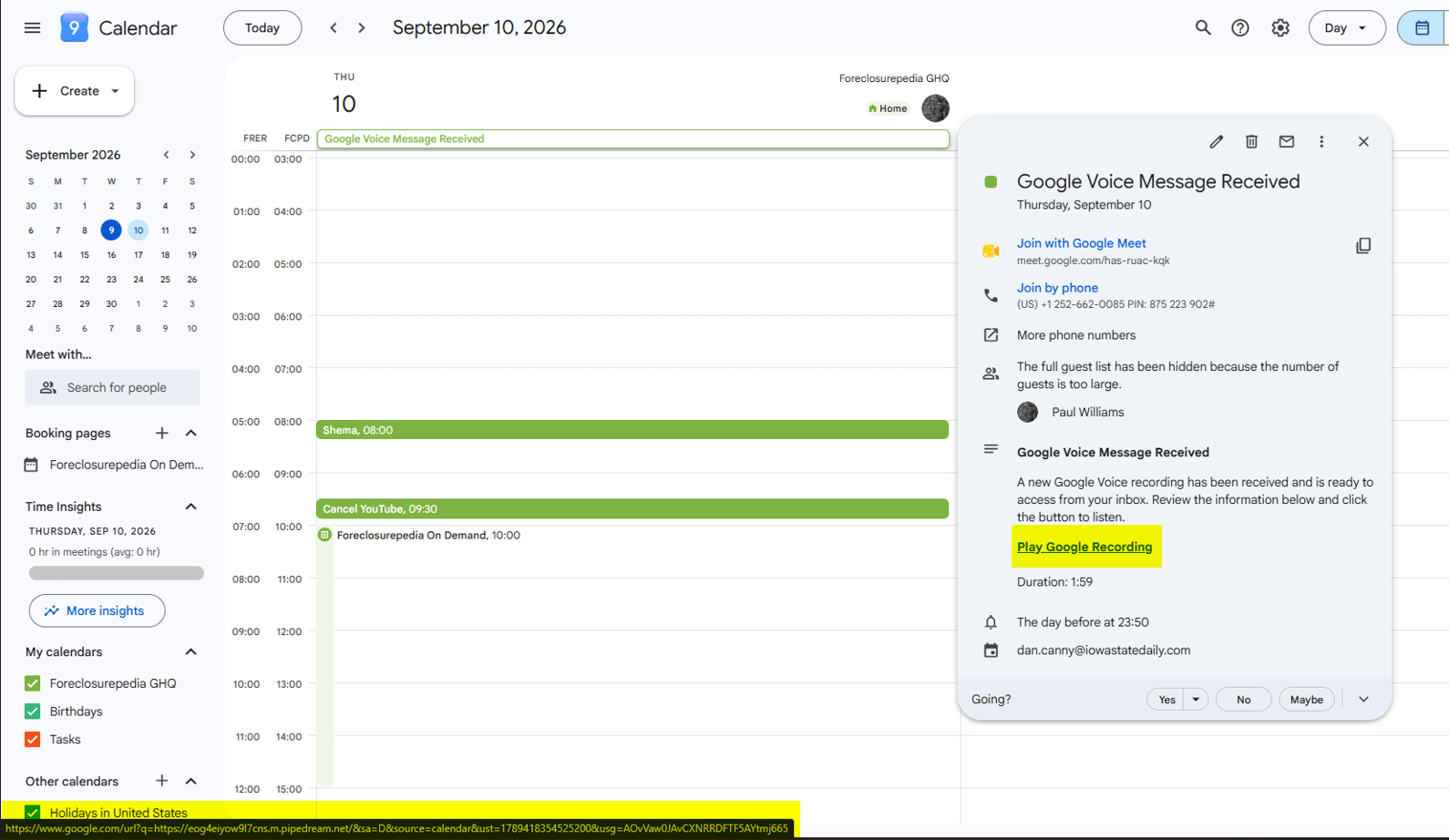
Somewhere on a server you’ll never see, a scammer built a fake event titled “Google Voice Message Received.” They mass-invited thousands of email addresses to it. Google Calendar, doing exactly what it was designed to do, auto-added that event to every calendar it touched. No click required. No download. No malicious attachment opened by a careless employee. The event simply appeared, sitting on the schedule like a legitimate meeting, waiting.

This is the threat model now. Attackers don’t need you to open an email anymore. They need you to trust your own calendar.

How the Con Works

The event mimics a Google Voice notification down to the last visual detail. It shows a fake voicemail duration, a fake “the day before” reminder timestamp, and a “Play Google Recording” link styled exactly like Google’s own UI. Everything about it is built to pass a half-second glance.

The tell is buried where most people never look: the status bar at the bottom of the browser. Hover over that “Play Google Recording” link and the real destination surfaces — not a Google domain, but a redirect through Pipedream, a legitimate developer platform that scammers have weaponized to obscure where the link actually leads. From there, the chain typically terminates at a credential-harvesting page built to look like a Google sign-in screen.

The guest list is hidden, flagged as “too large to display.” That’s not a bug. That’s confirmation the invite went to a scraped list numbering in the thousands, and your address was one line in a spreadsheet somebody bought or stole.

GCV

Why This Matters More Than the Usual Phishing Email

Traditional phishing training tells people to scrutinize the sender, check the “From” field, and hover over links in the email body. None of that applies here. The attack arrives inside a tool employees are conditioned to trust implicitly — their own scheduling software — and it does so without any action on the recipient’s part. By the time a user sees it, they’re not evaluating an unsolicited message. They’re evaluating what looks like a routine calendar notification.

For anyone in the mortgage field services and property preservation space — Field Service Technicians, Inspectors, vendor coordinators, servicer-facing staff — this isn’t an abstract IT nuisance. These are people juggling dozens of calendar invites a week from clients, vendors, and internal systems. A fake event blends into that noise instantly. One careless tap on “Yes” or “Maybe,” let alone the recording link itself, can hand a credential-harvesting operation a foothold into a corporate Google Workspace account tied to servicer data, contractor records, or payment systems.

What To Do About It

Do not click the recording link. Do not respond Yes, No, or Maybe — any RSVP confirms to the attacker that the address is live and monitored, which makes it more valuable on the next list sold or traded. Delete the event and report it as spam through Calendar’s event menu.

Then close the door it walked through. In Calendar settings, under Event Settings, set “Automatically add invitations” to “No, only show invitations to which I have responded.” That single change stops most of this campaign from ever reaching your view again.

The Bigger Picture

This campaign is not targeted. It is a mass-scale exploitation of a default setting that Google ships to make scheduling frictionless — and that friction-free design is precisely what makes it dangerous. Every organization running Google Workspace has employees with this default still turned on, which means every organization is currently exposed to an attack vector most security training has never addressed.

The mortgage field services industry runs on trust between vendors, servicers, and Field Service Technicians and Inspectors who rarely meet face to face. That trust is built on systems working the way they’re supposed to. When the calendar itself becomes an attack surface, the industry needs to start treating “routine” notifications with the same scrutiny it applies to unsolicited emails — because increasingly, there is no meaningful difference between the two.

Ottawa Hits Back, Wall Street Bleeds, and Field Services Labor Gets the Bill — Again

IAFST Trade War

At 12:01 a.m. Tuesday, Canada pulled the trigger on $27.6 billion in retaliatory tariffs against American goods. The move was billed as “dollar for dollar,” matching the 50% Section 338 tariffs Washington slapped on Canadian imports back on August 22. Steel and aluminum coming out of the United States now face a 50% Canadian tariff. So do furniture, motorcycles, clothing, and beauty products. Dairy, household appliances, agricultural equipment, pulp and paper, and electronics all took hits ranging from 15% to 50%, spread across more than 700 product categories.

This is not the end of it. Trump has already threatened to push tariffs on Canadian cars, trucks, auto parts, and steel to 50% starting January 1, 2027 — a date that would gut one of the most tightly integrated manufacturing relationships on the continent. As of this writing, no new trade talks are scheduled between Washington and Ottawa. Both governments are dug in for a prolonged standoff, not a resolution, and every field services contractor who depends on steel-price-sensitive materials — locks, boards, appliances, HVAC units pulled for REO turns — needs to understand that the anticipated one-upsmanship is not theoretical. It is scheduled.

Wall Street responded the way Wall Street always responds when the ground shifts under it: badly. The Dow Jones Industrial Average dropped 628 points Tuesday, a 1.18% slide to 52,786.07, its second consecutive losing session after Friday’s 272-point drop. The S&P 500 fell 0.58%. The Nasdaq slid 0.32%. None of this happened in a vacuum. Oil is the accelerant. Brent crude pushed toward $99 a barrel and WTI traded above $93, driven by fresh violence in the Middle East, including reported Houthi strikes that forced Saudi Arabia to halt operations at energy facilities across its southern region. Ten-year Treasury yields climbed toward 4.8%, and traders are now pricing in the real possibility of another Fed rate hike this month, layering monetary tightening on top of a trade war that is already raising the cost of everything a property preservation company touches.

None of this is abstract for the men and women driving from vacant to vacant with a trunk full of tools and a 1099 in their glovebox. AAA’s national average for regular unleaded sits at $4.15 a gallon today — up on the day, and roughly a quarter higher than it was a year ago. Every mile an FST drives between work orders, they are eating that increase out of pocket, because nobody in this industry reimburses mileage like it is 2026 and not 1996.

And that is where the real story lives — not on a ticker, but on an invoice. NAMFS member firms have not raised base pricing for Labor in more than thirty years. Inspections still pay $7 to $9. Grass cuts still pay $25 to $30. Winterizations still pay $45 to $50. Those numbers were low in the 1990s. They are an insult now, with tariffs about to push the price of a padlock, a plywood sheet, or a replacement water heater higher, and with gas prices climbing alongside a barrel of oil that is flirting with triple digits for the first time in two months.

Every dollar the tariffs add to steel, appliances, and building materials gets absorbed by the servicer, passed to the asset manager, passed to the national firm, and stops dead before it ever reaches the technician standing in the driveway. That is how this industry has operated for three decades, and there is no evidence — none — that a trade war with Canada is going to break the pattern. If anything, firms will use rising input costs as cover to squeeze harder on the labor side of the ledger while insisting their own margins are untouchable.

Meanwhile, Labor is still fighting just to get paid on time, let alone paid fairly. Federal contracting rules already require prime contractors to certify subcontractor payment entitlement before billing the government, and to notify the contracting officer within fourteen days of any payment that runs ninety-plus days past due. Those rules exist because the industry’s default position, absent enforcement, is to let field techs carry the float. Add a trade war, a market selloff, and $100 oil to that equation, and the incentive to delay, dispute, or simply not pay only grows.

The tariffs took effect today. The Dow bled today. Oil climbed today. And somewhere in Grainger County, in Cook County, in every county in between, a Field Service Technician and Inspector are filling up a truck at $4.15 a gallon to go collect $9 for an inspection that will not be invoiced correctly, will not be paid on time, and will not see a rate increase no matter how high Ottawa and Washington escalate this fight. That is the story nobody on CNBC is going to tell you. Foreclosurepedia will keep telling it.