




By the Foreclosurepedia Staff | April 26, 2026
The default mortgage field services industry has never been particularly good at reading Washington. It missed the CFPB wave until servicers were paying nine-figure settlements. It ignored the FHA conveyance timeline enforcement cycle until contractors were eating penalties. And now, as the Trump administration has transformed its anti-ESG and anti-DEI posture from political theater into enforceable federal contract law, three of the most prominent names in the field services and default mortgage services ecosystem — Altisource, Mortgage Contracting Services, and ServiceLink — are each carrying publicly visible ESG or DEI commitments that range from quietly problematic to acutely dangerous. None of them, based on available public evidence, have addressed it.
The Legal Framework That Changed Everything
To understand why this matters now in a way it did not matter eighteen months ago, you have to understand the progression of the Trump administration’s enforcement architecture. Early in his second term, President Trump’s administration rolled back several key policies calling into question the future of ESG-related initiatives and investments, with the January 21, 2025 executive order terminating DEI and DEIA policies in the federal government and explicitly encouraging private sector companies to eliminate similar programs.
That encouragement became pressure, and pressure became mandate. On March 26, 2026, an Executive Order titled “Addressing DEI Discrimination by Federal Contractors” fundamentally shifted compliance from broad policy goals into enforceable contractual obligations. Starting April 25, 2026, all new federal contracts and modifications must include a clause prohibiting racially discriminatory DEI activities, including race-based recruitment, mentorship, and supplier diversity programs. Non-compliance is explicitly deemed material under the False Claims Act, exposing contractors to treble damages, contract termination, and debarment.
The compliance clock is not approaching. It has already struck. By April 25, 2026, federal agencies and departments must insert a clause in all contracts and subcontracts prohibiting racially discriminatory DEI activities, and contractors must furnish all information and reports, including providing access to books, records, and accounts.
What makes this particularly dangerous for field services companies is the qui tam mechanism baked into the False Claims Act. A whistleblower — a disgruntled subcontractor, a competitor, a former employee with a grudge — can file suit on behalf of the government and collect a portion of any recovery. In an industry defined by thin margins, hypercompetitive vendor relationships, and long institutional memories, the qui tam threat is not hypothetical. It is a standard business risk that now has a new trigger: a company’s own public website.
Leadership teams often treat websites, ESG disclosures, recruiting campaigns, annual reports, board diversity goals, and supplier diversity announcements as communications matters rather than contract evidence. Increasingly, that separation is dangerous. If a company certifies one thing in a federal agreement but describes materially different workforce or supplier practices in public disclosures, those statements may later be used as evidence in an enforcement review, bid protest, suspension matter, or subcontract dispute.
With that framework established, let’s go company by company.
MCS and Stewart: The ESG Page That Keeps Running
Mortgage Contracting Services, now wholly owned by Stewart Information Services Corporation following the December 2025 acquisition, presents a different risk profile than say Altisource — more elaborate in its public ESG commitments and operating through a more indirect federal contractor pathway, but no less serious when the full picture is assembled.
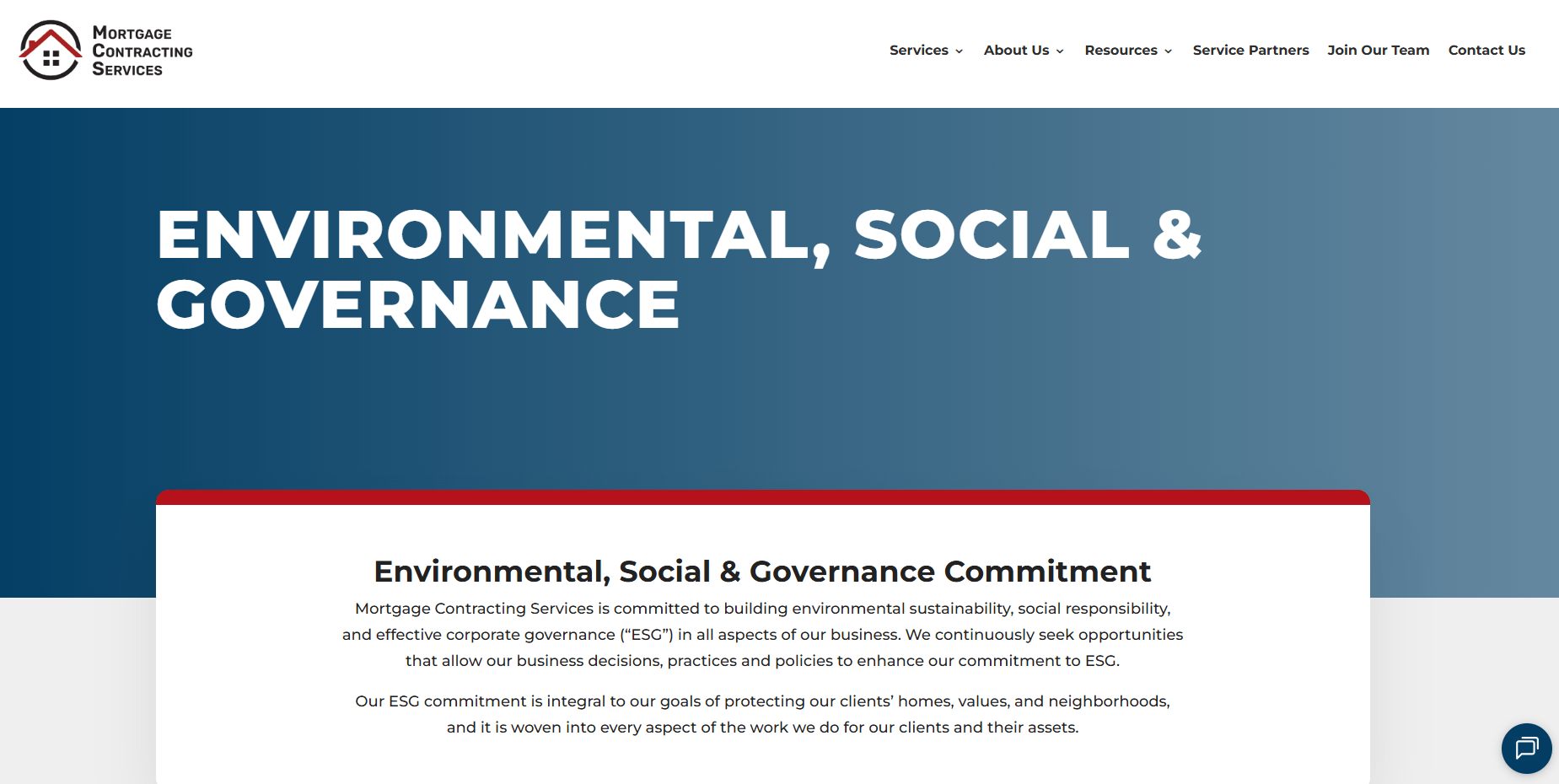
The ESG page located here is a comprehensive, three-pillar public declaration. On the environmental side, MCS pledges to reduce its impact on climate change, to conserve natural resources, and to build a service model that addresses climate change risk. On the social side, the company commits to maintaining a diverse and inclusive work environment and to supporting social causes and education initiatives. On the governance side, MCS promises specific benchmarking against ESG key performance indicators with long-term accountability. This is not aspirational language buried in an annual report footnote. It is the company’s own About section, one click from the homepage, titled in plain text: Environmental, Social & Governance.
The parent company compounds the exposure in a way that MCS alone could not manufacture. Stewart’s 2025 Form 10-K, filed in February 2026 — after the acquisition of MCS was complete and the Trump anti-DEI architecture was already well established — states that Stewart is committed to recruiting strategies grounded in fairness, equity, and inclusivity. A public company’s 10-K is not a marketing document. It is a sworn disclosure to the SEC. When a company certifies in a federal contract that it is not engaged in prohibited DEI activities while simultaneously representing in a regulatory filing that its recruiting strategies are grounded in equity and inclusivity, it has created a contradiction in the documentary record that federal enforcement attorneys and whistleblower plaintiffs are specifically trained to find and exploit.
MCS’s federal exposure flows primarily through servicer clients and GSE relationships rather than direct HUD contracts, placing it in the same downstream flow-down category as ServiceLink. But the scale of MCS’s FHA-related business amplifies the stakes considerably. MCS operates the Convey360 platform, maintains a 99% on-time FHA conveyance rate, and functions as one of the largest field services technology platforms in the default mortgage space. The volume of federally-touched work flowing through MCS’s systems means the flow-down compliance obligation is not an occasional concern — it is embedded in the company’s core revenue base. Every major servicer client that holds a federal contract and routes FHA default work through MCS’s platform is now required to flow the DEI prohibition clause down through their vendor chain, straight to MCS’s door.
If a company certifies one thing in a federal agreement but describes materially different workforce or supplier practices in public disclosures, those statements may later be used as evidence in an enforcement review, bid protest, suspension matter, or subcontract dispute. MCS has a dedicated ESG page. Its parent has a 10-K statement. Both are public. Both post-date the Trump administration’s initial anti-DEI executive orders. Neither has been revised.
ServiceLink and FNF: The Most Elaborate Paper Trail in the Room
ServiceLink, the default services and field services subsidiary of Fidelity National Financial, presents the most layered compliance exposure of the three companies examined here — not because its individual statements are necessarily more extreme than the others, but because the institutional commitment runs deepest, has been most formally documented, and is backed by the governance infrastructure of a publicly traded Fortune 500 parent.
FNF has built a comprehensive ESG program complete with annual sustainability reports dating to 2019, and a sustainability page that is actively maintained and updated, and a suite of separately published supporting policy documents available for public download. The sustainability page itself prominently discloses that in 2024, women represented over 69% of FNF’s U.S. workforce and 43% of the members of FNF’s leadership team, and that the board has codified its commitment to diversity in director selection since 2018.
More significantly, FNF publishes a standalone Diversity and Inclusion Policy Statement as a downloadable PDF — last reviewed August 2024, meaning it was actively updated and reaffirmed well after the Trump administration’s initial wave of anti-DEI executive orders were already in force. That document explicitly commits the company to growing diversity in hiring and advancement decisions, directs the Board’s Nominating Committee to consider ethnic and gender diversity in director selection, and describes active programs including Women in Leadership and Leadership Development initiatives. The document states in plain language that its policies and processes apply to all FNF employees and majority-owned subsidiaries. ServiceLink is a majority-owned subsidiary. There is no ambiguity about whether ServiceLink is covered by FNF’s Diversity and Inclusion Policy Statement. FNF answered that question itself.
ServiceLink’s own public footprint adds a second layer of independent exposure. The company has a documented institutional partnership with NAMMBA — the National Association of Minority Mortgage Bankers of America — a purpose-driven organization dedicated to the inclusion of minorities and women in the mortgage industry, with ServiceLink’s participation described as deepening relationships within minority communities and creating economic opportunity focused on business development for minority brokers. That is not a philosophical statement. It is a described, publicly announced business practice in the documentary record, including on ServiceLink’s own blog and LinkedIn presence.
ServiceLink’s own job opportunity pages state that the company upholds its mission by promoting and nurturing a productive and diverse community. The careers portal describes diversity as a core component of the employee value proposition. These statements are indexed, cached, and available to anyone conducting a federal contractor compliance audit or preparing a qui tam complaint.
ServiceLink’s federal exposure, like Altisource’s and MCS’s, runs primarily through its servicer and GSE client relationships rather than direct federal contracts. But the FNF parent structure creates a specific additional risk that the other two companies do not face. FNF is a publicly traded company whose ESG commitments are embedded in investor-facing disclosures, governance documents, and annual reports. Unwinding those commitments is not a website edit — it requires board-level governance decisions, updated SEC disclosures, and a deliberate public repositioning that will itself generate scrutiny. The very formality that made FNF’s ESG program look like responsible corporate governance in 2022 is now the anchor that makes rapid compliance adaptation difficult.
Altisource: The Ghost of HUD Complaints Past
Altisource presents a different kind of trap compared to MCS and Stewart — less about glossy ESG pages and more about a prior documented record of conduct that directly contradicts the public virtue signaling. You won’t find a dedicated “ESG” tab shouting about “equity” and “inclusion” on their site (though their Human Rights statement does dutifully pledge “equal opportunity without regard to race” while name-checking the UN Guiding Principles) . The real issue is the federal paper trail they can’t delete. While the Trump Executive Orders demand the eradication of DEI programs, Altisource already has a certified history of being sued by the National Fair Housing Alliance for allegedly doing the exact opposite of “equal maintenance.” Remember 2018? Altisource was slapped with a federal lawsuit—backed by 30,000 photographs—accusing them of maintaining bank-owned homes in African-American and Latino neighborhoods far worse than those in white neighborhoods, effectively weaponizing property upkeep to depress property values in minority communities . That isn’t just a violation of the Fair Housing Act; in the current regulatory environment, actively managing assets in a way that treats neighborhoods differently based on race (even if framed as “disparate impact”) is the kind of “equity-adjacent” liability that makes HUD enforcement attorneys salivate. Altisource cannot certify to the federal government that it is “neutral” while simultaneously settling past claims of racial steering through property neglect. The risk isn’t a three-pillar webpage—it’s the ghost of HUD complaints past that proves their operational model already failed the color-blind test.
The Common Thread and the Shared Vulnerability
What Altisource, MCS, and ServiceLink share is not simply that they have public ESG or DEI language. It is that all three have failed to treat their public communications architecture as a legal compliance document in the post-March 26, 2026 environment. The exposure is not identical — Altisource’s is downstream through vendor chain flow-down provisions, MCS’s is amplified by a parent company’s SEC disclosures, and ServiceLink’s is compounded by the most formally documented ESG governance structure of the three. But in each case the mechanism of harm is the same: a public statement that contradicts a federal contract certification, sitting on a publicly accessible platform, available to anyone with a search engine and a motive.
In 2026, the risk is not coming from landmark court rulings declaring DEI unlawful. It is coming from enforcement tools: investigations, subpoenas, contract terms, and leverage applied across multiple fronts — often before any litigation is filed.
The field services industry is not immune to this dynamic. It is, if anything, more vulnerable than most sectors because of its structural dependence on federal contract relationships — HUD, FHA, GSE, and the servicer ecosystem that sits between those agencies and the vendors on the ground. The compliance obligation does not require a company to have DEI beliefs. It requires a company not to maintain public DEI commitments that contradict its federal contract certifications. The public websites, LinkedIn pages, SEC filings, and published policy documents of these three companies suggest commitments that are, at minimum, in direct tension with what those certifications now legally require.
The March 26 order creates a mandatory contract clause turning DEI compliance into a binding legal obligation with real consequences for noncompliance. The grace period ended on April 25, 2026 — yesterday, as this article goes to press. The question is no longer whether Washington is watching the field services industry. The question is who else is watching, and how long before the first bid protest, the first contract compliance flag, or the first qui tam filing names a company whose own website provided all the evidence needed.