




The mortgage field services industry has long operated in the shadows of the federal housing system, quietly maintaining and monitoring properties tied to federally insured mortgages. At the center of this system is the HUD Mortgagee and Management program, commonly referred to as HUD M&M, which relies on layers of contractors to carry out essential work on distressed assets. Field Service Technicians are the labor backbone of this system, performing physically demanding tasks such as grass cuts, securing structures, debris removal, winterization, and emergency repairs. Inspectors, by contrast, are responsible for occupancy checks, condition reports, and documentation that informs downstream decisions by servicers and HUD. Both roles are critical, yet neither holds real power when payment is withheld by upstream entities. Over the past several years, one HUD M&M Field Service Manager awardee, 24 Asset Management, has become emblematic of a systemic breakdown in accountability. Despite documented services rendered on HUD assets, labor across multiple states reports nonpayment stretching months and in some cases years. This is not an isolated billing dispute but a pattern that raises serious legal and ethical red flags.
This is the fraud that the Trump Administration said they were going to get rid of, but due to entrenched relationships with Eduardo San Roman and the previous fraud committed at Assero, the reality has been years long refusal to pay while HUD Secretary Scott Turner refuses to uphold the rule of law. How much are the deep state operatives being paid in kickbacks is anyone’s guess.
Multiple Field Service Technicians have reported completing full scopes of work on HUD properties only to see invoices ignored or rejected without justification. These technicians often advance their own funds for fuel, materials, and equipment, operating on thin margins with the expectation of timely reimbursement. When payment does not arrive, the economic consequences ripple outward into missed rent, lapsed insurance, and mounting personal debt. Inspectors have faced similar issues, particularly when occupancy checks and damage reports are accepted and uploaded into systems but never compensated. The work itself is not in dispute, as the properties reflect completed preservation and documented inspections. Photographic evidence, work order histories, and HUD system entries consistently corroborate the labor claims. Yet despite this documentation, payments remain stalled or entirely absent. This dynamic effectively forces labor to act as an involuntary creditor to a federal contractor.
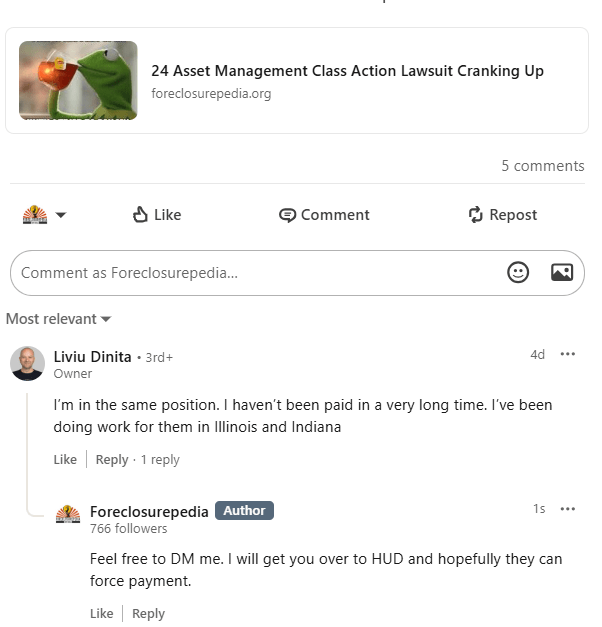
What elevates this situation beyond routine contractor misconduct is the prolonged duration and the scale at which it has occurred. Reports indicate that nonpayment by 24 Asset Management has persisted across multiple contract cycles and geographic regions. Field Service Technicians in states such as Illinois and Indiana have publicly stated that they have not been paid in a very long time, despite continued work. Inspectors echo these statements, noting that their reports were accepted and used, yet compensation never followed. This pattern suggests more than administrative incompetence and points toward systemic abuse of labor. When services are knowingly accepted without intent to pay, legal scholars often characterize such behavior as fraud. In the context of federally funded programs, this raises the specter of False Claims Act violations. The federal government is effectively paying for services that the actual labor force never receives compensation for.
The attached documentation illustrates how these disputes surface in public and semi-public forums, often as desperate attempts by labor to be heard. Comments from contractors describe identical experiences across different states, undermining any claim that the issue is localized or anecdotal. Field Service Technicians are not sophisticated financial actors; they are tradespeople who rely on predictable cash flow to survive. Inspectors similarly depend on volume and timely payment to sustain their businesses. When labor turns to social platforms to seek redress, it is usually because formal channels have failed them. These posts often trigger private messages, backchannel conversations, and referrals to HUD offices that may or may not respond. The very existence of such documentation underscores how normalized nonpayment has become in this segment of the industry. It also exposes the imbalance of power between large FSMs and individual workers.
HUD’s role in this controversy cannot be ignored, particularly given the reported awareness at the highest levels of the agency. HUD Secretary Scott Turner and many within the Procurements department have reportedly been made aware of these issues, including allegations of years-long fraud and potential False Claims Act violations. Awareness without action, however, amounts to tacit approval in the eyes of affected labor. The HUD M&M program is governed by strict contractual and ethical requirements, including prompt payment provisions and compliance obligations. When an awardee repeatedly violates these standards without consequence, it calls into question the integrity of HUD’s oversight mechanisms. Field Service Technicians and Inspectors reasonably ask why they are held to strict performance metrics while FSMs face no apparent penalties for nonpayment. The silence from HUD leadership has become a central grievance among workers. This perceived indifference erodes trust in the federal housing apparatus.
From a legal standpoint, the implications are severe and far-reaching. If an FSM submits claims to HUD indicating that work has been completed and paid for, while knowing that the underlying labor has not been compensated, the elements of a False Claims Act violation may be present. Such violations carry substantial civil penalties and treble damages, designed to deter abuse of federal funds. Field Service Technicians and Inspectors, though often unaware of these legal frameworks, are the direct victims of the underlying conduct. They perform the work in good faith, relying on the legitimacy of HUD’s contracting system. When that system fails them, it effectively transfers risk from large contractors to individual workers. This inversion of responsibility is not accidental but structural. It thrives in an environment where enforcement is lax or nonexistent.
“We are done providing free work and material for HUD. Some of us have already begun removing the materials used for repairs we were never paid for including the locksets. They can go to hell!” said one Field Service Technician we interviewed. His statement was on par with those we both polled and interviewed over the past week or so.
The economic consequences of this misconduct extend beyond individual workers to entire local economies. Field Service Technicians often hire helpers, purchase supplies locally, and invest in equipment based on expected revenue. Inspectors similarly contribute to local business ecosystems through vehicle expenses, technology purchases, and professional services. When payments are withheld, these economic activities stall or collapse. Small, labor-driven businesses are forced to shut down, consolidate, or exit the industry altogether. This attrition reduces competition and concentrates power further in the hands of large FSMs. Ultimately, HUD assets suffer as well, as fewer qualified workers remain willing to service them. The public interest is undermined when federal programs destabilize the very labor force they depend on.
Ethically, the situation represents a profound failure of stewardship. HUD’s mandate includes protecting communities, stabilizing neighborhoods, and ensuring responsible management of federally backed properties. None of these goals can be achieved by exploiting unpaid labor. Field Service Technicians securing vacant homes and Inspectors documenting conditions are performing public-interest work, even if indirectly. To allow their exploitation is to undermine the moral foundation of the program itself. Ethical governance requires not only rules on paper but active enforcement in practice. When leadership is informed of abuse and declines to intervene, the harm becomes institutional rather than incidental. This is why labor advocates increasingly view the issue as a systemic injustice rather than a series of bad actors.
The distinction between Field Service Technicians and Inspectors is crucial in understanding the breadth of the harm. Field Service Technicians absorb direct material costs and physical risk, making nonpayment immediately catastrophic. Inspectors, while less exposed to material costs, rely on volume and accuracy-based compensation that evaporates when invoices go unpaid. Both groups are misclassified in practice as expendable vendors rather than essential program participants. This misclassification allows FSMs to externalize risk while internalizing profit. It also obscures the human cost behind clean spreadsheets and compliance reports. Any serious reform effort must recognize and correct this imbalance.
As pressure mounts, labor is increasingly turning to documentation, coordination, and potential legal action. Some workers are exploring whistleblower avenues under the False Claims Act, while others seek direct intervention from HUD oversight offices. The attached documentation is one small example of a much larger evidentiary trail that continues to grow. Whether HUD leadership will act remains an open question, but the cost of inaction is no longer abstract. It is measured in unpaid invoices, shuttered businesses, and eroded trust. A federal housing program that cannot ensure payment to its labor force is fundamentally broken. Until accountability is enforced, the exploitation of Field Service Technicians and Inspectors will remain an open secret of the mortgage field services industry.
For workers navigating these conditions, joining the International Association of Field Service Technicians (IAFST) offers a concrete step toward collective protection, documentation, and advocacy in an industry that too often isolates labor. IAFST exists to represent Field Service Technicians and Inspectors as professionals whose work underpins federal and private asset management programs, not as disposable vendors. Membership provides access to shared knowledge, dispute documentation practices, and an organized voice capable of engaging regulators, oversight bodies, and policymakers when individual workers are ignored. It also creates a formal record of participation in the industry, which can matter when payment disputes, audits, or investigations arise. To encourage broader participation, IAFST is offering a straightforward incentive for new members who join now. All new members may use the discount code NEWMEMBER10 to receive ten dollars off the first year of local memberships for Field Service Technicians and Inspectors. That same code also provides ninety percent off all other membership categories, making entry accessible regardless of role or scale of operation. In an environment where nonpayment and abuse thrive on fragmentation, collective affiliation is not just a benefit but a defensive necessity.