




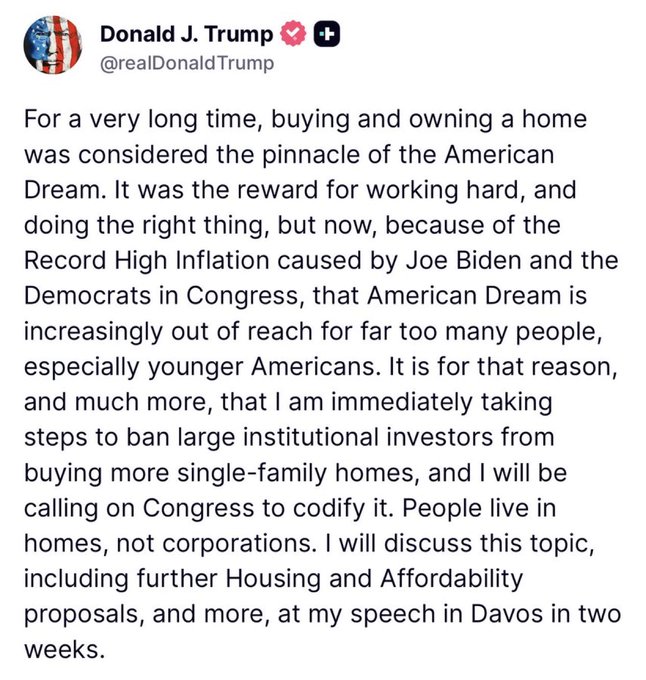
President Donald Trump’s recent announcement that he intends to bar large institutional investors from purchasing single-family homes landed in the housing industry like a thunderclap, reverberating through a sector that has been struggling under the weight of Wall Street’s appetite for real estate. In a Truth Social post, the White House claimed that private equity and other corporate buyers are distorting affordability by competing directly with families for homes that were long considered owner-occupied assets, not investment vehicles. The narrative framing was clear and calculated. According to Trump, single-family housing should serve individuals and families first, rather than investment firms seeking yield from rental income and asset appreciation. The move is framed as both corrective and patriotic, with an implicit argument that housing ought to be a cornerstone of household stability and generational wealth. While the political establishment debates the constitutionality and economic rationale, operators in the mortgage field services industry quietly observe that any policy shift affecting homeownership and default rates will inevitably cascade into their world. That world has long existed in the shadows of foreclosure pipelines that swell and contract with economic policy and credit cycles. With institutional buyers suddenly positioned as villains in a national affordability crisis, the question becomes not whether change is coming, but what shape it will take for everyone downstream.
For Field Service Technicians who perform the heavy lifting of property preservation labor, the prospect of fewer institutional buyers reshapes the speculative calculus that has defined the last decade. Corporations like Blackstone, Invitation Homes, Progress Residential, and a constellation of private equity vehicles turned distressed inventory into single-family rental empires after the Great Recession, creating a consistent demand for neighborhood stabilization activities and turn-ready maintenance. Technicians were dispatched to mow lawns, remove debris, winterize plumbing, and secure properties as these companies aggregated assets at scale. That labor facilitated the transformation of foreclosures into rentals, feeding margins for investors while suppressing the return of inventory to owner-occupants. If Trump’s proposal succeeds in curtailing such acquisitions, the volume of turn-to-rental work may tighten and prices for services may decline. However, some argue that it may also lead to a healthier cycle by routing distressed assets back into households rather than corporate portfolios. For Technicians, who have endured wage stagnation and piece-rate compensation for over a decade, any structural shift that reduces the stranglehold of investors might open space for more stable valuation of preservation work.
Inspectors occupy a different vantage point entirely, serving as the eyes and ears of the system rather than the hands that perform the repairs. Occupancy checks, photo-documented condition reports, and hazard assessments became indispensable tools for investors seeking to evaluate collateral risk across large distributed portfolios. Institutional buyers relied heavily on inspection data to determine asset quality, rental readiness, and liquidation strategies. The corporate growth model rewarded scale, which in turn standardized inspection workflows, often at the expense of compensation and processing times. If the government prohibits further expansion of these portfolios, Inspectors may experience a decline in volume as the pipeline of new investor acquisitions shrinks. Yet, they also speculate that a reversion toward family buyers and traditional mortgage lending could restore some of the inspection work tied to default servicing rather than landlord operations. As with everything in the mortgage field services ecosystem, competition and margin compression follow capital flows.
Economists debate whether institutional buyers are solely to blame for housing inflation, though the timing of their rise tells its own story. Between 2012 and 2024, the single-family rental market expanded at a pace that astonished even veteran analysts of residential credit cycles. Institutional buyers leveraged cheap financing, securitization vehicles, and data science to identify markets with high rental yields and stable tenant demand. Families attempting to purchase homes in these same markets encountered bidding wars against cash buyers able to close in days, not weeks. This altered the landscape of homeownership and produced ripple effects for mortgage origination, appraisal standards, and property disposition. While some policymakers applauded the transformation as market innovation, others claimed it cannibalized entry-level housing stock that traditionally served first-time buyers. Trump’s policy announcement reflects an ideological shift that interprets housing as a social foundation rather than a pure commodity, even if the implementation mechanics remain unclear.
Labor advocates within the mortgage field services sector note that institutional buyers never truly engaged with the workers who enabled the viability of their portfolios. Field Service Technicians often complained that corporate landlords demanded near-instant turnaround times for preservation work yet balked at paying rates that reflected inflation, fuel costs, insurance premiums, and specialized skill requirements. Inspectors likewise report that photo documentation standards became more rigorous and time consuming, but pay scales stagnated or declined. Amid this backdrop, the proposed policy change is viewed not only as a housing affordability intervention but also as a reordering of power dynamics between capital and labor. If fewer homes sit in the hands of corporate landlords, then perhaps communities will see lower vacancy rates, reduced blight risks, and more accountable occupancy. Technicians know firsthand that abandoned or investor-neglected properties invite vandalism, copper theft, and structural decay, all of which increase work hazards without corresponding compensation.
The legal pathway to implementing such a prohibition remains murky. Constitutional scholars warn that any law restricting corporate access to a class of asset could trigger takings claims and Commerce Clause challenges. Real estate investment trusts and private equity firms have significant lobbying power and have already signaled their intent to contest what they describe as an assault on free market principles. Trump’s administration counters that Congress can narrowly tailor restrictions to preserve community stability and affordability. The tension illustrates a clash between economic ideology and housing policy, both of which have historically shaped foreclosure volumes and servicing practices. For the mortgage field services industry, legal battles translate to delayed certainty, which in turn means planning for multiple possible futures. Should courts uphold restrictions, default servicing cycles may decouple from private equity acquisition strategies for the first time in over a decade. Should the restrictions fail, Wall Street may interpret the outcome as a green light to re-accelerate purchases.
The ethical debate surrounding institutional homeownership is not new, yet it has rarely received such direct political targeting. Critics argue that homes are not just shelters but engines of intergenerational advancement, and the erosion of owner-occupancy undermines the social contract that has underpinned suburban America since the postwar period. Supporters of institutional ownership counter that rental housing offers flexibility and stability for those unable to purchase. Field Service Technicians observe neither narrative from ivory towers but from once-middle class neighborhoods where grass grows over vacant driveways and plywood stands in for windows. Inspectors document these changes from porches and curbs, cataloging the quiet transformation of communities into financial products. Trump’s proposal forces the public to confront a fundamental question about who housing is for, and which actors should benefit from distress and recovery cycles. The answer has implications not only for future homeowners but for the labor that services the industry’s underbelly.
Foreclosure pipelines represent the nexus where housing policy converges with mortgage field services labor. If institutional buyers exit or are expelled from acquisition markets, distressed properties may channel back through traditional foreclosure, auction, and REO pathways. That realignment could revive workflows familiar to pre-2012 default servicing, wherein banks and servicers offloaded properties to families or small landlords rather than corporate giants. For Technicians, that shift could reintroduce a form of market diversity that redistributes work among smaller property holders rather than aggregators. For Inspectors, it could restore inspection cadence tied to borrower default and asset liquidation rather than rental optimization and tenant management. The scale would be smaller, but some argue that it might be healthier. Others warn that without institutional capital absorbing inventory, foreclosure volumes could flood markets and depress values. As with all predictions in this sector, outcomes hinge on interest rates, labor availability, and regulatory posture.
Political opportunism also saturates the debate, especially as both major parties jockey to frame housing affordability as an existential crisis for younger and working-class voters. Trump positions his proposal as a populist intervention on behalf of families who feel shut out of the American Dream. Democrats signal interest in the core idea but want to shape the contours to ensure protections for renters and affordable housing developers. Neither party has yet spoken directly to the Field Service Technicians or Inspectors whose labor supports both ownership and rental ecosystems. This silence is predictable, as the mortgage field services workforce remains largely invisible to policymakers. Nonetheless, seasoned operators know that every shift in housing policy eventually materializes as boots on lawns, clipboards on porches, and invoices in servicing queues. Housing is political, and in the mortgage field services industry, politics is always experiential and tactile.
Even if Trump’s vision survives legislative scrutiny, enforcement mechanisms present a maze of practical concerns. Policymakers must determine how to define institutional investors, how to monitor acquisitions, and how to prevent circumvention through shell companies and spinout entities. Institutional investors have proven adept at structuring around regulatory obstacles, often using subsidiaries and opaque investment vehicles to acquire assets discreetly. Technicians and Inspectors recall similar maneuvering during the height of the REO to Rental boom, when bulk purchase programs dwarfed traditional retail transactions. The administrative state would need new reporting standards and verification protocols to ensure compliance. Failure to do so could render the policy symbolic rather than transformative. Symbolism does little to alter affordability metrics in markets like Phoenix, Atlanta, Charlotte, and Houston, where families continue to lose bidding wars to faster, better financed buyers.
As the industry waits to see whether the proposal morphs into law or remains campaign rhetoric, many veterans note that housing affordability crises never resolve cleanly. They tend to shift burdens rather than eliminate them. Field Service Technicians worry that if affordability improves for buyers, lenders may tighten margins in servicing and preservation. Inspectors worry that changing ownership structures could alter inspection demand and compensation in unpredictable ways. But both groups agree that years of institutional buying distorted the fundamental relationship between homes, families, and financial capital. Trump’s announcement marks the first serious challenge to that distortion from the executive office, even if it is still wrapped in political theater. The true test will come when policy interacts with the cold math of foreclosure, disposition, and community stability. In this industry, lofty speeches always yield to the logic of labor, asset condition, and who ultimately pays the invoice.