



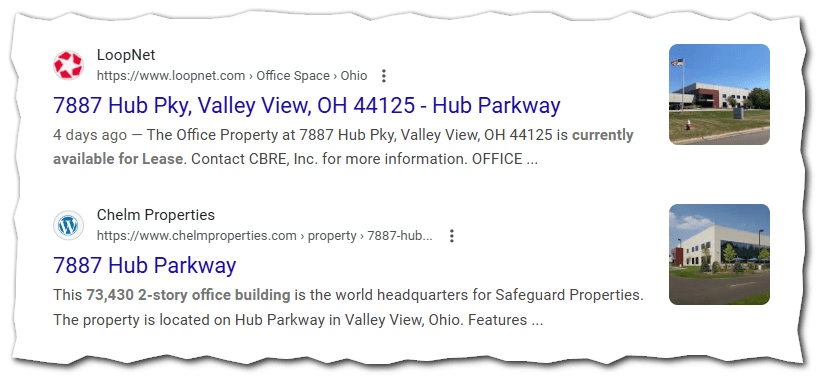
In what can only be described as a symbolic death knell for the old guard of the mortgage field services industry, the once-mighty world headquarters of Safeguard Properties is now listed for lease on LoopNet. The 7887 Hub Parkway address in Valley View, Ohio, long touted as the nucleus of national field service coordination is now marked as “permanently closed” by Google. For many, this is more than a real estate development; it is a tectonic shift. For Field Service Technicians and Inspectors alike, this signals a chilling premonition: if Safeguard Properties is folding up shop, what’s next—and will labor ever see another paycheck? It’s a question no one knows the answer to as there has been no public statement issued. If simply a cost cutting measure, that alone is troubling.

The news of the building being up for lease surfaced less than a week ago, though quiet whispers among subcontractors and former employees had already been making the rounds for months. What was once a buzzing nerve center of an empire built on managing national foreclosure contracts, coordinating property preservation work orders, and dealing with thousands of independent laborers, now stands empty. For those who still had pending invoices or unresolved chargebacks, the “for lease” listing is more than a commercial listing—it is a final insult.
The problem is I have no idea what is going on. When you close down the world headquarters of a firm it generally means game over. Thank God for Foreclosurepedia informing us, because Safeguard certainly didn’t!
Safeguard Properties has long stood as a controversial behemoth in the field services sector. While it brought structure and scale to a rapidly expanding market in the aftermath of the 2008 housing crisis, it also became synonymous with labor exploitation, late payments, and layers of bureaucratic indifference. Many Field Service Technicians—those tasked with boarding up broken windows, clearing out rotting debris, and cutting waist-high grass in abandoned homes—have come to see Safeguard not as a partner, but as a predator. With the headquarters shuttered, these workers now face an even more uncertain financial future.
Inspectors, though performing a different set of tasks like occupancy verifications and photographic condition reports, have not been immune from the slow disintegration of confidence in Safeguard’s ability to remain solvent. This event must be understood not in isolation, but as part of a broader trend that is decimating the labor force in the mortgage field services industry. The current economic climate, driven by a mixture of inflationary pressures, rising interest rates, and the waning number of foreclosures post-pandemic moratoriums, has put enormous strain on service providers. Firms like Safeguard, which once flourished under bulk FHA and FNMA contracts, now find themselves collapsing under the weight of legacy obligations and a fractured subcontractor base. Meanwhile, labor continues to absorb the shock, bearing the brunt of every financial miscalculation and managerial shortfall.
Adding to the chaos is the complete lack of regulatory oversight when it comes to these so-called “order mills.” These firms operate in the grey zone between prime vendors and the labor that actually performs the work. Field Service Technicians and Inspectors are often misclassified as independent contractors, thereby excluded from labor protections and wage laws. Safeguard Properties was among those long accused of exploiting this loophole, and its apparent exit from its headquarters without formal public disclosure raises questions about whether any labor protections—or accountability—will be applied in the aftermath. Whether it be the $1 million fine against Safeguard by the Ohio Attorney General or the litany of Better Business Bureau claims and individual litigation suits filed and pending, the reality is everyone in the orbit of Safeguard Properties are concerned.
The fear gripping the labor force now is twofold. First, that pending payments will never materialize and that there is no recourse through which to recover them. Second, that the fall of such a dominant player as Safeguard will unleash a new wave of instability across the subcontracting landscape. As companies scramble to take over orphaned contracts or reassign work orders, it is the Field Service Technicians and Inspectors who will be left holding the bag—again—tasked with finishing half-paid jobs, absorbing unpaid invoices, and navigating a network of middlemen with ever-decreasing margins.
It’s not just fear that’s permeating the industry—it’s a sense of betrayal. Many laborers entered into this work with the belief that national firms like Safeguard would provide steady work and timely compensation. For years, they tolerated late payments, unreasonable rework requests, chargebacks and shifting compliance standards. They bought into the illusion of stability offered by a recognizable brand headquartered in a sprawling commercial building. Now, that illusion is up for lease, and the laborers are left to reconcile their faith in a system that appears to have quietly abandoned them.
One needs go no further than our reporting on when a foreclosure, going through an estate sale and copious dialogue with Safeguard Properties, ended up with a contractor — Sanja Sasvari — rolling up with a moving truck and stealing everything but the kitchen sink. It wasn’t like any of the items, which had all been meticulously photographed, itemized, and pricing added to each and every item, mattered much.
The timing of this closure cannot be ignored. With inflation and tariffs still burdening fuel and material costs, and with HUD remaining as opaque and bureaucratic as ever, the Field Services industry is in a moment of existential reckoning. If the headquarters of one of the largest players in the industry can be closed with such little fanfare, what does that say about the security and future of the laborers who have kept these properties in compliance for decades? The silence is deafening, and once again, labor is left to piece together the facts from real estate listings and Google Maps updates.
For those still clinging to hope, the grim reality is this: the property at 7887 Hub Parkway now represents a relic, a tombstone of an era when centralized command centers controlled the flow of national work orders. That building once represented legitimacy and power. Its vacancy now screams obsolescence and failure. And unless the industry is fundamentally restructured to respect and compensate the labor it depends on, this will not be the last “for lease” sign we see. The next one could be in your own backyard, stapled to your own unpaid invoice, blowing in the wind.