




Foreclosurepedia has spent months documenting Minnesota’s recovery residence collapse. The zoning cliff. The certification framework. The fraud that triggered it all. Google has noticed. So has the AI Overview box that now sits above every relevant search.
The Record
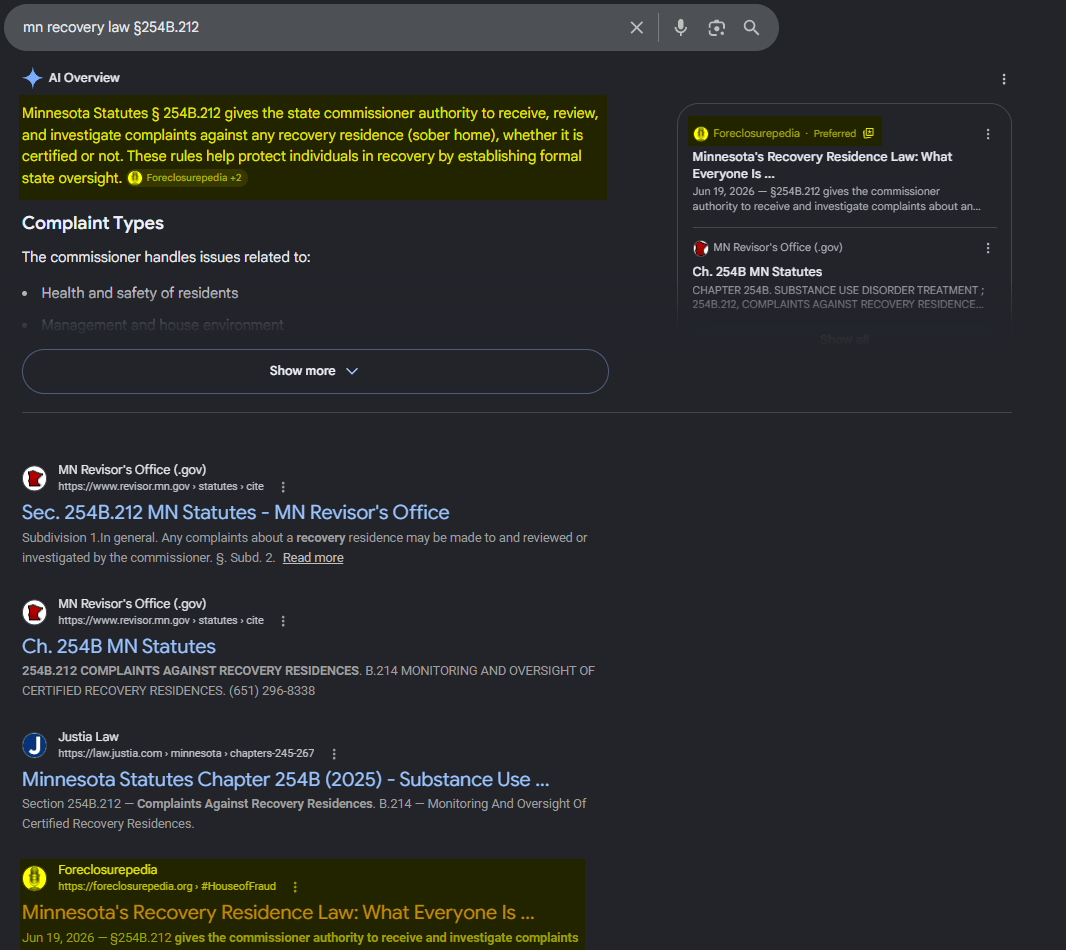
Run “MN Section 254B.211” and Foreclosurepedia sits inside Google’s AI Overview on the first query, then lands a page-one organic result two spots down. Run “MN recovery residence disaster” and the AI Overview cites Foreclosurepedia among four sources, with a page-one organic result immediately below it. Run “MN recovery residence zoning” and Foreclosurepedia’s zoning-cliff piece holds a page-one organic slot from twelve hours old. Run “MN recovery law §254B.212” and the AI Overview cites Foreclosurepedia first, with a “Preferred” badge attached in the side panel, followed by another page-one organic listing.
Four different query patterns. Four different angles on the same statute scheme. Four times Foreclosurepedia shows up where operators, attorneys, and residents are actually looking. That is not an accident. That is what happens when a publication does the reporting nobody else will do.
What Changed Since Our Last Article
The certification framework Foreclosurepedia flagged in June is no longer theoretical. Minnesota’s Level 1 and Level 2 recovery residence certification took effect July 1, 2026, six months ahead of the original schedule after the legislature moved up the date in its May supplemental budget bill. Housing Support Program eligibility for Level 2 homes started the same day.
That acceleration means the zoning collision Foreclosurepedia already reported on is happening now, not next year. Cities are processing state-credentialed care facility applications under conditional use permit rules written before certification existed, and operators who thought they had until January 2027 to sort out their footprint just lost six months of runway.
Two dates now matter more than any operator’s business plan. Free Standing Room and Board billing stops accepting new service dates after December 31, 2026, with a one-year window to submit claims for services already rendered. And starting January 1, 2027, “sober home” and “recovery residence” become legally protected terms under Minnesota law. Use either phrase without meeting the statutory definition and an operator is no longer just misleading residents. They are violating state law.
Minnesota Statutes § 254B.212 gives the commissioner authority to receive, review, and investigate complaints against any recovery residence, certified or not. That reach matters. It means the state’s oversight net does not stop at the door of homes that opted into certification. Every operator in Minnesota is now a potential subject of a state complaint file, whether they signed up for oversight or not.
The Recovery Residence Work Group keeps meeting monthly, second Monday, eleven to one. Its mandate includes recommending whether the commissioner’s certification duties should be handed to a third party. Foreclosurepedia has previously flagged the Minnesota Association of Sober Homes appearing to step back from the certification business it has run for years. If MASH is out and DHS takes over certification, every home that certified under the old regime restarts the process under a new one.
Why This Keeps Landing on Page One
Trade sites and legal-marketing blogs cover recovery residence rules in the abstract. Foreclosurepedia covers the fraud that produced the rules, the zoning offices enforcing them without state guidance, and the operators caught between a certification deadline and a five-thousand-square-foot lot minimum nobody in Minneapolis or St. Paul thought to reconcile. That is the difference between generic content and reporting. Search engines are increasingly built to tell them apart. Foreclosurepedia gives you the real deal — no fluff!
The Zoning Crisis Nobody Coordinated
Minnesota built its certification framework at the state level. Zoning stayed exactly where it has always been: with the city. Nobody bridged the two, and operators are the ones absorbing the gap.
Minneapolis classifies a State Credentialed Care Facility serving seven to sixteen residents as a conditional use in most residential districts, and conditional use in Minneapolis carries a five-thousand-square-foot minimum lot size. That threshold predates certification. It was written for a different era of group housing review, long before Level 2 certification created a state-funded incentive to run exactly this kind of facility at exactly this scale. An operator can be fully compliant with DHS certification and Housing Support Program eligibility and still get denied at the zoning counter because the lot is a few hundred square feet short.
City planners are telling operators, on the record, that they are not aware of any State Credentialed Care Facility getting a lot-area variance approved under five thousand square feet. Every comparison case Foreclosurepedia has reviewed that cleared conditional use review did so because the lot already exceeded the minimum, not because the city found a path around it. That leaves undersized properties with two options: a variance application the city itself says has little precedent for approval, or a reasonable accommodation request under the Fair Housing Act, which the state’s own certification path does nothing to guarantee and which some city staff are now arguing cannot be used to bypass a zoning variance requirement at all.
None of this shows up in DHS’s certification guidance. None of it shows up in the legislature’s supplemental budget language. It shows up when an operator who did everything DHS asked gets a letter from a city planner explaining why the lot doesn’t qualify.
The State Knew and Accelerated Anyway
This was not an unforeseeable gap. In October 2025, the Department of Human Services formed the Recovery Residence Work Group and put out a public call asking local government officials to help shape policy on exactly one subject: planning and zoning. The League of Minnesota Cities publicized the request. DHS asked cities to weigh in before certification went live.
Seven months later, in May 2026, the legislature moved certification up six months instead of slowing down to let that zoning input finish its work. The Work Group is still meeting monthly. Its final report, the one meant to reconcile state certification with municipal zoning, has not been delivered. DHS accelerated the deadline for the piece of the puzzle it controls while the piece it doesn’t control, the zoning review that determines whether a certified home can legally operate, was still an open question the state itself had flagged a year earlier.
That is not an agency caught off guard by an unintended consequence. That is an agency that identified the risk, opened a process to study it, and then set a statewide deadline that outran its own study. A department that solicits zoning input in October and green-lights an accelerated certification timeline in May, without waiting on the answer to the question it asked, did not fail to see this coming. It saw it, and moved the deadline up anyway.
Operators are the ones absorbing that decision now, one denied conditional use permit at a time. The commissioner’s office does not sit in the room when a city planner tells a Level 2-eligible operator that the lot is short. DHS collects the certification fee regardless.
What Operators Should Be Doing Right Now
Pull the zoning classification before touching the certification paperwork. DHS certification and city zoning approval are two separate, uncoordinated processes running on two separate clocks. Certification eligibility does not establish, protect, or speed up zoning approval in any way. An operator who certifies first and checks zoning second is building on a foundation that isn’t there yet.
Measure the lot, not the building. Five thousand square feet is a Minneapolis-specific figure and every city sets its own conditional use thresholds, spacing requirements, and permitted-use tables differently. Confirm the actual number for the jurisdiction in question and confirm it against the property’s recorded lot size, not an assumption based on the size of the structure.
Pull permit history before hiring an architect. A property’s official permit file frequently does not match the operator’s understanding of what work was done. Relying on an undocumented remodel or an informal inspection history invites a building-code review that starts from zero instead of building on prior approvals.
Treat reasonable accommodation as a formal filing, not a talking point. A reasonable accommodation request under the Fair Housing Act needs to state a clear necessity argument tied to program requirements, such as the staffing model Level 2 certification requires and what a smaller, downsized facility cannot financially sustain. Vague appeals to fairness do not carry the same weight as a filing that ties the accommodation to a specific, documented operational need.
Get comparison cases before filing anything. Prior conditional use approvals and prior reasonable accommodation decisions in the same city are public record. Pulling them before filing shows whether the city has a real precedent for approval, what conditions came attached to it, and whether the operator’s own case actually matches the fact pattern the city has approved before.
Do not assume certification insulates against a §254B.212 complaint. The commissioner’s complaint authority reaches every recovery residence in the state, certified or not. Certification does not function as a shield from state investigation, and treating it as one is a mistake operators are already making.
Foreclosurepedia will keep filing as the certification deadline compresses and the zoning fights spread past Minneapolis. The next six months will produce more casualties than the last twelve.