




Series Part II: In the weeks since the Glamory Effect was first brought into sharper focus, an uncomfortable stillness has settled over the mortgage field services ecosystem, specifically in the narrow corridor where the HUD Mortgagee Compliance Manager (MCM) ought to operate. It was widely expected that once HUD had been made aware of the failures and omissions that RE-Global has been presiding over, some measurable course correction would occur. Instead, the prevailing sentiment among Prime Vendors, Field Service Technicians performing the actual preservation labor, and Inspectors conducting occupancy and condition assessments is that nothing at all has changed. They report no increase in work orders, no transparency from the Prime by way of bids which have languished for weeks on end in Yardi, HUD’s internal data system, and no meaningful policy communication that could be interpreted as a roadmap to recovery. A quote that has begun circulating in the contractor base, “Little movement and RE called [off] their weekly calls for the foreseeable future,” captures the sense of futility that is beginning to metastasize across vendors. The HUD mission has never been to warehouse assets in an indefinite limbo, and yet that is exactly what the current silence and deferral appears to be accomplishing. For many who have survived this industry long enough to remember the NFN collapse and the MCS transactional shuffle, the emerging pattern feels both familiar and unsustainable.
The NIH National Library of Medicine, at the National Center for Biotechnology Information describes what appears to be the problem, vis-à-vis RE-Global’s CEO Tanesha Gamory and HUD Secretary Scott Turner, as follows,
Shared psychotic disorder (folie à deux) is a rare disorder characterized by sharing a specific delusion among two or more people in a close relationship. The inducer (primary) who has a psychotic disorder with delusions influences another individual or more (induced, secondary) based on a delusional belief. It is commonly seen among two individuals, but in rare cases, can include larger groups. This activity outlines the presentation and management of shared psychotic disorder and highlights the role of the interprofessional team in improving the care of patients with this condition.
The contradiction is particularly glaring when viewed against the White House rhetoric of the present Trump administration and the stated intent of HUD Secretary Scott Turner, both of whom have underscored repeatedly that housing assets must be made available and marketable. President Trump has explicitly tied the national inventory shortage to governmental inefficiencies and has demanded that agencies eliminate chokepoints preventing properties from returning to the market. Turner, following a similar thread, has emphasized aligning HUD’s contracting apparatus with the broader economic objective of freeing up housing units. Yet the MCM contract, designed specifically to ensure that assets do not languish, has drifted into dormancy under RE-Global’s management. Rather than facilitating conveyance, inspection, and preservation sequences, the contract’s execution has constricted volumes so severely that even qualified Field Service Technicians and properly credentialed Inspectors have little to do. The professional layers that make the system function are idle, not due to lack of national housing demand, but due to the prime contractor’s unwillingness or inability to implement the mechanisms HUD has already paid for.
HUD was quite clear in what it expected when RE-Global was awarded the Mortgagee Compliance Manager 4.0 (MCM) services in support of HUD’s Single Family Real Estate-Owned (REO) property inventory. Their predecessor, ISN, had maintained the MCM Award for years, without incident. In fact, HUD spelled it out quite clearly here,
The Contractor shall be responsible for pre-conveyance and post-conveyance activities associated with claims, acquisition, and disposition of FHA Single Family insured assets (Conveyed Properties, Claims Without Conveyance Title (CWCOT) and Home Equity Conversion Mortgage (HECM)). HUD has identified primary objectives for the Mortgagee Compliance Manager (MCM) Contractor. The MCM will be responsible for the pre-conveyance and post-conveyance reviews associated with REO assets. These responsibilities include reviewing property inspection reports to ensure the property is being conveyed to HUD in “conveyance condition”, verifying that marketable title is conveyed to HUD, resolving conveyance exceptions, providing guidance to Mortgagees related to pre-conveyance and post-conveyance responsibilities, and leveraging HUD’s REO system of record and other systems to execute and complete the tasks within the contract. Additionally, the MCM will provide HUD with real-time access to all pertinent documents, reports, and information relative to Mortgagee Compliance.
Low volumes were once explained away as a temporary intake bottleneck pending systems integration, but that narrative has worn thin as the calendar continues to advance. Each passing week of suppressed activity represents tax-payer funded assets deteriorating unnecessarily, while preservation specialists with decades of institutional knowledge sit on the sidelines. The MCM framework was structured precisely so that the awardee would alleviate lag between foreclosure, custody, and conveyance. Instead, RE-Global has engineered an environment in which the very purpose of the contract has been inverted. In the older HUD M&M eras, asset managers were routinely pressured to move inventory along or risk deobligation. 24 CFR §574.540 is quite specific in how HUD should be addressing their cozy relationship with Gamory, but alas it would appear that DEI reigns supreme in the same manner as Minnesotta. Here, Prime Vendors and Field Service Technicians alike report no such urgency, no benchmarks, and no consequence. The gulf between policy and execution is not the result of market volatility, but rather a product of operational neglect.
What must not be forgotten is that Field Service Technicians and Inspectors are not fungible bodies in a supply chain, but licensed, registered, and competitively trained individuals whose compliance obligations are significant. Technicians conducting debris removal, board-ups, grass cuts, winterizations, and re-key operations face occupational hazards, insurance mandates, and regulatory overhead that are neither trivial nor optional. Inspectors performing occupancy checks, loss mitigation assessments, and condition reports are held to factual accuracy standards that have real legal consequences when misreported. Both groups understand that volumes ebb and flow due to seasonal foreclosure patterns, but they also understand what contractual sabotage looks like. Many of them have expressed that RE-Global’s refusal to perform has now crossed from incompetence into breach-adjacent territory, particularly because the refusal is occurring after HUD has already been alerted. If the MCM prime cannot operate, the lawful outcome is re-competition or reassignment, not indefinite hibernation disguised as administrative prudence.
Trump SBA administrator Kelly Loeffler has reduced the goal to the law’s actual standard of 5 percent. Her administration has also demanded financial records from 8(a) businesses to weed out fraud. One would wonder if perhaps SBA ought to take a deeper dive into RE-Global? Gamory is truly pushing the envelope claiming both a current status as a African American and now petitioning for Native American Status. Their DEI credential page reads like a Who’s Who of minority benefits.

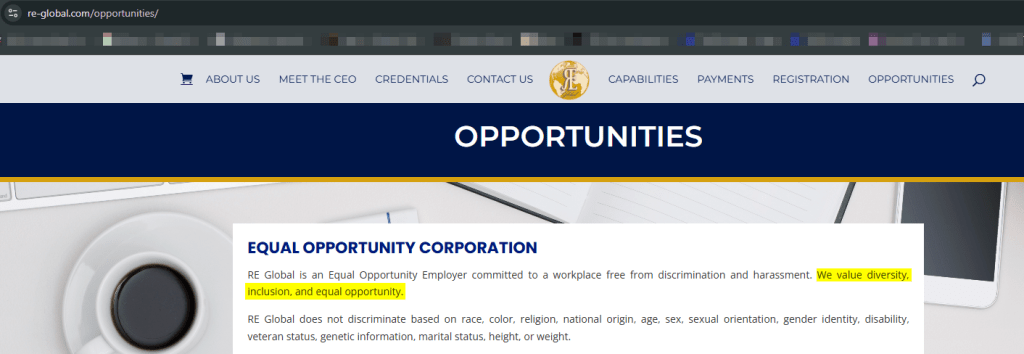
The political context deepens the controversy. President Trump has issued Executive Orders targeting diversity, equity, and inclusion (DEI) programs in federal contracting, instructing agencies to remove related criteria from award determinations and to ensure compliance among government vendors. Against that backdrop, RE-Global’s own corporate website openly touts its DEI participation and “equal opportunity” framing, as evidenced by recent captures of its Opportunities page. While there is nothing inherently wrong with companies promoting inclusive messaging in the private market, federal contracting is not private procurement. Executive policy now treats DEI criteria as disqualifying, or at minimum conflicting with federal acquisition directives. That means that RE-Global’s public embrace of DEI is not merely a branding choice, but a possible basis for immediate disbarment or suspension if the contracting authority interprets the Executive Orders strictly. If HUD is serious about contract integrity and political compliance, then a vendor advertising a now-prohibited policy position should not still be holding a mission-critical contract, particularly one already failing objectively measurable performance standards.
The optics worsen when viewed through the lens of leadership prioritization. Industry stakeholders note that Tanesha Gamory, RE-Global’s CEO, appears far more attentive to a separate daycare operation in Tucker, Georgia than to the HUD MCM contract. The tension here is not that executives cannot own multiple ventures, but rather that the daycare appears to be the more actively managed and publicly promoted enterprise. Contractors who once attempted to escalate performance concerns report that their queries were redirected, deferred, or ignored outright, fueling the perception that the HUD contract is not being treated as the primary fiduciary responsibility. Even more unsettling is that this leadership diversion is unfolding during an ongoing federal crackdown on daycare fraud across multiple states, wherein billing irregularities, subsidy misuse, and credential falsification have triggered investigative sweeps. No one is asserting that Gamory’s daycare is implicated in those matters, but the coincidence is not invisible to those familiar with how federal investigative lanes open. When a federal program fails operationally on one contract vehicle and the same principal operates in an industry currently under federal scrutiny, regulatory curiosity tends to follow the smoke.
From the perspective of Labor, the hostility of the present arrangement is not ideological but material. Field Service Technicians and Inspectors are transactionally compensated, meaning when the MCM does not issue work, they do not get paid. They must continue carrying their commercial auto policies, general liability coverage, worker compensation obligations in applicable states, and specialized tool inventories whether volumes are present or not. These hard costs do not evaporate because a politically connected prime contractor decides to postpone performance indefinitely. If HUD and the White House intend to place American labor at the center of economic revitalization, then the suppression of work orders in a federal contract zone is not merely contradictory, but destructive. Vendor attrition is already occurring, with skilled preservation specialists leaving the sector entirely, further weakening HUD’s ability to execute future programs without rebuilding a labor base from scratch.
Definitely no hope on the horizon from HUD or RE-Global. Here is a quote today pertaining to the complete collapse of communications from RE-Global to both financial institutions and the Prime Vendors,
Those calls were for bank and contractors like us to find out the status or movement of their process. Last week they (RE-Global) just cancelled and said they will be back in touch about their process and status of delayed bids.
Meanwhile, asset deterioration is not hypothetical. Properties in custody are not museum pieces, but living structures subject to weather, vandalism, theft, mold, and unmitigated vacancy stress. Winterizations left undone become plumbing failures, which become insurance claims, which become increased carrying costs for taxpayers. Grass and landscape neglect attracts municipal code enforcement, which introduces liens and civil penalties, which further depress marketability. These cascading failures are the exact phenomenon that the MCM architecture was designed to prevent. Yet the inertia remains undisturbed, as if the federal government has decided that the preservation of housing assets is optional so long as the paperwork reports a different story. Vendors insist that the story HUD is being shown bears no resemblance to conditions on the ground, where occupancy checks go unassigned and preservation windows close.
What makes the silence more galling is that HUD had a chance to intervene early. Once informed of the failures weeks ago, the expectation was that HUD would invoke contractual remedies, compel corrective action, or place RE-Global on performance notice. Instead, there has been no visible enforcement, no remedial plan, and no communications to the labor base that relies upon the program for continuity. For a program explicitly justified as a tool to accelerate asset readiness, such bureaucratic passivity effectively repudiates its own founding rationale. HUD may be reluctant to acknowledge that the MCM contract has failed so soon after award, but denial does not preserve properties, nor does it generate conveyances. It only shields the prime contractor while punishing the very workers who make the system operational.
In conversations with preservation veterans, the comparison often raised is that the M&M 3.8 and 3.9 eras, despite their dysfunctions, at least generated volume and revenue for the labor tier. Those contracts suffered from systemic pricing compression, predatory chargebacks, and unreasonable compliance demands, but they moved assets through the pipeline. The current MCM construct has in contrast preserved the worst aspects of the old regime, such as opaque management and vendor intimidation, while eliminating the one redeeming feature, which was transactional throughput. No Field Service Technician or Inspector wants to return to the days of negative margin work orders, but idling them completely is not reform, it is liquidation of the labor ecosystem.
If HUD does not intervene soon, the market will. Every month that properties sit unmanaged, asset quality declines and disposition values suffer, weakening HUD’s balance sheet and impairing the political narrative around housing availability. This is not a theoretical concern. National housing inventory remains historically low, rental prices remain structurally inflated, and foreclosure pipelines are beginning to reintroduce volume across multiple judicial states. A functional MCM would be accelerating assets into disposition to relieve pressure. Instead, RE-Global’s stewardship has bottlenecked the very relief mechanism the White House claims to prioritize. That contradiction is not sustainable, particularly in an election cycle where policy optics matter more than bureaucratic courtesy.
At the end of the day, the question is not merely whether RE-Global can fulfill its contractual obligations, but whether HUD has the institutional will to enforce performance. The MCM award was never meant to be a ceremonial credential for its holder, but a workhorse tool for national housing stability. If the contractor will not perform, then HUD must replace it, disbar it, or restructure it. If the contractor’s leadership is preoccupied with external ventures, then the government must decide whether that arrangement is compatible with federal fiduciary duty. And if political directives from the White House conflict with the public branding of the prime contractor, then compliance mechanisms already exist for resolving that tension. The labor tier has endured collapses, bankruptcies, predatory order mills, and hostile pricing for over a decade. What it cannot endure is policy indifference masquerading as reform.