




Foreclosurepedia Staff Report
April 12, 2026 | FHA Default Services / Florida Market Analysis
Between $1.6 and $2.1 billion dollars worth of work is being performed annually in the FHA default pipeline by people receiving $7 to $9 per occupancy check and $25 to $30 per grass cut. The nationals — NAMFS members — directing that work are retaining the majority of every dollar billed. The workers supplying the labor that generates the entire pipeline see a fraction of it, bear all the operational costs, and have no seat at the table where the fee structures are set. That is not a labor dispute. That is a $1.6 to $2.1 billion annual transfer of value away from the people who create it, operating inside a federally regulated mortgage program whose purpose is to expand homeownership access to lower-income Americans, serviced by workers who frequently live in the same economic bracket as the borrowers whose defaulted properties they are maintaining. When the MBA Q1 2026 numbers land in mid-May and the FHA delinquency rate ticks above 11.52 percent, which the ICE data strongly suggests it will, every one of those figures moves higher. That is the article to have ready to publish the day the survey drops.
The Altisource formula originates from the August 6, 2020 earnings call of Altisource Portfolio Solutions, a publicly traded integrated real estate and mortgage services company, during which management stated that for every one percent increase in the national mortgage delinquency rate, the addressable market for default-related services increases by approximately $700 million. That figure was derived against a mortgage market carrying roughly $10.6 trillion in outstanding residential loan balances at the time, and it represented Altisource’s estimated capturable slice of the default services ecosystem based on their specific service lines and client relationships, which internal analysis and SEC filing cross-referencing suggests represented approximately 12 to 15 percent of the total industry.
Foreclosurepedia has adjusted that baseline figure forward to 2026 dollars using two factors: the growth of the total U.S. mortgage market from $10.6 trillion in mid-2020 to $13.17 trillion as of Q4 2025, a 24 percent expansion, and the cumulative consumer price inflation of approximately 27 percent recorded between August 2020 and early 2026 per Bureau of Labor Statistics data, producing an inflation- and market-size-adjusted per-point value of approximately $1.05 billion in 2026 dollars.
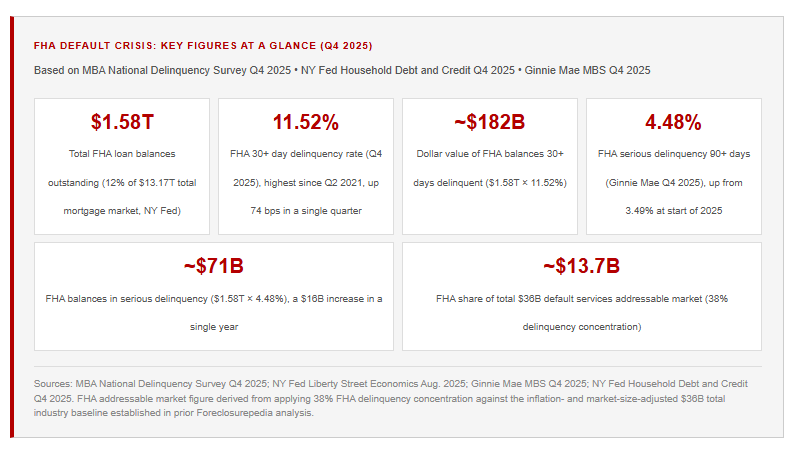
Applying that adjusted per-point value across the current national delinquency rate of 4.26 percent produces a total industry addressable default services market of approximately $32 to $40 billion annually, and scaling it specifically to the FHA portfolio using the New York Federal Reserve’s confirmed finding that FHA loans represent 38 percent of all 30-plus day delinquent balances despite constituting only 12 percent of total outstanding mortgage debt produces an FHA-weighted per-point value of approximately $399 million, which when applied to the current FHA delinquency rate of 11.52 percent yields a total FHA default services ecosystem value of approximately $4.6 billion, of which the Field Service Technician and Inspector share representing hands-on preservation and inspection labor is estimated at $1.6 to $2.1 billion annually.
The number the mortgage default services industry does not want to discuss is $13.7 billion, and the reason is not that the number is wrong but that it is correct. That figure represents the estimated share of the total default services addressable market attributable to FHA loans at current delinquency levels, derived from a 30-plus day delinquency rate that the Mortgage Bankers Association confirmed hit 11.52 percent on the FHA loan portfolio in the fourth quarter of 2025, the highest reading since the second quarter of 2021 and exactly 6.5 times the conventional loan delinquency rate of 1.78 percent. FHA loans represent approximately 12 percent of the $13.17 trillion in total outstanding U.S. mortgage debt, which translates to a $1.58 trillion portfolio, and with 11.52 percent of that portfolio now sitting in 30-plus day delinquency, the dollar volume of distressed FHA balances has reached approximately $182 billion.
The Ginnie Mae mortgage-backed securities data for Q4 2025 shows that the FHA serious delinquency rate, loans 90 or more days past due, has climbed to 4.48 percent, up sharply from 3.49 percent at the start of 2025, meaning roughly $16 billion in additional FHA loan balances fell into serious delinquency over a single calendar year. Every dollar of that serious delinquency represents a property that an Inspector has already visited to verify occupancy and document condition, and that a Field Service Technician is either currently maintaining or preparing for conveyance to HUD under federal timelines the servicer cannot miss without financial penalty. The executives managing the FHA servicing books at the national field services firms understand precisely what these numbers mean for their revenue pipelines. The Inspectors receiving $7 to $9 per occupancy check and the Field Service Technicians cutting grass for $25 to $30 a property do not, because nobody in this industry has ever considered it a priority to tell them.
Florida: The Canary in the Coal Mine
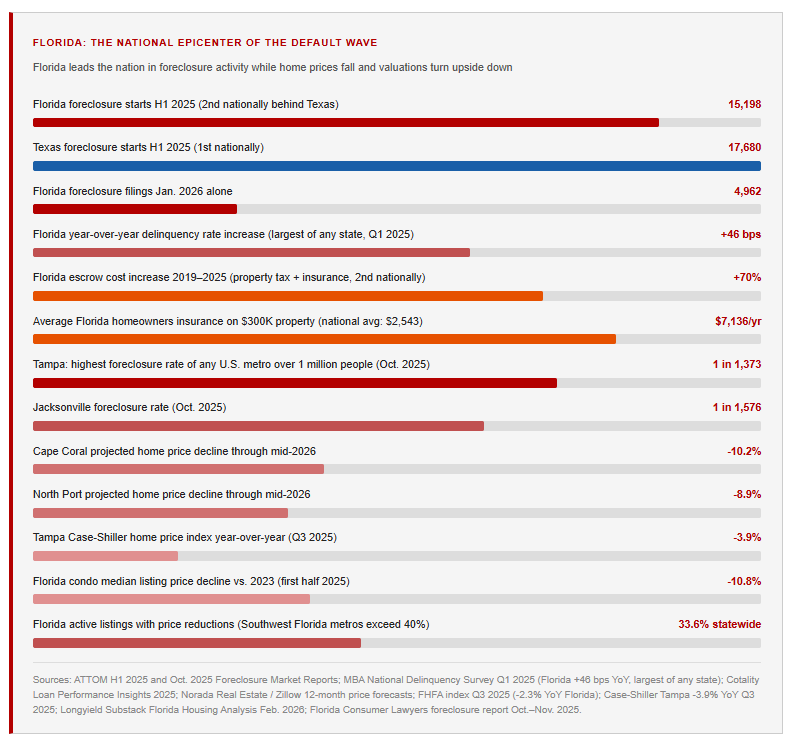
Florida is not simply a state with elevated default activity. It is the most complete and concentrated laboratory for every structural failure that the national mortgage default services industry has spent two decades pretending does not exist, and the convergence happening there right now has no recent precedent in a single state housing market outside of the post-2008 crisis. Florida ranked second in the nation for foreclosure starts in the first half of 2025 with 15,198 filings, trailed only by Texas, and by October 2025 had claimed the top national foreclosure rate with approximately 1 in every 1,829 homes receiving a foreclosure filing. Tampa carried the highest foreclosure rate of any U.S. metropolitan area with more than one million people, approximately 1 in every 1,373 homes, with Jacksonville and Orlando close behind. The MBA confirmed in Q1 2025 that Florida posted the largest year-over-year increase in overall delinquency rate of any state in the country, up 46 basis points, and the serious delinquency data from metros including Tampa, Lakeland, and Cape Coral is accelerating, not stabilizing.
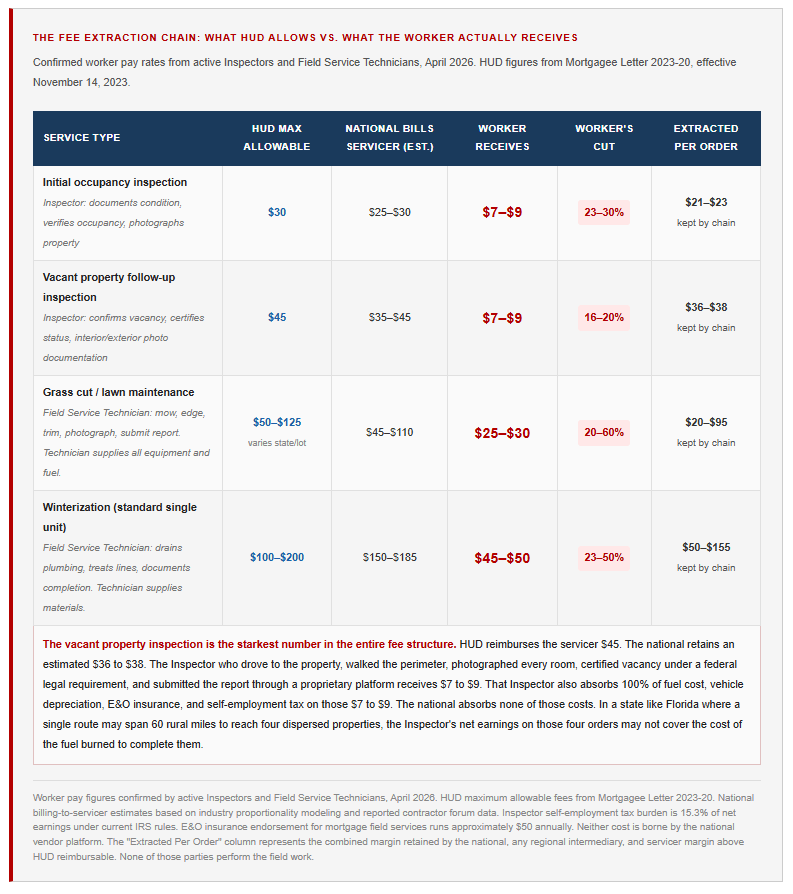
HUD sets the maximum allowable vacant inspection fee at $45. The Inspector who drove to the property, certified the vacancy under federal legal requirement, and filed the report through a proprietary platform receives $7 to $9. In Tampa, Jacksonville, and Cape Coral, that Inspector is navigating one of the highest foreclosure density environments in the country and absorbing fuel costs in a state where insurance alone costs nearly three times the national average. The national retains $36 to $38 on that same order. No fee schedule in any HUD mortgagee letter since 2015 has addressed this gap.
What makes Florida categorically different from a normal default cycle, and what makes its current trajectory so dangerous for the Field Service Technicians and Inspectors working its defaulted properties, is the simultaneous collapse of home values that is turning a growing percentage of those distressed properties upside down before they ever reach foreclosure sale. Cape Coral is projected to see a 10.2 percent home price decline through mid-2026, North Port 8.9 percent, and Tampa 3.6 percent, with the Case-Shiller Tampa index already showing a 3.9 percent year-over-year decline as of Q3 2025. The Florida statewide median home value has fallen approximately 5 percent over the past year, and in the condo market, where the structural pressure from Florida’s SB 4-D safety law is forcing owners to list regardless of their equity position, median listing prices were down 10.8 percent compared to 2023 levels in the first half of 2025. When a delinquent FHA borrower in Cape Coral owes more on their mortgage than the home is worth, the servicer’s loss mitigation options collapse, the likelihood of conveyance to HUD increases dramatically, and the volume of mandatory inspection and preservation work generated by that single loan expands substantially, because the property will stay in the pipeline longer and require more touchpoints before it can be disposed of at a price that satisfies any party in the transaction.
The mechanics of the fee extraction are made worse in Florida than almost anywhere else in the country by a combination of factors that the nationals have never had to account for in their pricing to contractors because they have never been required to. Florida’s property insurance crisis has driven average annual premiums to $7,136 for a $300,000 property against a national average of $2,543, and total escrow costs in Florida have risen 70 percent between 2019 and 2025, a figure second only to Colorado nationally. Those cost increases hit FHA borrowers first and hardest because FHA loans by design serve households with thin financial margins, and when the escrow payment on a mortgage originated in 2022 increases by several hundred dollars annually because insurance premiums spiked after consecutive hurricanes, the borrower who was already stretching to meet the payment has nowhere to absorb it.
The result is the delinquency acceleration that the MBA confirmed, and the result of that delinquency acceleration is a mandatory inspection and preservation pipeline being routed through national vendor networks to Inspectors and Field Service Technicians in Florida who are themselves subject to the same insurance cost increases, the same fuel prices, and the same inflationary environment as every other resident of the state. An Inspector covering a Tampa metro zone may be routed to properties in Hillsborough, Pinellas, and Pasco counties on the same day, driving across territory where the traffic infrastructure was not designed for the current population density and where the properties themselves increasingly sit in neighborhoods experiencing simultaneous value declines and delinquency increases that make the work more complex, more time-consuming, and more physically demanding than a standard suburban route. That Inspector receives $7 to $9 per completed occupancy check. The national vendor retains an estimated $21 to $38 on the same order depending on the service type. The national does not drive those roads, submit those certifications, or absorb any of the operational costs that make the work possible. What is happening in Florida is not a regional anomaly in an otherwise stable national picture. It is the sharpest expression of a structural dynamic that exists in every market where FHA defaults are rising, and it is accelerating.
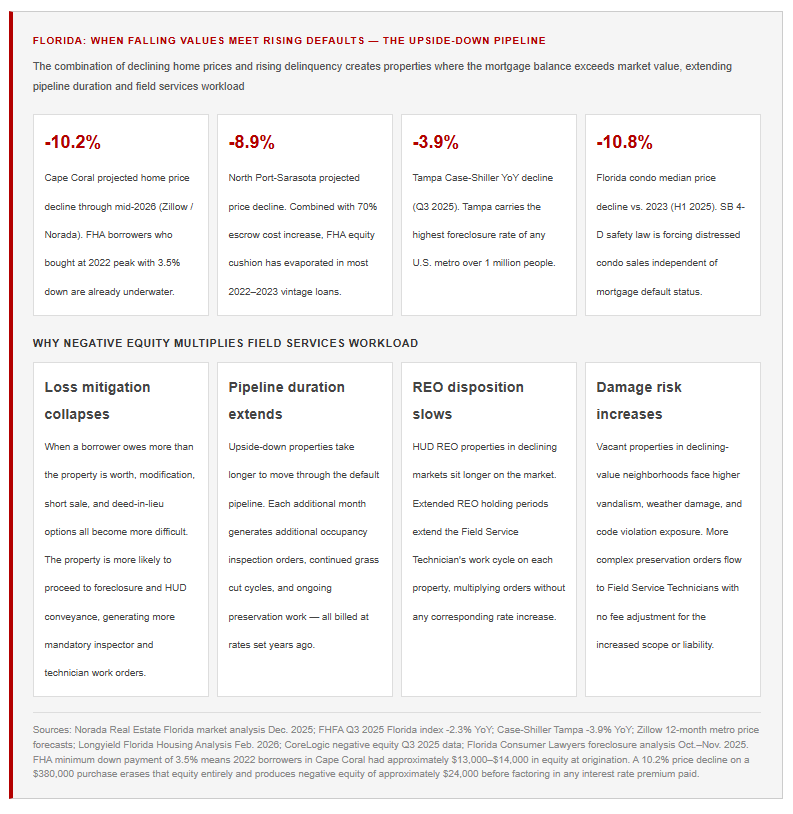
The negative equity dynamic unfolding in Southwest Florida, the Tampa metro, and the broader Gulf Coast corridor is not a theoretical risk being modeled by economists. It is a present operational reality that is already showing up in the behavior of defaulted loans and the volume and complexity of preservation work orders being generated in those markets. An FHA borrower who purchased a Cape Coral home at the 2022 peak with the FHA minimum 3.5 percent down payment had approximately $13,000 to $14,000 in equity at origination. A 10.2 percent price decline on that same property erases that equity entirely and produces negative equity of approximately $24,000 before accounting for any interest rate premium or insurance cost escalation that has been capitalized into the loan over the intervening months. That borrower cannot execute a short sale without servicer negotiation and HUD approval. That borrower cannot do a deed-in-lieu without HUD sign-off. That borrower almost certainly cannot reinstate because the same affordability forces that drove the delinquency have not resolved. The loan proceeds to foreclosure, and from the moment of first delinquency, every month that property sits in the pipeline generates mandatory work orders under HUD Handbook 4000.1 that flow to Inspectors and Field Service Technicians through the national vendor networks. The Inspector photographs the condition every 30 days.
The Field Service Technician cuts the grass on whatever cycle the national mandates. When the property goes vacant, which it will, the Field Service Technician secures it, winterizes it if necessary, boards any compromised openings, removes debris, and continues maintaining it through foreclosure sale and into conveyance condition. All of that work is performed by someone receiving the rates documented in the chart above. The national directing that work, collecting the servicer billing, and retaining the margin does not set foot on the property. Florida’s combination of the highest state foreclosure rate in the nation, the second-largest escrow cost increase of any state, the steepest metro-level home price declines on the Gulf Coast, and a growing FHA delinquency rate that the MBA confirmed was rising faster year-over-year than any other state as of Q1 2025 means that the fee extraction documented in this article is operating at maximum volume in minimum-pay conditions, in a state where both the borrowers losing their homes and the workers maintaining those homes are being crushed by the same underlying economic forces while the entities in the middle collect the margin.
The consolidation now reshaping the national field services market arrives at the worst possible moment for Inspectors and Field Service Technicians working the Florida pipeline specifically. MCS, which built specialized FHA conveyance compliance infrastructure over nearly four decades including its Convey360 tracking platform and a documented 95 percent or higher on-time FHA conveyance rate, completed the sale of its mortgage services business in December 2025. The displaced FHA portfolio volume that was flowing through MCS is being redistributed among the remaining nationals at precisely the moment when Florida’s foreclosure pipeline is accelerating most rapidly. Safeguard Properties, ServiceLink, Cyprexx, National Field Representatives, and the regional players absorbing that volume will route it through inspector panels and preservation contractor networks in Florida where the rates have not changed to reflect an insurance environment where homeowners pay an average of $7,136 annually, a fuel environment that has not improved meaningfully, or a market environment where the properties themselves are declining in value faster than any comparable period since 2011.
The Field Service Technician in Hillsborough County who receives a grass cut assignment on a vacant FHA property being actively maintained for HUD conveyance is working in what ATTOM confirmed is the highest foreclosure rate metro in the United States among large cities, for $25 to $30 per completed order, using equipment they own, burning fuel they purchased, carrying insurance they pay for, and filing reports through a platform they had no say in choosing. The $13.7 billion addressable market that the FHA default crisis has generated does not flow to that person. It flows upward through every layer of the extraction chain that has been deliberately constructed above them, and Florida is simply where the consequences of that construction are most visible, most documented, and most immediate in 2026.