



Senator Joe Manchin — Coal Mine Joe — certainly has a sense of irony that rings almost as hollow as the National Association of Mortgage Field Services (NAMFS) Executive Director Eric Miller’s $10K a year pay raises while refusing a single one to Labor for nearly 30 years. Manchin has been circling the wagons in his peek-a-boo game of centrist arguing that the Advanced Child Tax Credit which nearly 36 million people have received during COVID is a benefit and not to be compared to the tens of trillions of dollars given away at a quarter of a percent — that is not a typo — interest to his cronies. We will break all this down in a moment, but first, we wanted to talk about Coal Mine Joe’s biggest pork barrel score for his family.
Gayle Conelly Manchin is the federal co-chairwoman of the Appalachian Regional Commission, an economic development partnership between the federal government and 13 Appalachian states — and the $167,000 a year doesn’t hurt too much, either! Manchin’s wife was just appointed to the position with potentially a $1 Billion budget in further pork barrel issuance coming down the pike.
Coal Mine Joe likes to throw stones in a glass house. If you are going to change the world, begin by cleaning up your own home. The American Rescue Plan Act of 2021 temporarily expands the child tax credit for 2021. First, it allows 17-year-old children to qualify for the credit. Second, it increases the credit to $3,000 per child ($3,600 per child under age 6) for many families. Third, it makes the credit fully refundable and removes the $2,500 earnings floor. Fourth, it requires half of the credit to be paid in advance by having the IRS send monthly payments to families from July 2021 to December 2021.
So, let’s get down to brass tacks. The child tax credit (CTC) has been around since 1997. Historically, the federal child tax credit has had bipartisan support. According to the Congressional Research Service (used by Congress for legislative background), “It was established as a part of the 1997 Taxpayer Relief Act. When the child tax credit was initially enacted in 1997, it was a relatively modest nonrefundable tax credit for middle-income families with children. Through successive legislative changes, eligibility for the credit has expanded to both lower- and higher-income families, while the amount of the credit has also generally increased for recipients.” The amount of and access to the CTC was increased under Presidents Bush, Obama, Trump — yes Trump — and again under Biden. Interestingly, the CTC, originally issued under President Clinton in 1997, was only for middle and upper-middle income families. Under President Bush, “The first significant change to the child tax credit occurred with the enactment of the Economic Growth and Tax Relief Reconciliation Act of 2001 (EGTRRA; P.L. 107-16). EGTRRA increased the amount of the credit over time to $1,000 per child. The law also made the credit available to low-income taxpayers with more than $10,000 of earned income. Specifically, lower-income taxpayers with more than $10,000 of earned income — who generally have little to no income tax liability — could receive part or all of the child tax credit as the refundable additional child tax credit or ACTC.”
In March 2021, Congress enacted the American Rescue Plan Act of 2021 or ARPA (P.L. 117-2), which made additional temporary changes to the child credit in effect for 2021. These changes include making the credit fully refundable so that the lowest-income taxpayers are eligible to receive the maximum credit amount, increasing the maximum credit (with a larger credit for younger children), expanding eligibility to include 17-year-old children, and issuing up to 50% of the 2021 credit in advance payments before 2021 tax returns are filed.
So, what we do know is that the CTC has been a part of the law over 13 years before Coal Mine Joe decided to show up and collect his checks as a Senator. Coal Mine Joe’s problems with at least the CTC appear to be his fear that poor people are going to spend the money on drugs and go hunting. I bullshit you not. Here is how NBC News put it,
Sen. Joe Manchin, D-W.Va., had privately raised concerns in recent months that parents would use their child tax credit payments — a key part of the Build Back Better legislation — to buy drugs, three sources familiar with the comments said.
Manchin also raised private concerns with congressional colleagues that Americans, specifically West Virginians, would abuse paid leave time and use it to go hunting during deer season, two sources familiar with his comments said.
And while I would normally chock that up to piss poor rhetoric coming from a privileged white boy, the reality is that to understand how that statement is the pot calling the kettle black, we need to take an honest look at how Coal Mine Joe has presided over Big Pharma — Sen. Joe Manchin’s (D-W.V.)’s daughter worked with Pfizer Inc. in 2016 to monopolize and raise the price of the EpiPen while the company gave generous campaign donations to Manchin — as well as apparently believing that is was not “unreasonable” for three of America’s biggest corporations — the drug wholesalers AmerisourceBergen, Cardinal Health and McKesson — to ship roughly 81 million highly addictive opioid pills to pharmacies in one small Rust Belt city on the Ohio River located in WV. In fact, nothing tells the story better about Coal Mine Joe than his request to use Opiod Settlement monies for his own helicopter,
As West Virginia governor in 2007, now-Senator Joe Manchin wanted to use $3 million of a $44 million settlement from Purdue Pharma, maker of the prescription painkiller OxyContin, to purchase a “governor’s helicopter.” The request was marked as a “red flag” by West Virginia’s Division of Criminal Justice Services, according to memos recently obtained by the Washington Free Beacon.
Coal Mine Joe aside, let’s take a look under the tent and see precisely how much money has been given in the form of corporate welfare during the COVID pandemic. There are a handful of provisions within the Federal Reserve which allow for a nearly unending zero percent interest flow of money and the purchasing of toxic assets which Corporate America makes unwise investments in. It is a veritable casino overseen by the very financial institutions whom erased $11 trillion of Americans’ net worth during the 2008 Financial Crisis. That Crisis was the worst since The Great Depression. And today not much has changed. To understand the mind boggling amount of money the Fed has funneled to Big Business, one first needs to understand the timelines — several months BEFORE the pandemic hit — and the timeline of the pandemic itself.
In the last quarter of 2019 — before there was any news of COVID-19 in the U.S., and months before the World Health Organization declared COVID-19 a pandemic — the Fed pumped $4.5 trillion in cumulative repo loans to unnamed trading houses on Wall Street — its so-called “primary dealers.” [N]ow having the precise tally of the $11.23 trillion in cumulative repo loans the Fed made from September 17, 2019 through July 2, 2020, it now appears that the bulk of the emergency repo loans were a stand-in operation until the Fed could roll out its full ensemble of emergency lending programs, which it carefully characterized as “in response to COVID-19.”
Now, many have questioned why, precisely, financial institutions needed such a tremendous amount of capital pre-COVID. And to this day, no answer has ever been given. Today, if you are a corporation, bank, securities firms or money market mutual fund, you are able of drawing billions of dollars for .25% interest — that is not a typo. If you are a hard working American, though, your average credit card interest — remember, the money you are paying back was borrowed for .25% — is probably around 18%. And if you need a bump of liquidity, let’s say as an overnight loan before payday, the number is probably around 24.99%. You see, the same corporation, bank, securities firms or money market mutual funds whom place their representatives on the Board of the Fed. Here is how the St Louis Fed puts it,
While the Board of Governors is an independent government agency, the Federal Reserve Banks are set up like private corporations. Member banks hold stock in the Federal Reserve Banks and earn dividends. Holding this stock does not carry with it the control and financial interest given to holders of common stock in for-profit organizations. The stock may not be sold or pledged as collateral for loans. Member banks also elect six of the nine members of each Bank’s board of directors.
One of the vehicles to get the trillions of dollars out — at .25% interest — is the Discount Window. The discount window is a central bank lending facility meant to help commercial banks manage short-term liquidity needs. Banks that are unable to borrow from other banks in the fed funds market may borrow directly from the central bank’s discount window paying the federal discount rate — currently set at .25% interest. So, even if you cannot borrow from the regular market where the American public are required to, you can still go direct to the Fed. And why would you borrow at a high percentage rate when you did not have to?! The three rates are defined as the primary credit rate, secondary credit rate, and seasonal discount rate.
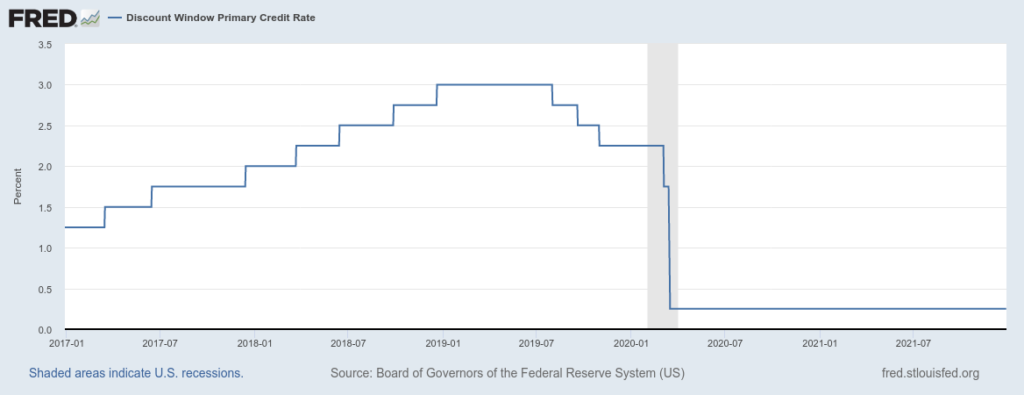
Secondary credit is given to banks that are in financial trouble and are experiencing severe liquidity problems. The central bank’s interest rate on secondary credit is set at 50 basis points (0.5 percentage points) above the discount rate. The interest rate on these loans is set at a higher penalty rate to reflect the less-sound condition of these borrowers. So, if you are a hardworking American with liquidity problems you get nothing from Coal Mine Joe or your government, but if you are a bank in financial trouble and are experiencing severe liquidity problems you get to borrow all the cash you want at roughly three quarters of a percent.
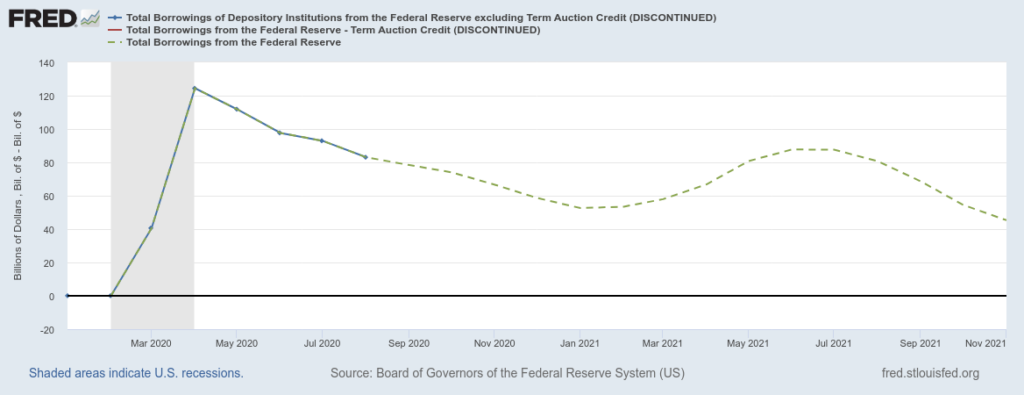
Trillions of dollars have moved to and fro between the Fed and those players cleared by the Fed in a rigged casino inside of which hardworking Americans are not allowed access. It gets better, though. The repurchase agreement, or “repo,” market is an obscure but important part of the financial system that has drawn increasing attention lately. On average, $2 trillion to $4 trillion in repurchase agreements – collateralized short-term loans – are traded each day. A repurchase agreement (repo) is a short-term secured loan: one party sells securities to another and agrees to repurchase those securities later at a higher price. The securities serve as collateral. The difference between the securities’ initial price and their repurchase price is the interest paid on the loan, known as the repo rate. NASDAQ has a pretty good article summing up this side of the casino’s house,
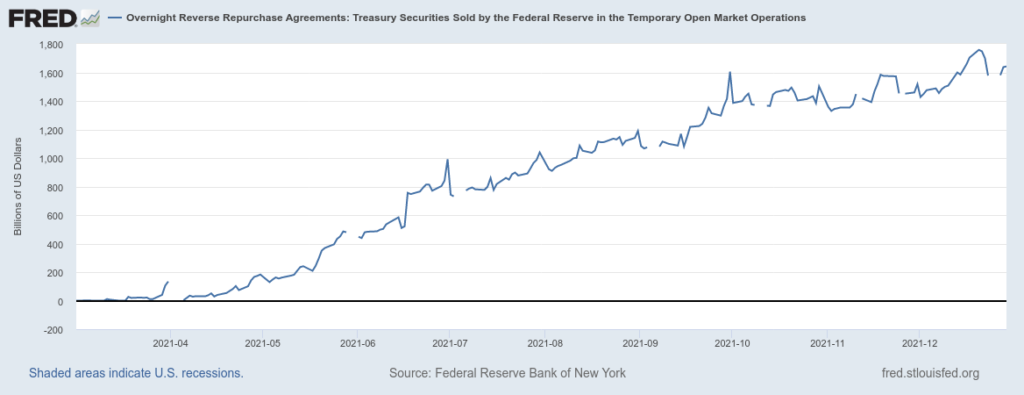
A repo is a way for the Fed to add temporary liquidity to the market, whereby the central bank’s open market desk purchases assets from banks for a short time, usually overnight, before reversing the deal. It is basically a loan of cash to the bank, guaranteed by the assets purchased. A reverse repo is, logically enough, the reverse of that, where the bank makes a short-term, guaranteed loan to the central bank. Reverse repos are a sign of excess liquidity in the system, meaning that banks have money left over after covering their liabilities and investing and lending what they are comfortable with.
So, it is both interesting that the Markets are saying there is too much liquidity in the system and simultaneously, it is scary as hell as the amount of money being pumped out by the Fed, through other programs, is at all time highs.
And while money has virtually seized up for Americans, short of the paltry $2,000 or so in stimulus checks, Coal Mine Joe and his cronies have been moving trillions around their casino. Since the outbreak of COVID-19, the Fed has vastly expanded the scope of its repo operations to funnel cash to money markets. The Fed’s facility makes cash available to the primary dealers in exchange for Treasury and other government-backed securities. Before coronavirus turmoil hit the market, the Fed was offering $100 billion in overnight repo and $20 billion in two-week repo. It ramped up the operations on March 9, offering $175 billion in overnight and $45 billion in two-week repo. Then, on March 12, the Fed announced a huge expansion. It is now on a weekly basis offering repo at much longer terms: $500 billion for one-month repo and $500 billion for three months. On March 17, at least for a time, it also greatly increased overnight repo offered. The Fed said that these liquidity operations aimed to “address highly unusual disruptions in Treasury financing markets associated with the coronavirus outbreak.”
In closing, when Coal Mine Joe wants to lecture hardworking Americans on fiscal responsibility; when Coal Mine Joe wants to denigrate the memories of nearly a quarter million whom died during the Opiod Crisis with many in his own backyard; and when Coal Mine Joe wants to rewrite history by saying the Child Tax Credit is a benefit and not a right under law, perhaps Coal Mine Joe ought to take a look at his own world before attempting to destroy others.