
Blog

Steve Horne Left Black Dome Owing Its Employees, Put A2Z Field Services In Chapter 11 And Now He Is a Chief Growth Officer.

Steve Horne GAMG

A former Black Dome Services employee contacted Foreclosurepedia this week with a short message: “There is no one at Black Dome.” The employee asked that their name not be used. Foreclosurepedia is honoring that request.

It was then that I was reading the press release from Steve Horne’s latest endeavor, and it read like a script from The Wolf of Wall Street. Wingspan, the company he founded, filed Chapter 7 in July 2015 owing $12.07 million against $1.24 million in assets. A2Z Field Services, which Black Dome bought in November 2025, is now in Chapter 11, and Black Dome left its own staff unpaid. Horne is now Chief Growth Officer of a publicly traded company that promises “opportunity origination” and will not say what it pays him.

Black Dome Services is the company that bought A2Z Field Services in November 2025. Steve Horne owned it. A2Z is now in Chapter 11 bankruptcy. The Field Service Technicians and Inspectors who worked for A2Z have been waiting for their money for months.

The Debt Went One Direction

Foreclosurepedia has reported that Horne loaded A2Z with debt after the acquisition and then disappeared. A2Z now sits in bankruptcy carrying obligations it did not have before Black Dome arrived. Horne himself is also reported to carry substantial debt.

The former employee says the damage did not stop at A2Z’s vendors. Black Dome’s own staff were left unpaid as well. In the employee’s words, “he owes all his former employees.”

The Department of Labor Has Already Looked

According to the former employee, a Department of Labor investigation found that wages are owed. The investigation also assessed a sanction for ignoring the Department’s inquiries and interest that continues to accrue daily. The employee says the matter is now headed to a state attorney general.

The employee estimates that Black Dome owes its former staff about $120,000 in total. The pattern the employee describes, however, is one Foreclosurepedia has now seen across the industry: work performed, payment withheld, and the people at the top gone.

The Insurance Problem

The most serious allegation in the account involves health insurance. The former employee says the company’s coverage was canceled retroactively to February 1. The employee further says Horne kept the refund check from the insurer for the cancellation.

According to the employee, premium deductions kept coming out of paychecks anyway. Employees did not learn the coverage was gone until they went to doctor appointments and the insurance was declined.

The Human Resources Department Walked Out

The employee says the company’s human resources staff quit because they were not being paid either. That detail matters. The people responsible for payroll, benefits, and employee complaints were themselves unpaid. Nobody was left to receive a complaint.

“So many layers,” the employee wrote. The employee added that they “could write a novel of the horrors there.”

He Was Seen At An Industry Event In August

The former employee says Horne showed up at a NAMFS or Five Star event in August. If the account is accurate, Horne was working an industry room while his former employees were chasing back pay. This is the eternal story of NAMFS and its membership.

And Now A New Title

The former employee then pointed Foreclosurepedia to an announcement from GAMG. The company’s own press release, by its headline, states that GAMG was approved for the OTCQB Venture Market and appointed Steven Horne as Chief Growth Officer.

Foreclosurepedia then noted a financial review of GAMG published by Wall Street Global Research. Wall Street Global Research reviewed GAMG and stamped it “blacklisted.” Its verdict is unambiguous: avoid the stock, take no position, and sell any shares already held. The firm calls GAMG a case study in narrative over substance.

The review starts with the numbers, or the lack of them. GAMG claims a market capitalization above $300 million, yet the firm found a balance sheet with no discernible assets, liabilities, or equity. In the reviewer’s telling, the promotional materials promise an empire while the financial record shows a void.

Then comes the ambition. GAMG’s website says the company will add $200 million in asset value every year, starting with a first milestone of $500 million in assets. The review says those projections have no foundation. The strategy runs from government-assisted rentals to luxury for-sale homes to the eventual purchase of a lending institution. The firm calls that a company trying to be everything to everyone.

The review is harshest on the people. It says Chief Executive Officer Richard Balles and his team publish generic biographies with no verifiable achievement in large-scale development or capital markets. It finds no evidence that anyone on the team has sourced, built, or managed a portfolio anywhere near the size they now promise. The vision, the reviewer concludes, has nothing to do with the team’s proven capacity.

The firm then puts questions to the company. With no revenue, how is GAMG paying its bills, and what does it burn each month? Where are the “over a thousand properties” the website advertises, who manages them, and where are the audited rent figures? Which lender issued the $30 million in construction financing the site mentions, on what terms, and against what collateral? The review says the company’s materials avoid every one of these.

The reviewer also notes that GAMG trades over the counter, where disclosure rules are looser than on the national exchanges. In that setting, the firm says, GAMG still offers almost nothing. Its closing line calls the risk unquantifiable.

That is the company that handed Steve Horne the title of Chief Growth Officer. His former employees say they are owed their wages. The research firm says GAMG cannot show where its own money comes from.

Two Trusts And The Insiders Held 93 Percent

The annual report’s ownership table, dated December 31, 2025, lists two trusts at the same Rockville, Maryland address. The RB Family Trust held 120,380,000 shares and the CM Trust held 125,000,000. That was 35.5 percent and 36.9 percent of the company, or about 72 percent between them. Directors and officers held another 21 percent, or 70,148,425 shares. That left roughly 23.5 million shares, under 7 percent of the company, in everyone else’s hands.

GAMG did not start as a startup. It is the old Kenilworth Systems Corporation, incorporated in New York in 1968, which discontinued its business operations in 2023 and renamed itself in June 2025. Three months later it issued 250,000,000 shares to the owners of DC Rental Portfolio Corp. in a reverse merger.


The SEC’s own investor bulletin says a reverse merger is “perceived to be a quicker and cheaper method of ‘going public,’” that many such companies “fail or struggle to remain viable,” and that “there have been instances of fraud and other abuses involving reverse merger companies.” GAMG fits the structure the SEC describes: an old public listing, a thin float, and a new story attached to it.

That was year end. After June 30, holders surrendered 295,001,197 common shares for cancellation in connection with a new class of Series A Preferred Stock. Each preferred share carries 2,500 votes, and the company can convert each one into 2,500 common shares at its own option. The designation authorizes 50,000 of them, which would carry 125 million votes. The filing does not say who surrendered the shares or who received the preferred.

The Market Cap Rests On A Sliver

Yahoo Finance showed a market value near $198 million in late September. The company now reports 145,991,661 common shares outstanding. At the 49 cents Yahoo showed in early October, that is about $71.5 million. It rests on a thin slice of stock. At year end, only about 23.5 million shares sat outside the trusts and insiders, worth about $11.5 million at that price. Between late December and early May, FINRA’s weekly data shows the stock trading as few as 102 shares in a week and never more than about 49,000. GAMG’s own press release concedes that OTCQB approval guarantees no trading volume, liquidity, or capital.

Where The Shares Came From

In September 2025, GAMG handed 250,000,000 shares to the owners of DC Rental Portfolio Corp. in a reverse merger. At year end, that one deal equaled nearly three-quarters of the 339 million shares outstanding. The company had 83.7 million shares at the end of 2024 and 339 million a year later. In the second quarter of 2026 it issued the DC Rental owners another 100,000,000 shares, which pushed the count to 440 million by June 30. Then holders surrendered 295,001,197 shares for cancellation, and the count fell to 145,991,661 on September 16. The company’s auditor flagged the valuation of the DC Rental deal as a critical audit matter. The annual report carries an accumulated deficit of $39.9 million.

The Balance Sheet Is A Mortgage

GAMG ended 2025 with $10.2 million in assets, almost all of it real estate. Property is carried at $7.64 million, with $1.6 million in escrow holdbacks and $577,510 in construction. Against that sits $9,989,625 in mortgage debt. Equity at year end was $17,118. By March 31, 2026, it had fallen to a deficit of $358,743. Interest expense was $66,773 for all of 2025 and $345,471 for the first six months of 2026.

The company now says that annual report left out a property. Unit C-1 at 3628 Georgia Avenue in Washington was bought in August 2025 with a $250,000 loan that carries 25 percent interest. The loan matured February 8 unpaid, and a foreclosure sale was scheduled for July 16 before a third party agreed to buy the note. With that correction, year-end assets are $10.46 million and mortgage debt is $10.24 million.

GAMG is a penny stock. It trades over the counter at under 50 cents a share, not on any exchange, and fails the SEC’s exemptions for companies with real net assets or revenue. Its stockholders’ equity is a deficit of $1,555,409 and its restated revenue for the second quarter was $236,261. Brokers must warn buyers in writing before they can sell it.

The Company Said Its Own Numbers Could Not Be Relied On

On October 1, the same day GAMG announced its OTCQB approval and Horne’s appointment, it filed an amended quarterly report. The board said the second-quarter statements issued August 19 should no longer be relied upon, because the company had left acquired entities out. The restated six-month loss is $1,292,840, up from $465,837 as first reported. Cash is $187,933 against a working-capital deficit of $12,453,319. The company admits its controls were ineffective.

The amended report also shows how thin the margin is on the insurance that protects those officers. GAMG bound a $41,200 directors and officers liability policy on April 20, paid $7,200 down on June 12, more than seven weeks later, and financed the rest through FIRST Insurance Funding at $3,534.02 a month. On August 28 the lender issued a Notice of Intent to Cancel Insurance Coverage, with cancellation scheduled for September 11.


As of September 2 the balance was $24,838.14, of which $3,634.02 was past due, and a second $100 late charge had been assessed. GAMG says it made payments on July 31, August 5 and August 7, that the policy has never been cancelled, and that the account is current and in good standing.


The former Black Dome employee says that company’s health coverage was canceled retroactively while premiums kept coming out of paychecks, and that Horne kept the insurer’s refund. GAMG says it caught up. Black Dome’s employees say nobody did.

The restated June 30 balance sheet is larger and worse. Total assets are $25,957,919 against total liabilities of $27,513,328, which leaves a stockholders’ deficit of $1,555,409. Notes payable of $12,355,184 are classified as current, including $9,855,184 in convertible debentures and $2,500,000 owed to Bogdan Capital. Mortgage debt has grown to $11,447,504.

The Revenue Is A Marketing Agency

Nearly all of the $95,309 in 2025 revenue came from Bella Rio Marketing Agency, which GAMG bought for 450,000 shares. The annual report says plainly that real estate produced no revenue in 2025. The review asks where the “over a thousand properties” are. The annual report names three DC holdings: a 31-unit walk-up, a 41-unit building under contract, and nine condominium units. In the first quarter of 2026, GAMG took in $93,201 and spent $470,072. The restated figures for the first six months show revenue of $359,514 against operating expenses of $1,652,354.

The Notes Can Become Stock

GAMG’s own filings show $10.48 million in notes that let the holders swap debt for stock at a discount to the market. Two of them, $3.5 million and $6 million, became convertible on October 6 and 8. Each converts at 90 percent of the stock’s 30-day average price. A third note, issued for a landscaping company GAMG bought with no cash, converts at 85 percent with no floor and no cap, starting six months after it was issued on August 31. Another $248,000 in notes to related parties becomes convertible six months after each issue date.


The lower the stock falls, the more shares each dollar of debt takes. GAMG now has 145,991,661 common shares outstanding. At the 49 cents the stock showed in early October, the two big notes convert into about 21.5 million shares, or 15 percent of the company. At 20 cents, about 52.8 million shares, or 36 percent. At 10 cents, about 105.6 million, or 72 percent. At 5 cents, about 211 million shares, more than exist today.

The filings give no limit on how far that can go. The amended quarterly report puts the company’s cash at $187,933 against a working-capital deficit of $12,453,319. Anyone who holds this stock is holding it behind a line of lenders who profit when the price drops.

The CEO Owes The Company $251,155

The restated June 30 balance sheet shows a note receivable from CEO Richard Balles of $251,155, up from $14,463 at year end. The note is unsecured and due on demand. Related parties owe the company another $844,606. Going the other way, the company owes Balles $98,302 for funds he paid over to it. The annual report says the company’s survival depends on continued financial support from its major shareholders.

The pay promised to GAMG’s officers dwarfs the money coming in. Employment agreements effective August 1, 2025, set annual pay of $300,000 for Chief Executive Officer Richard Balles, $275,000 for President John Murray, $225,000 for General Counsel Erik Carlson and $175,000 for Chief Marketing Officer Andrew Roiniotis, a combined $975,000, plus $305,000 in signing bonuses. That base pay alone is more than ten times the $95,309 GAMG took in during all of 2025.


For the first six months of 2026, restated revenue was $359,514 against operating expenses of $1,652,354, and half a year of those salaries is $487,500, more than every dollar the company brought in. Yet the annual report says no executive officer received cash compensation above $100,000 in 2025, and the filings do not say whether the promised pay was paid, accrued or deferred. That is the question for the officers.

On May 6, GAMG closed on the Memorial Real Estate Group, the former Memorial Hospital in Pawtucket, Rhode Island. The sellers were owed $6,455,000: a $6,000,000 one-year convertible note plus $455,000 in cash. The restated filing says GAMG disbursed no cash at closing. The $455,000 came from a loan Bogdan Capital made to the hospital’s own company. It paid prior advances, a tax settlement installment, legal invoices, and utilities. A second convertible note, for $3,500,000, went to a shareholder and related party for a 16.875 percent stake in the company’s Rhode Island subsidiary. The company booked the property at $10,992,835. The deal closed five weeks after a quarter that ended with $27,394 in the bank.

GAMG announced in March that Leonite Fund I, LP would provide a senior secured convertible note facility of up to $10 million. The filings show something smaller. On July 1, GAMG received $75,000 in net proceeds from the third installment. On September 9, it settled with Leonite for $310,353.39 over the note. Along the way it issued Leonite 20,000 commitment shares and a warrant for 50,000 shares at $1.50. GAMG also issued 500,000 shares to Alpine Securities Corporation for investment banking.

GAMG has not said what it is paying Steve Horne. The October 1 Form 8-K and the press release name him Chief Growth Officer, to lead opportunity origination and market expansion, and state no salary, shares, options, bonus or contract. The company reported the appointment under Item 8.01, Other Events, not Item 5.02, the item that covers compensation arrangements for certain officers. The release gives two effective dates, September 25 and October 1.

GAMG’s executive employment agreements, signed July 30, 2025, promise its four top officers about $975,000 a year in base pay and $305,000 in signing bonuses. The company took in $95,309 in revenue that year. Its income statement shows total operating expenses of $202,174 for all of 2025, and its quarterly report says it has never granted a stock option.

The Office And The Auditor

The Rockville headquarters is a virtual office at $150 a month. It is not a brick-and-mortar office. The operating office in Rockford, Illinois, rents for $150 a month from an entity controlled by GAMG’s President, John Murray. The company has six employees.

The audit was done by LAO Professionals of Lagos, Nigeria, which has audited GAMG since 2025. LAO registered with the Public Company Accounting Oversight Board on November 14, 2023, less than two years before it took on GAMG. Its report carries a going-concern warning.

Lagos, Nigeria. Really? A company that reported $95,309 in revenue and $10 million in mortgage debt for 2025, with 245 million shares in two trusts at year end, audited for about $20,000 by a firm more than half a world away.

The Pattern Labor Already Knows

This story is not new to the Field Service Technicians and Inspectors reading it. A company collapses and the invoices stay behind. A new letterhead appears, and the same executives show up in a new building with a new title. Labor is left holding the debt.

Black Dome’s employees now face the same lesson Inspectors learned from A2Z. Back pay is a claim in a line, not a check in the mail. The Department of Labor has found wages owed. An attorney general is next. A bankruptcy court is already involved on the A2Z side.

Foreclosurepedia will keep following the money from A2Z to Black Dome to wherever Horne lands next. Anyone with documents on Black Dome payroll, benefit deductions, or the A2Z acquisition debt can contact us. We will protect your name.

Black Dome’s staff are still waiting for their wages. Horne has a new job title.
$130,000 More: A Minnesota Vendor Says 24 Asset Management Owes For Lead Based Paint Work HUD Already Paid For

Turner On Labor

A vendor in Minnesota has come forward with the latest claim, and it is the heaviest yet. The vendor was forwarded Foreclosurepedia’s reporting on the HUD FSM 3.12 awards and says 24 Asset Management owes $130,000 for completed, approved work.

That claim goes onto a running tally of unpaid Labor that now exceeds half a million dollars. Every article in this series adds to the same number, and not one has drawn a reply from HUD or from the Office of Inspector General.

What The Vendor Says Is Owed

The vendor reports close to 1,100 completed and approved Lead Based Paint work orders, dating from June 24 through October 1, with some projects reaching back to July. That is more than three months of production, performed in the field, approved, and submitted.

The vendor also reports 30 completed excessive debris projects that remain unpaid, the oldest dating to 2024. A bill that has sat for two years is not a cash flow problem. It is a decision about who gets paid and who waits.

Almost all of these work orders, the vendor says, were paid by HUD. The vendor says a HUD Contracting Officer verified that payment to 24 Asset Management on the approved work. Foreclosurepedia has not seen that conversation and reports it as the vendor’s account.

I received your name and company as someone to contact regarding unpaid debt from 24 Assets. I was forwarded your article regarding the HUD FSM contract and the total mess 24 has created. Currently, 24 Assets owe me $130,000. I have LBP projects dating back to July, which HUD has paid 24. Close to 1,100 completed and approved individual work orders dating from June 24th to October 1. Excessive debris work orders are a mess; they owe me for 30 completed projects dating back to 2024. Almost all of these work orders have been paid by HUD. I have spoken to a HUD Contracting Officer and verified payment to 24 on approved work orders.

24 Asset Management Got Paid And Kept The Money

Take the vendor’s account at its plain meaning. HUD paid 24 Asset Management for work that Labor performed, and 24 Asset Management did not pass that money down. That is not a payment delay, and it is not a dispute between trading partners.

Foreclosurepedia’s position is that a prime contractor that collects federal money for approved work and refuses to pay the subcontractors who performed it violates the False Claims Act. A prime that asks HUD for payment represents that it is entitled to the money. Collecting on that representation and keeping what belongs to Labor is the conduct the statute was written to punish.

Lead Is Not Trash

The vendor made one point forcefully, and it deserves space. Lead Based Paint work is not hauling debris out of a vacant house. It demands training, containment, and careful cleanup, and it carries real health risk for the crew and for the next family that lives in the home. A vendor who does that work correctly, wins approval, and then waits months for payment has financed a federal contract out of pocket while carrying the liability.

HUD Wrote It Down

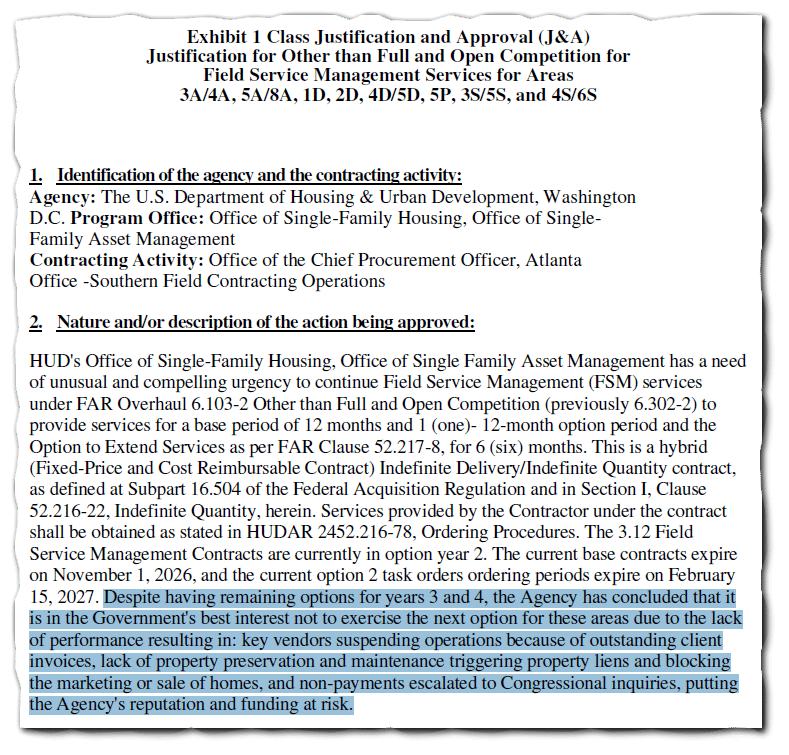
HUD has already told the public why the 3.12 contracts failed. In its Justification and Approval for Other Than Full and Open Competition, J&A 26-30, HUD says it will not exercise the next option for the affected areas. It cites lack of performance, and it lists what that lack of performance caused.

HUD’s words: “key vendors suspending operations because of outstanding client invoices, lack of property preservation and maintenance triggering property liens and blocking the marketing or sale of homes, and non-payments escalated to Congressional inquiries, putting the Agency’s reputation and funding at risk.”

Read that slowly. HUD is not describing a paperwork dispute. It is describing vendors who shut their doors because they were not paid, homes frozen by liens, and Congress asking questions. The agency wrote it, and the agency signed it. HUD cannot say it did not know.

HUD Congressional Inquiries

The Contractor Behind The Nonpayment Held Six Of Those Contracts

24 Asset Management held six of the 3.12 vehicles: 3A/4A, 5A/8A, 1D, 4D/5D, 5P, and 3S/5S. Spectrum Solutions Acquisitions held 2D and 4S/6S. Those incumbents continue through option year 2, with ordering periods running to February 15, 2027.

HUD’s stated reason for walking away is nonpayment. The vendors’ stated experience is that the prime was paid and Labor was not. Foreclosurepedia has now documented well over half a million dollars in claims, and HUD has taken no public step to recover a dollar of it for the people who did the work.

HUD’s Answer Was A Limited-Sources Award And A Chapter 11 Debtor

HUD’s replacement vehicle is J&A 26-30, a limited-sources procurement worth an estimated $170,829,743.00 across eight areas. HUD invoked “unusual and compelling urgency” to skip full and open competition. The term is 30 months, a 12-month base, one 12-month option, and a six-month extension.

HUD sent a Sources Sought Notice to five companies in July 2026, and all five answered. HUD shortlisted three as “uniquely capable”: Alpine Companies, P.K. Management Group, and A2Z Field Services. Altisource Solutions and VRM Mortgage Services answered in writing too and were not shortlisted.

A2Z Field Services is a Chapter 11 debtor in Subchapter V, Case No. 2:26-bk-52098 in the Southern District of Ohio. Its own sworn monthly operating report for August shows $1,979.31 in the bank, zero full-time employees, and $261,065.19 in post-petition vendor bills past due.

Either HUD never opened a public court record that anyone can pull in ten minutes, or HUD read it and shortlisted a bankrupt company that is not paying vendors for a program it says was ruined by vendors who did not pay. Both answers are an indictment.

Foreclosurepedia put A2Z’s sworn bankruptcy declaration in front of HUD’s Craig Karnes in May 2026, more than a month before the Sources Sought Notice went out. He did not reply.

The Rush To Award

HUD’s own paper trail adds to the problem. Alpine’s three awards, 3A/4A, 5A/8A, and 4S/6S, totaling $51,568,665.00, were signed before the Chief Procurement Officer approved the J&A. Then HUD issued Amendment 0001, partially canceling four areas with no stated reason. Those four areas, 1D, 2D, 4D/5D, and 5P, carry $96,622,154.00, or 56.56 percent of the J&A.

The approval chain is on the page. Paul M. Olin certified for the program office. Contracting Officer Charles W. Hoyle Jr. signed. Francine L. Hemphill, as Chief Procurement Officer, approved. Each had the authority to stop it and ask what HUD had checked. Foreclosurepedia has seen nothing showing that anyone did.

What This Is, and What It Isn’t

Federal rules require a prime contractor to certify that its subcontractors are entitled to payment before it requests payment from the government. That is FAR 52.232-27(h). A prime that certifies, collects, and then does not pay has a serious problem under that clause and under the False Claims Act.

The separate FAR 52.242-5 requirement to notify the contracting officer of late or reduced subcontractor payments does not apply to small business primes, and 24 Asset Management is one. That gap may explain why HUD heard so little from the prime while the debt grew.

A False Claims Act case still requires proof of what 24 Asset Management knew and certified. Foreclosurepedia has not seen the work orders, the HUD payment records, or the Contracting Officer conversation. That is exactly why the vendors’ records belong in front of investigators now, and the statute lets Labor put them there.

What Labor Must Do Now

File the complaint. Every unpaid Field Service Technician and Inspector, and every contractor stacked beneath them, who has a record of work HUD paid for should report it in three places.

Go to america.gov/fraud and file your claim. It is separate and outside of HUD.

Go to the HUD Office of Inspector General hotline and file here: https://www.hudoig.gov/hotline/hotline-form#no-back

Report it to Foreclosurepedia at [email protected].

Keep every work order, approval, photograph, invoice, and message about payment. If a HUD official verified payment to the prime on your work, write down who said it, when, and what was said.

Stay Off The HUD M&M FSM Contract

Unless and until the money owed to Labor is paid, Foreclosurepedia is calling on Labor to avoid the HUD M&M FSM contract. HUD’s own document says nonpayment is wrecking the program. The vendors say HUD paid the prime and Labor still went unpaid. Working that contract on those terms means financing a federal program out of your own pocket, and Foreclosurepedia considers it unsafe.

Do not take the work. Do not extend credit to a prime that has not paid its last invoice. Do not let anyone tell you the money is coming.

HUD said vendors were not paid. The vendors say HUD paid. The total is above half a million dollars, the Inspector General has not answered, and Labor is the only party in this chain that has already done its job.

The Debt Owed Thus Far


State/Territory Low High Basis
Puerto Rico $42,900.00 $42,900.00 Documented: audits of 2,145 properties
Illinois $29,286.50 $29,286.50 Documented: invoice sheet, 250 work orders
Texas, New Mexico, Puerto Rico $45,458.00 $45,458.00 Documented: formal claim, 1,023 invoices
Central Florida $37,035.00 $37,035.00 Documented: vendor invoice list
Pennsylvania $100,000.00 $100,000.00 Vendor-reported, two vendors, approximate
Iowa $25,000.00 $30,000.00 Vendor-reported
Indiana $28,000.00 $28,000.00 Vendor-reported, three cleanouts
Minnesota $158,000.00 $158,000.00 Vendor-reported, two vendors: $130,000.00 (about 1,100 Lead Based Paint work orders and 30 debris projects) and $28,000.00
Colorado $20,800.00 $20,800.00 Vendor-reported
Montana $3,500.00 $3,500.00 Vendor-reported
Nebraska $30,000.00 $30,000.00 Vendor-reported
North Dakota $24,000.00 $24,000.00 Vendor-reported
State not identified $46,000.00 $46,000.00 Vendor-reported: $33,000.00 on one asset since April, $13,000.00 since March
Total $589,979.50 $594,979.50


HUD Put It In Writing: Unpaid Vendors Put The Agency’s “Funding At Risk.” The White House Is Now Paying For Fraud Tips. Labor Should File.

HUDSEC Turner Throne

On Tuesday the President and the Vice President opened a $25 million Fraud Whistleblower Incentive Program. Go to https://america.gov/fraud and file your complaint today. The Justice Department runs it. Make sure you have the names of the companies, which in most cases is 24 Asset Management, the vendor managers, staff, everyone you contacted or spoke with via phone or email, your amounts owed and work order numbers, and FILE TODAY! Stealing money on federal contracts such as the HUD M&M FSM is not right. Nor is HUD proposing never to pay Labor and simply short list a company like A2Z Field Services which is in Chapter 11 bankruptcy as the solution.

The President described it as a 1 percent commission with “no limit,” and said journalists can take part. He also said he will personally decide who gets paid when more than one person claims the same tip.

Foreclosurepedia is not deciding what is fraud. That call belongs to the White House, and the door is now open. What Foreclosurepedia can do is put HUD’s own words in front of Labor before anyone files. The President was quite clear that “…the money will be paid out “if we recover the money” rather than if criminal charges are brought.” We already know that monies have been collected by HUD against 24 Asset Management, so this seems to be a slam dunk. Reread that and FILE TODAY!

What HUD Wrote

HUD’s Justification and Approval 26-30 explains why the agency will not exercise the next option on its current Field Service Management contracts. HUD cites “key vendors suspending operations because of outstanding client invoices, lack of property preservation and maintenance triggering property liens and blocking the marketing or sale of homes, and non-payments escalated to Congressional inquiries, putting the Agency’s reputation and funding at risk.”

Read that again. A federal agency signed a document saying that non-payment to vendors on its own contracts put its funding at risk. It did not write that as a theory. It wrote it as the reason.

The justification does not name a contractor. It does not name a dollar amount. The tie to 24 Asset Management comes from Foreclosurepedia’s reporting on the six vehicles HUD awarded that company and the Field Service Technicians and Inspectors left unpaid on them, which by Foreclosurepedia’s tally stands at no less than $353,679.50.

Four Signatures

Paul M. Olin certified the justification as accurate and complete. Contracting Officer Charles W. Hoyle Jr. certified it. Acting Deputy Chief Procurement Officer Amber Jones signed it. Chief Procurement Officer Francine L. Hemphill approved it.

Four officials put their names under a document that admits the problem. Secretary Scott Turner runs the department that produced it. Nobody on that signature page wrote down what happens to the vendors who were not paid.

Craig Karnes, a senior HUD official along with Sharon Washington and LaShura Ford, both working at HUD, have been in the loop for months. I would cite that in the filing so that the information might be more readily found in the searches conducted.

Uniquely Capable

The same document names Alpine Companies, P.K. Management Group and A2Z Field Services as “uniquely capable” of running the replacement work. It prices eight areas at $170,829,743.00. Alpine holds awards for three, and the other five carry $117,886,987.00 with no awardee Foreclosurepedia has seen.

A2Z is a Chapter 11 debtor in the Southern District of Ohio. HUD wrote that non-payment endangers its funding, then put a debtor on the list to take over the work.

The Old Work Keeps Running

HUD also wrote that the incumbents “will continue performance for option 2 in the eight contract areas through February 15, 2027, and option 3 will not be exercised.”

So Field Service Technicians and Inspectors keep working on contracts that HUD itself has written up as a reputation and funding risk. Foreclosurepedia has sent reports listing 24 Asset Management’s victims to Craig Karnes, acting deputy director of all HUD procurement, for years. HUD will not discuss the debt.

What Labor Does Now

File at https://america.gov/fraud and describe what happened in plain words, name the HUD-funded work, and let the White House decide what it is.

Document every unpaid work order by property, service, date and amount. Keep your invoices, completion photos, texts and emails. Keep your 1099 and compare it to your bank deposits.

Quote HUD’s own sentence in your filing. The agency has already said what non-payment does to its contracts.

File with the HUD Office of Inspector General as well. Then call your Representative and your Senator. Reach out directly to your local media providers such as newspaper and tv. HUD wrote that Congressional inquiries over non-payment hurt its reputation.

HUD wrote it down. The vendors are still waiting. The program is open.

HUD Wrote Its Own Indictment: Eight Years Of Broken Procurements, At Least $353,679.50 Owed To Labor, A Bankrupt Firm On The Shortlist, And Congress Already Asking Questions

HUD On FIre

Every day brings another headline, another controversy, and another crisis under the failed leadership of Secretary Scott Turner on the HUD M&M FSM as his henchman Paul Olin, Acting Deputy Secretary, scrambles to bury his head in the sand. Impeachment may be in the wind for Secretary Turner and only the midterms will tell.

HUD’s own Justification and Approval admits that unpaid vendors, liened houses and Congressional inquiries ended its Field Service Management contracts. It never admits that HUD ran the program that produced all three.

One Paragraph. Every Failure HUD Hoped You Would Not Add Up.

Buried in Section 2 of a class Justification and Approval covering eight Field Service Management areas, HUD wrote a sentence that deserves to be read aloud in a hearing room. HUD says it will not exercise the next option on the 3.12 contracts “due to the lack of performance resulting in: key vendors suspending operations because of outstanding client invoices, lack of property preservation and maintenance triggering property liens and blocking the marketing or sale of homes, and non-payments escalated to Congressional inquiries, putting the Agency’s reputation and funding at risk.”

That is HUD describing HUD’s program. HUD picked the awardees. HUD wrote the contracts. HUD approved the invoices. HUD collected the complaints. HUD now announces that the result is a threat to its own funding, and it files the confession as a procurement formality.

The sentence does not name a contractor. It does not name a dollar amount. It does not say who failed to pay, who failed to preserve, or who failed to oversee. It assigns the blame to “lack of performance” and moves on to the shortlist, as if the agency that ran the contracts for years had been a bystander.

HUD Congressional Inquiries

The Ledger HUD Left Out

Foreclosurepedia has monitored HUD’s Management and Marketing Field Service Management program for decades. The public record, including a federal decision HUD itself appeared in, tells the story of an agency that cannot plan, cannot award cleanly, and cannot supervise what it awards.

HUD planned to issue the 3.12 solicitation in October 2018. According to the Government Accountability Office, it could not post it until February 2021. The delay followed an appeal by the Small Business Administration of HUD’s own competition decision and protests, sustained by GAO, over a sister solicitation that failed to reflect the pandemic. That is twenty-eight months lost before a single 3.12 contractor was chosen.

In May 2021, Alpine Companies protested HUD’s interim “bridge” competition, and HUD canceled it rather than defend it. HUD then offered sixty-day sole-source extensions at existing prices and hoped every contract holder would say yes.

They did not. Five days before the final 3.10 task orders expired, HUD learned that Innotion Enterprises would not extend two areas and that holders of three others would not extend either. GAO counts that as two business days. HUD had not posted the replacement solicitation until three months before the old orders ran out. It had no fallback and never asked what would happen if the incumbents walked.

On May 30, 2021, HUD extended DGG RE Investments’ existing task orders and added the five areas. No competition, no proposals and no evaluation covered them. GAO denied the protest, citing the pandemic and the legal standard that an agency’s planning need not be error-free. That sentence describes the law. It was never praise for HUD, and HUD should not wear it as a medal.

HUD did give a reason for DGG. It told GAO that DGG was already performing similar work at a satisfactory or higher level and already had a presence in three of the Homeownership Centers. Agree with it or not, that is a reason an agency can point to. HUD had watched DGG work inside the program.

The eleven-area 3.12 awards then went to three companies and drew protests from the firms that lost. On July 27, 2022, HUD told GAO it would cancel all eleven awards, reevaluate proposals and decide again. Days later it posted another urgency justification to keep services running. The pattern repeats. HUD loses the calendar, claims an emergency, and skips competition.

Now it is October 2026 and HUD is doing it a third time. The Federal Acquisition Regulation says contracting without full and open competition may not be justified by a lack of advance planning. Eight years is not an emergency. It is a management record.

At Least $353,679.50 Owed. The Number Is Climbing.

Foreclosurepedia’s running tally of unpaid Field Service Technicians and Inspectors on 24 Asset Management work stands at no less than $353,679.50. It is a floor, not an audit, and it approaches $400,000.

The paper behind it includes $42,900.00 in Puerto Rico audits, a $29,286.50 Illinois sheet, a $45,458.00 claim covering 1,023 invoices and a $37,035.00 Central Florida list. The rest comes from vendors who reported what they are owed. Foreclosurepedia is not naming them.

HUD did not discover this in a headline. Craig Karnes, a senior HUD official wrote in 2023, to Foreclosurepedia, that HUD “is aware of the relationship between 24 Asset Management and Assero.” Assero is the predecessor firm whose own vendors went unpaid. Aware. That is HUD’s word. Foreclosurepedia has seen no referral to HUD’s Office of Inspector General in the years since. HUD was aware, and the debt grew.

Labor Is Paying HUD’s Penalties

Foreclosurepedia has reported that HUD assesses liquidated damages against its prime contractors, a feature carried from the 3.10 contracts into 3.12. HUD takes its money first, for missed quality control and similar failures. Labor is last in line.

The prime contractor being docked has fewer dollars to pay the people who did the work. HUD keeps its penalty and writes a procurement document about vendors going unpaid. Nobody tells a Field Service Technician or Inspector whether the work order they completed will ever turn into money.

That is the snowball. Field Service Technicians and Inspectors cannot pay their own subcontractors. Trucks, insurance and fuel go on credit cards. Small firms miss payroll. Bankruptcies begin. Families lose homes while the homes HUD owns sit with overgrown grass and liens attached. HUD’s own Justification says so.

HUD’s Answer To Unpaid Vendors: A Debtor, A HUD OIG Audit And Two Insecure Websites

Having confessed that non-payment ended the old contracts, HUD turned to the replacements. The Justification names Alpine Companies, P.K. Management Group and A2Z Field Services as “uniquely capable” of running contracts worth an estimated $170,829,743.00. HUD says it reached that finding through capability matrices and past performance data.

Foreclosurepedia’s files name 24 Asset Management, Spectrum and JGM as the 3.12 incumbents. None of the three shortlisted firms is on that list. Altisource Solutions and Vendor Resource Management answered the same Sources Sought Notice in writing and were not shortlisted. HUD has not said why.

A2Z: The Debtor

A2Z Field Services is a Chapter 11 debtor in Case No. 2:26-bk-52098, in the Southern District of Ohio. Its sworn August report shows $1,979.31 in the bank, zero full-time employees and $261,065.19 in past-due vendor bills with approximately 600 vendors owed.

HUD’s Justification says the work requires “a fully staffed and equipped office.” A2Z told a federal bankruptcy court it has no full-time employees. The docket is public and anyone can pull it in minutes. HUD either never pulled it or pulled it and shortlisted the debtor anyway. Both answers are an indictment.

PKMG: The HUD OIG Audit And The Website

P.K. Management Group has a history with HUD’s own Office of Inspector General. A 2016 HUD OIG audit of its Illinois work found that PKMG did not always provide property preservation and protection services as its HUD contract required. The auditors also found that it billed HUD for properties it had not serviced.

The Inspector General recommended that PKMG repay more than $19,000 for 105 properties that were not adequately maintained and more than $2,300 for properties it never serviced. The auditors projected that HUD could pay more than $2.5 million over the following year in fees for work not done to contract standards.

Foreclosurepedia reported in 2018 that every award PKMG held at that time drew a protest, and that the awardee entity was under a Service Contract Act pay investigation. HUD’s Justification mentions none of this.

The public face of the firm HUD calls “uniquely capable” does not support a secure connection. Browsers with HTTPS protection turned on stop visitors with a full-page warning before the page loads. Click through, and the site still describes PKMG as prime on HUD’s old M&M 3.6 and 3.8 programs. It never mentions 3.12.

Alpine: The Template

Alpine Companies has already been awarded three areas worth $51,568,665.00. Its website runs on plain, unencrypted HTTP, consists of two pages built on a GoDaddy template, and carries a 2022 copyright.

A website proves nothing about performance, and Foreclosurepedia does not claim it does. It shows what “uniquely capable” did not require, which is anything the public can check. A firm holding a $51.5 million federal award has published no capability statement, no team and no past-performance reference where Labor can read it.

Two of the three firms HUD trusts with $170,829,743.00 run public sites that do not support a secure connection. The third is in bankruptcy court.

Nobody On The List Has Current Experience. The Firms That Were Cut Never Got The Same Pass.

Alpine has not performed HUD M&M Field Service Management work for some years. PKMG’s own website still lists the 3.6 and 3.8 programs, which are generations old. A2Z is in bankruptcy court with no full-time employees. None of the three can claim current experience running these contracts.

Then “current experience” cannot be what separated the three from the two. Altisource Solutions and Vendor Resource Management answered the same Sources Sought Notice in writing. HUD cut both and kept a debtor, a HUD OIG audited contractor and a firm that has sat out the program for years.

HUD owes the public the criteria. If past performance was the test, show the data. If capability was the test, show the matrix. If it was neither, say so.

A limited sources competition is supposed to narrow the field to firms that can do the work. HUD’s version narrowed it to firms that answered, and then it kept the weakest of them. Foreclosurepedia expects Altisource and VRM to ask HUD the same question and protest the J&A if there is a path still remaining to do that.

Same Habit, Worse Facts

In 2021, HUD had five days and a pandemic to explain itself. In 2026, HUD’s own Justification says it will decline options for years 3 and 4 that it still holds. It has known the November 1, 2026 expiration since it signed the contracts. It had months, not days.

HUD sole-sourced DGG with a reason. It now shortlists a debtor, a HUD OIG-audited contractor and a firm that has been out of the program for years, and it calls the result “uniquely capable.” HUD should have to defend that phrase under oath, one firm at a time.

The Solicitation Is Already Falling Apart

HUD has already amended its own solicitation. Amendment 0001 partially cancels four of the eight areas, 1D, 2D, 4D/5D and 5P. Those four areas carry $96,622,154.00 of the $170,829,743.00. The amendment gives no reason.

Foreclosurepedia will not guess at the reason. HUD should say what changed, and whether anyone looked at the A2Z bankruptcy docket before pulling half the work off the table.

Alpine’s three areas are worth $51,568,665.00. Five areas remain unassigned, and HUD has told the public nothing about which firm it intends for them.

Congress Is Already In The Room, By HUD’s Own Admission

No critic invented the Congressional inquiries. HUD wrote that they happened and that they put its “funding at risk.” Foreclosurepedia has not seen the inquiry letters themselves; however, we are sure that Secretary Scott Turner has been sweeping the issues under the rug as quick as he can.

What did HUD do about it? It did not recover the money for Labor. It did not publish a debt list. It refuses to release information on the performance bond for Labor to file against including a recent FOIA filing. It sent no referral to the Inspector General that Foreclosurepedia has seen. It drafted a procurement document and named a bankrupt firm among the three it trusts.

If HUD believes its funding is at risk, the way to protect that funding is to pay the people who did the work and explain where the money went. Shortlisting a Chapter 11 debtor does the opposite.

Who Signs This

Secretary Scott Turner commands this department. The Justification passed through senior procurement officials and carries their approvals, and Paul Olin’s name sits in that chain. Turner was in position to ask what HUD checked before it shortlisted A2Z. He was in position to ask why unpaid vendors were still unpaid. Foreclosurepedia has seen no sign that he did.

Why he did not is immaterial. The signatures are on the page, and every one of them was a chance to stop.

What HUD Must Do Now

HUD should withdraw A2Z Field Services from the shortlist today. It should explain in writing why a debtor with no full-time employees was found “uniquely capable.” It should say what it knew about 24 Asset Management’s unpaid vendors, and when.

HUD should publish the criteria and scoring that kept Alpine, PKMG and A2Z on the list and dropped Altisource and VRM. It should open every remaining area to full and open competition. It should publish the liquidated damages it has withheld from its Field Service Management prime contractors, and what Labor has received in return. And it should refer the matter to its Inspector General in writing and say so publicly.

Congress should do what HUD’s own document says it is already doing. Ask questions, put them in writing and demand answers on the record.

What Labor Does Now

If A2Z owes you money, file your proof of claim in Case No. 26-52098 and call the office of Subchapter V Trustee Donald W. Mallory to confirm you were listed. If 24 Asset Management owes you, document every unpaid work order by property, service, date and amount, and send it to the HUD Office of Inspector General.

Then call your Representative and your Senator. HUD wrote that Congressional inquiries put its funding at risk. Call the media in your hometown. And file litigation against the appropriate parties that owe money including 24 Asset Management.

HUD put its reputation and its funding at risk in writing. A2Z has $1,979.31. Labor is still waiting.

Meanwhile The A2ZFS Debt Keeps Getting Worse


Loader Loading...
EAD Logo Taking too long?

Reload Reload document
| Open Open in new tab


HUD Shortlisted A Bankrupt Company To Fix What It Says Unpaid Vendors Broke: A2Z Field Services Has $1,979.31 In The Bank And $261,065.19 In Past-Due Vendor Bills

Turner Treasure

A2Z Field Services has been in Chapter 11 since May 1, 2026. Its sworn August report shows $1,979.31 in the bank, zero full-time employees, and $261,065.19 in past-due vendor bills. HUD’s J&A 26-30 calls A2Z Field Services “uniquely capable” of running federal Field Service Management work.

That is the same J&A in which HUD explains why it is ending the old contracts. HUD cites “key vendors suspending operations because of outstanding client invoices, lack of property preservation and maintenance triggering property liens and blocking the marketing or sale of homes, and non-payments escalated to Congressional inquiries, putting the Agency’s reputation and funding at risk.”

HUD wrote that unpaid vendors put its own reputation at risk when identifying the nearly $400,000 owed to Labor by 24 Asset Management. Then it shortlisted a bankrupt company that has not paid its vendors. Even worse, though, Secretary Scott Turner has had the opportunity to pay Labor and has categorically refused to even publicly acknowledge the problem. And Acting Deputy Secretary Paul Olin simply further embedded the salt in Labor’s wounds by short listing a currently in bankruptcy, with zero employees firm, A2Z Field Services for new HUD M&M FSM awards.

The Debtor HUD Called Capable

A2Z filed Case No. 26-52098 in Subchapter V, Southern District of Ohio. Black Dome Services, which bought A2Z in October 2025 according to the debtor’s own declaration, has asked the court to dismiss the case. Trial on that motion is set for December 11, 2026. So, which A2Z Field Services is HUD even dealing with?!

The declaration also lists over $1.1 million in merchant cash advances. The court has extended A2Z’s use of cash collateral, which means a lender holds a lien on the cash. HUD’s J&A says it reviewed each respondent for “financial securities.”

Now read the August report. Cash fell from $19,344.06 to $1,979.31 in one month, a drop of $17,364.75, or 89.77 percent. The $261,065.19 owed to vendors is 131.90 times what A2Z has in the bank.

Not One Dollar Is Current

Nothing on the aging schedule is under 31 days old. $71,337.34 is 31 to 60 days past due. $189,727.85, or 72.67 percent, is 61 days or older. The schedule runs four pages of vendors, and many are Field Service Technicians and Inspectors who did the work.

A2Z’s declaration says it had about 600 contractors working for it. The August report shows zero full-time employees, both now and on the day the case began. The declaration said 17 of its 19 employees were full-time.

HUD Certified What The Debtor’s Own Report Contradicts

The J&A says the work requires a “fully staffed and equipped office.” It says the three recommended firms have “the necessary office space, access to staffing, and resources to provide these services immediately.” The Contracting Officer certified the justification as accurate and complete. Does that mean that Paul Olin, HUD’s Acting Deputy Secretary or Charles Hoyle Jr were wrong? Was the information both incorrect and wreckless? And what role does Secretary Scott Turner play as the buck should stop with him?

A2Z swears it has no full-time employees. Either HUD read that sworn report and called A2Z staffed anyway, or HUD never read it. The J&A never uses the word “bankruptcy.” Both answers are an indictment.

HUD Told Us What Happens Next

HUD’s own sentence is a forecast. Vendors stop working when invoices go unpaid. Homes go unmaintained. Liens block sales. Congress gets the letters. The Agency’s reputation and funding take the hit.

Put a bankrupt prime with $1,979.31 into that sequence and the first link breaks first. Foreclosurepedia expects the next round of Field Service Technicians and Inspectors to learn what the last round learned, and HUD will have signed the paper that sent them.

Two Firms, One Pattern

Foreclosurepedia’s running tally of what 24 Asset Management owes Labor is no less than $353,679.50. It is a floor and not an audit. Add A2Z’s sworn $261,065.19 and the two firms stand at no less than $614,744.69.

HUD says non-payment is why 24 Asset Management is losing its contracts. HUD then put a debtor with the same kind of debt on the shortlist. Foreclosurepedia asks which of those two firms HUD believes will pay Labor.

Who Signed

Paul M. Olin certified the justification as accurate and complete. Contracting Officer Charles W. Hoyle Jr. certified it on September 30. Acting Deputy Chief Procurement Officer Amber Jones signed on October 9. Chief Procurement Officer Francine L. Hemphill approved it on October 13.

A2Z’s bankruptcy was on the public docket for the entire period. Foreclosurepedia emailed Craig Karnes, the former director of HUD’s Management and Marketing program, A2Z’s sworn declaration in May 2026. That was more than a month before HUD sent its July Sources Sought Notice. He did not reply.

Either every official on that signature page read a public docket showing a debtor with no employees, or none of them looked. Secretary Scott Turner commands this department. He had the authority at every step to demand a bankruptcy check before anything left his building. The buck stops with him.

HUD Congressional Inquiries

Five Areas Are Still Open

The J&A prices eight areas at $170,829,743.00. Alpine Companies holds awards for three. The other five carry $117,886,987.00: 1D, 2D, 4D/5D, 5P, and 3S/5S. Foreclosurepedia has seen no awardee for any of them. The larger problem for Alpine Companies is the simple and salient fact that they cannot even figure out how to secure their website.

The J&A does not say which firm is meant to take which area. Foreclosurepedia has seen no award to A2Z or P.K. Management Group. Nothing is signed yet, and that is the window. Normally, we would link PK Management Group’s website, pkmg.net, but it no longer even exists. And even if they can overcome that hurdle, April Cooper has yet to publicly discuss whether she will pay Labor; at what rates and timelines would she pay Labor, and why Labor should even trust her with ~$400,000 still owed to Labor in the same award areas.

What The Law Asks Of HUD

A bankruptcy filing does not by itself bar a federal award. That is not the argument. The argument is that a contracting officer must find a contractor responsible before awarding, and the federal standard has long required adequate financial resources. Even looming larger is whether or not A2Z Field Services would be capable of passing a HUD security check due to the potential for financial leveraging by foreign nationals. Moreover, though, the HUD M&M FSM requires a performance bond and I am not familiar with any firm that would grant a ~$10 million dollar performance bond for a firm currently in bankruptcy.

HUD’s J&A cites no financial analysis of A2Z beyond “financial securities.” It never mentions the case, the cash collateral order, or the motion to dismiss. HUD should say who ran that analysis and what it showed. Instead of the opaqueness that Secretary Scott Turner shrouds himself in, full transparency should be on display before yet another half million dollars is stolen from Labor.

What Labor Does Now

If A2Z owes you money, file your proof of claim in Case No. 26-52098. The general deadline was July 17, 2026, and the government deadline is October 28, 2026. Call the office of Subchapter V Trustee Donald W. Mallory and ask whether A2Z listed your debt.

If 24 Asset Management owes you, file with the HUD Office of Inspector General. File liens. Hire a lawyer and sue Fast Eddie San Roman. Contact the media and your Congressional representatives. Document every unpaid work order by property, service, date, and amount. Ask any firm in writing how and when you will be paid before you accept an order.

Call your Representative and your Senator. HUD wrote that Congressional inquiries over non-payment hurt its reputation. Make the next inquiry.

HUD wrote that unpaid vendors put its reputation at risk. Then it shortlisted a bankrupt company with $1,979.31 in the bank. The vendors are still waiting.

Disclosure: Foreclosurepedia’s founder has previously worked for A2Z Field Services and has had a past consulting relationship with Alpine’s CEO.