




April 13, 2026 | Antitrust / Industry Consolidation / Fuel Crisis
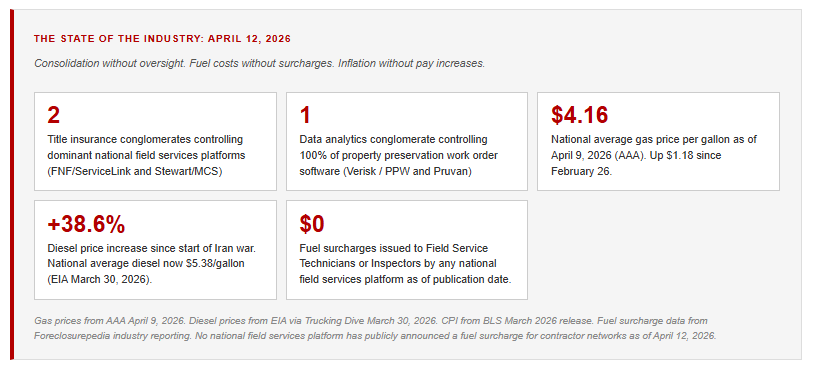
The mortgage default field services industry has spent the past decade engineering one of the most complete consolidations of market power in any federally adjacent service sector in the United States, and on February 28, 2026, the geopolitical event the industry’s consolidated structure was never designed to accommodate arrived without warning. The United States and Israel launched military operations against Iran, Iran responded by effectively closing the Strait of Hormuz, and the largest supply disruption in the history of the global oil market began rippling through every cost center of every contractor who routes work through the dominant national field services platforms. The national average for a gallon of regular gasoline, which stood at $2.98 on February 26, crossed four dollars for the first time since 2022 on April 2 and reached $4.16 as of April 9 according to AAA. Diesel, the fuel used by Field Service Technicians operating trucks, trailers, and heavy equipment on preservation work orders, has surged 38.6 percent since the start of the conflict to a national average of $5.38 per gallon as of March 30 according to the Energy Information Administration, with Florida, one of the two highest foreclosure volume states in the country, recording diesel prices above five dollars per gallon and regular gasoline at $4.23. The March 2026 Consumer Price Index, released April 10 by the Bureau of Labor Statistics, showed headline inflation at 3.3 percent annually with gasoline prices posting their largest single-month increase since 1967, up 21.2 percent in March alone, accounting for nearly three-quarters of the overall monthly CPI increase.
Amazon imposed a 3.5 percent fuel and logistics surcharge on its seller network effective April 17. FedEx imposed a 26.5 percent surcharge on ground deliveries. The United States Postal Service imposed an 8 percent fuel surcharge on packages effective April 26. UPS implemented comparable adjustments. Every major logistics operator in the American economy has passed fuel cost increases to the participants in its network. Not one national mortgage field services platform has issued a fuel surcharge to the Inspectors and Field Service Technicians who drive to properties on their behalf. The rate for an occupancy inspection is still $7 to $9. The rate for a grass cut is still $25 to $30. The rate for a winterization is still $45 to $50. The fuel cost environment in which those rates must be absorbed has increased by more than a dollar per gallon for gasoline and more than two dollars per gallon for diesel since the conflict began, and the platforms collecting the servicer billings on work those contractors perform have responded with silence.
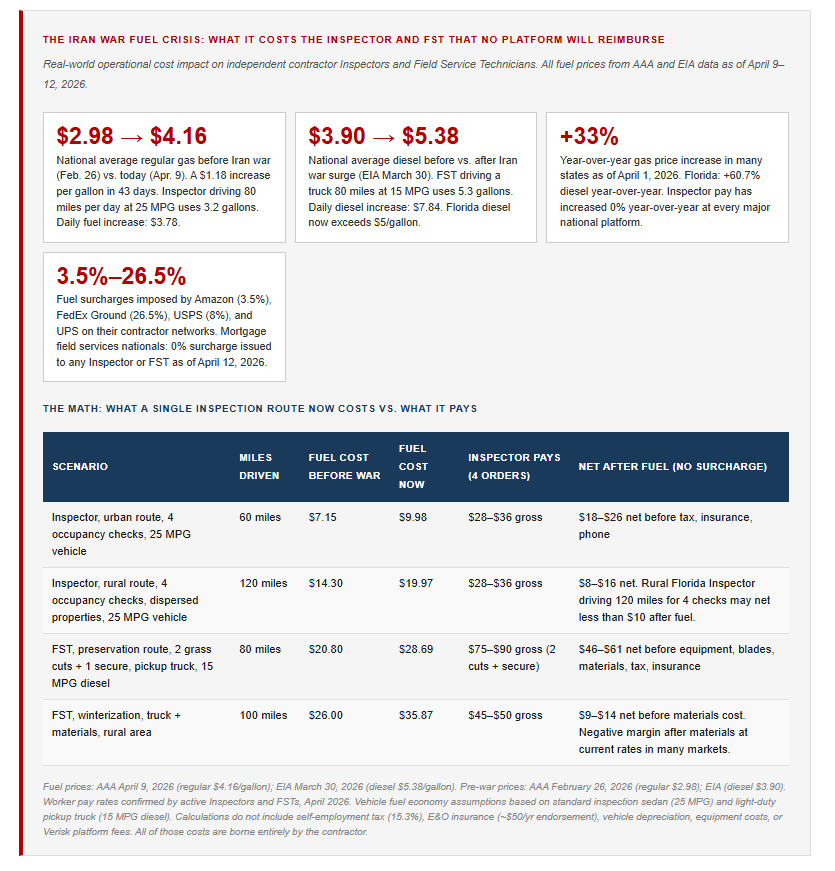
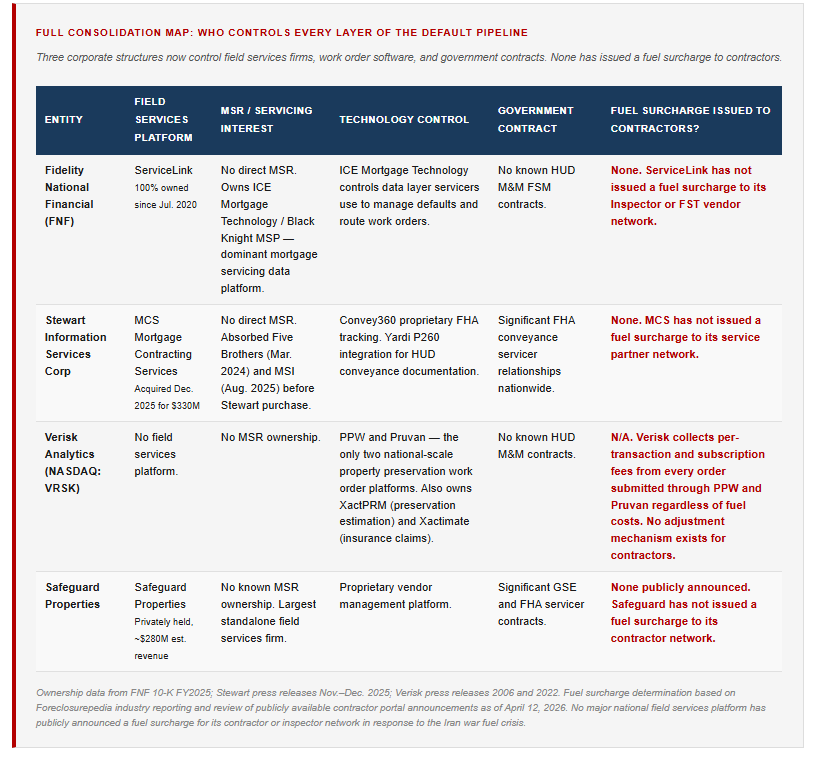
The industry’s refusal to issue fuel surcharges is not an oversight. It is a policy choice made possible by the same consolidated market structure that this article has documented across every other layer of the default field services supply chain, and it illustrates with clinical precision how market power operates in the absence of regulatory oversight. Amazon issued its 3.5 percent fuel surcharge because Amazon operates in a competitive market where sellers can switch fulfillment providers if the economics become untenable, and where the public visibility of its seller relationships creates reputational pressure to acknowledge cost sharing. FedEx issued a 26.5 percent fuel surcharge because it competes against UPS, the USPS, and regional carriers, and because its large commercial clients have contract terms that implicitly anticipate fuel adjustment mechanisms. The United States Postal Service, a federal agency, issued an 8 percent surcharge because it could not absorb a 21.2 percent single-month gasoline increase without compromising its operational solvency. Every one of those entities acknowledged the Iran war fuel shock as a real operational cost that the entity directing the work could not unilaterally impose on the people performing it without some acknowledgment of shared burden.
The nationals controlling the mortgage default field services pipeline have issued no such acknowledgment because they do not need to. The Inspector performing occupancy checks in Tampa has no alternative platform through which to access the institutional servicer market. The Field Service Technician cutting grass on HUD-adjacent FHA properties in Jacksonville has no competing national to route his work through that will offer better rates or fuel cost recognition. Safeguard Properties, ServiceLink, and MCS Mortgage Contracting Services all post rates in their vendor portals and those rates are what they are, and the contractor who does not like them can stop accepting work orders, which is not a realistic option for someone whose livelihood depends on the volume those platforms control. The concentrated structure of the market means that the nationals are insulated from competitive pressure to share any cost increase with their labor network, and the absence of any regulatory oversight of that structure means there is no external mechanism to compel a different outcome. The March 2026 CPI showed that real earnings for workers decreased 0.6 percent for the month because wages rose only 0.2 percent while prices rose 0.9 percent. For an Inspector or Field Service Technician whose gross pay has not changed in years and whose fuel costs have increased more than 33 percent year-over-year, the concept of real earnings decline is not an abstraction from a Bureau of Labor Statistics table. It is the difference between a route that covers its costs and one that does not.
The cumulative inflation context makes the fuel crisis a crisis within a crisis rather than a standalone event, and that distinction matters when evaluating the economic position of the workforce that sustains this industry. The cumulative consumer price inflation between August 2020 and March 2026 now stands at approximately 30 percent, meaning that the $7 occupancy inspection fee paid to an Inspector in August 2020 had the purchasing power of approximately $5.38 in 2020 dollars by March 2026 before the Iran war fuel shock began. The grass cut paid at $25 in 2020 had the purchasing power of roughly $19.23 in 2020 dollars by the same date. The Iran war has added a new and acute fuel cost layer on top of six years of compounding inflation that the nationals have never acknowledged in their rate structures, in a market where the consolidated ownership structure documented throughout this article ensures that no competitive pressure exists to force acknowledgment.
The trucking industry analogy is instructive and damning in equal measure. Dean Croke, a principal analyst at DAT Freight and Analytics, told CNN that small truckers in the spot market are “really getting dumped on right now” because large carriers have long-term contracts with automatic fuel surcharge clauses while independent operators absorb higher costs in all-in rates with no carveout for fuel. The parallel to the mortgage field services contractor market is exact: the nationals holding the servicer contracts have sophisticated fee structures that recover their costs from the servicers, but the Inspectors and Field Service Technicians at the bottom of the chain work on all-in rates with no fuel adjustment mechanism, no automatic surcharge trigger, and no contractual protection of any kind. The difference between trucking and mortgage field services is that a trucker can refuse a load that does not cover his fuel costs without losing access to the entire freight market. An Inspector or Field Service Technician who refuses work orders from the dominant nationals because the rates no longer cover operating costs loses access to the only institutional market that exists for their services, because the consolidation described in this article has reduced the number of credible alternative platforms to a number that can be counted on one hand.
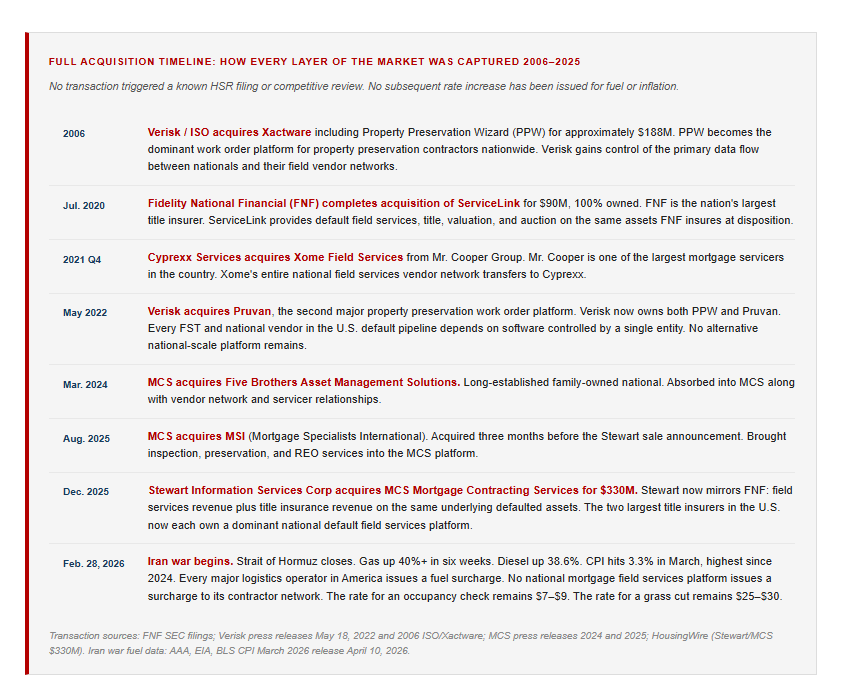
The HSR threshold analysis that explains why none of these consolidation transactions triggered mandatory federal review remains unchanged by the fuel crisis, but the fuel crisis illuminates why that regulatory gap carries real human consequences. The 2025 HSR minimum size-of-transaction threshold is $126.4 million, meaning acquisitions below that figure carry no mandatory notification obligation. The Five Brothers acquisition without a disclosed price, the MSI acquisition without a disclosed price, and the Verisk acquisition of Pruvan without a disclosed price all either fell below the threshold or were structured to avoid it. The Stewart acquisition of MCS at $330 million almost certainly crossed the threshold and would have required an HSR filing, but no public challenge, second request, or remedial condition was announced. What a proper antitrust review of these transactions in the aggregate would have revealed is exactly what the fuel crisis has made undeniable: that the consolidated market structure of the mortgage default field services industry removes any mechanism by which the people performing the physical labor can capture a fair share of the economics they generate or resist the imposition of cost increases that the dominant platforms choose not to share. The FTC’s January 2025 joint guidelines with the DoJ explicitly addressed the antitrust implications of wage-fixing, no-poach agreements, and the sharing of competitively sensitive compensation data among competing employers, noting that coordinated suppression of worker compensation is a Sherman Act concern.
The mortgage field services market presents a more structurally embedded version of the same problem: not wage-fixing through explicit coordination, but rate suppression through consolidated buyer power in a market where the sellers of labor have no meaningful alternative, no regulatory protection, and now no fuel surcharge in the middle of the largest energy price shock in the history of the global oil market. The Inspector receiving $7 to $9 for a vacancy certification in a state where gas costs $4.23 per gallon is not an abstraction in a legal brief. She is a person doing a job that a $13.7 billion market depends on, for a rate that has not changed while everything around it has, under a market structure that no federal regulator has ever scrutinized, in a fuel environment that every other industry in the American economy has acknowledged requires cost adjustment. The industry’s silence on fuel surcharges is not a business decision made in good faith. It is the exercise of consolidated market power, and it has a name in antitrust law.
“Amazon issued a 3.5% fuel surcharge. FedEx issued 26.5%. The USPS issued 8%. UPS matched FedEx. Every major logistics operator in the United States has acknowledged that a 21.2% single-month gasoline spike and a 38.6% diesel increase since the start of the Iran war constitutes a cost that cannot be unilaterally imposed on the people doing the work. The nationals controlling the mortgage default field services market have issued nothing. The Inspector driving to properties on their behalf still receives $7 to $9 per occupancy check. The Field Service Technician cutting grass still receives $25 to $30. The consolidated market structure that produced this outcome was assembled without a single antitrust review. The fuel crisis has revealed its human cost.”
The antitrust remedies available to address this market structure are real, and the current fuel crisis creates the most visible and most easily documented harm that those remedies could address. Section 7 of the Clayton Act permits the DoJ and FTC to challenge consummated mergers and acquisitions where the effect may be substantially to lessen competition, including retrospective challenges to deals that closed years ago. Section 2 of the Sherman Act prohibits monopolization and attempted monopolization, which the Verisk control of PPW and Pruvan across the property preservation software market presents as a straightforward case if any enforcement agency chose to examine it. The DoJ’s aggressive pursuit of RealPage for algorithmic price coordination among landlords demonstrates that coordinated suppression of prices paid to market participants, whether tenants or contractors, falls within the scope of Sherman Act enforcement.
The January 2025 joint guidelines on labor market competition confirm that monopsony power, the buyer-side concentration that allows purchasers of labor to suppress wages below competitive levels, is an antitrust concern. The mortgage default field services market, with two title insurance conglomerates owning the dominant field services nationals, a data analytics corporation owning the only two work order platforms through which contractors must submit completed work, and an industry-wide rate structure unchanged by six years of compounding inflation and now unchanged by the largest single-month fuel spike since 1967, is not a market that lacks antitrust problems. It is a market where every structural element of the antitrust problem has been documented in press releases, SEC filings, and earnings calls over the past decade while every regulatory authority with jurisdiction has done nothing.
The Field Service Technician who is considering whether a winterization order at $45 to $50 is worth accepting when diesel costs $5.38 per gallon and materials costs have also risen with inflation deserves to know that the market she is operating in was not created by market forces. It was created by transactions. Transactions that could have been reviewed, challenged, conditioned, or blocked at the time they occurred. And that no one in Washington chose to do any of those things.