




April 10, 2026 | Mortgage Field Services Industry
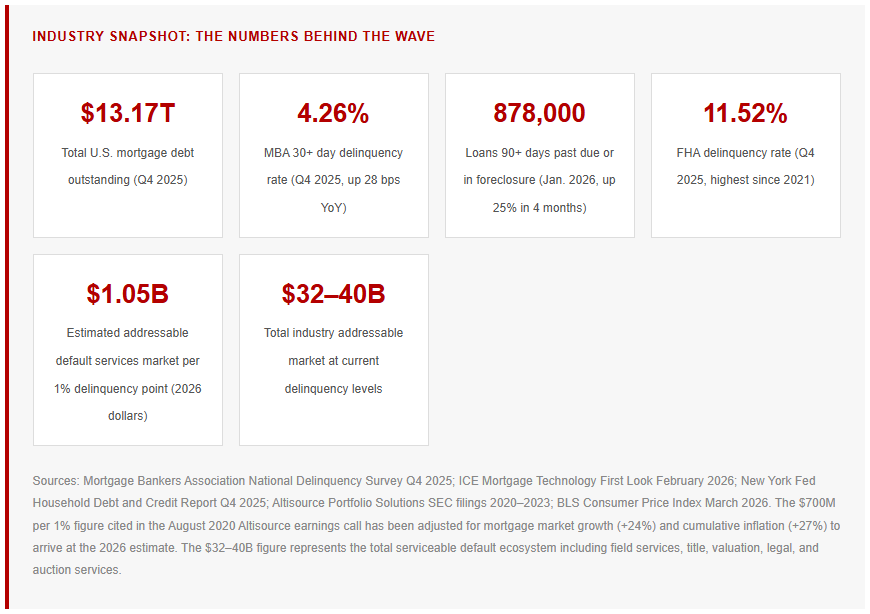
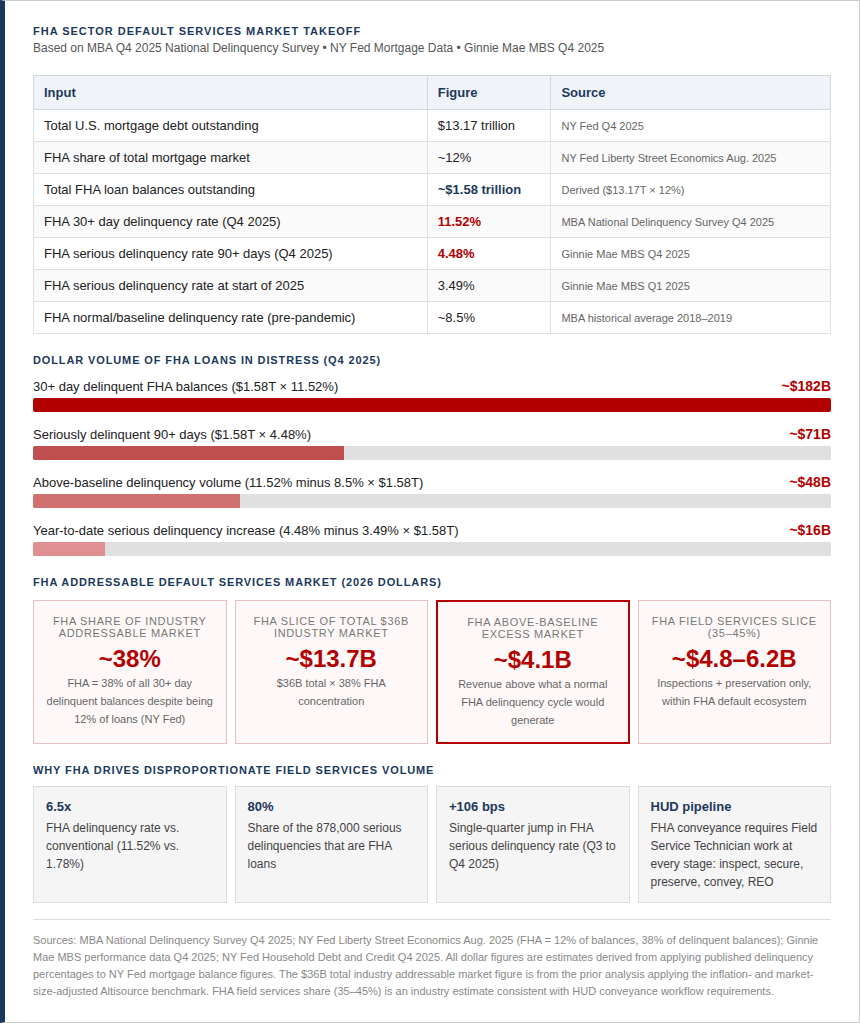
The mortgage default services industry is standing at the edge of a wave that the executives in high-rise offices have been quietly anticipating for three years, while the men and women who will actually absorb the physical labor of that wave have not received a single substantive conversation about what it means for them. The data no longer leaves room for ambiguity. The Mortgage Bankers Association confirmed in February 2026 that the national 30-plus day delinquency rate has climbed to 4.26 percent of all outstanding loans, a figure representing some 878,000 households sitting in serious delinquency or active foreclosure as of January 2026, up a staggering 25 percent in just four months. The FHA delinquency rate, the single most relevant leading indicator for the field services workforce because FHA properties generate the densest preservation and inspection workloads, now sits at 11.52 percent, the highest reading since 2021 and more than six times the conventional loan delinquency rate of 1.78 percent.
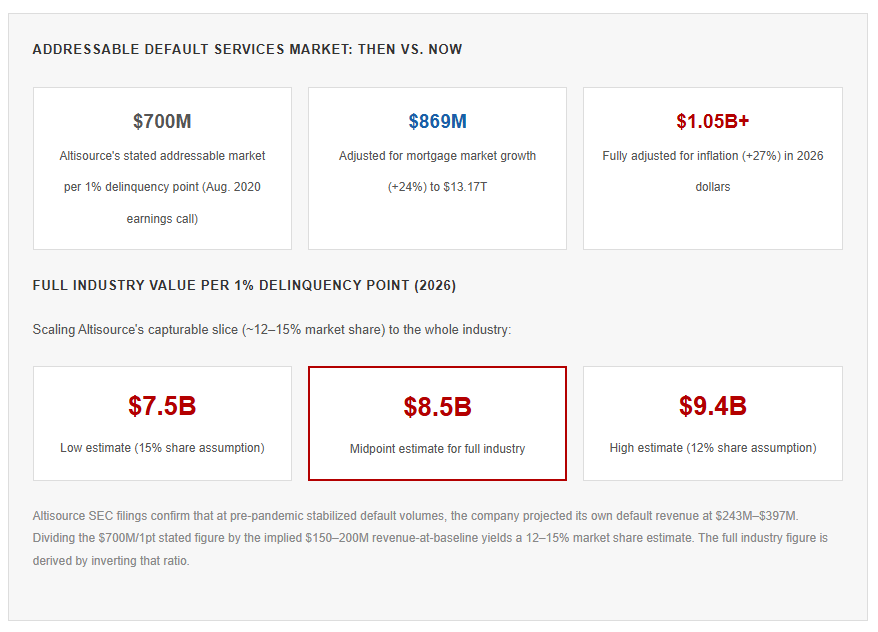
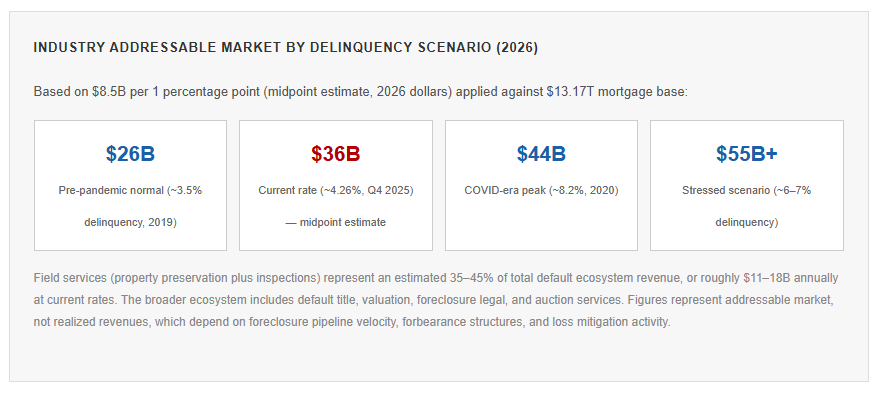
When Altisource Portfolio Solutions made its now-cited declaration during its August 6, 2020 earnings call that every one-percent increase in delinquency rates translates to approximately $700 million in additional addressable market for default-related services, the mortgage market sat atop roughly $10.6 trillion in outstanding debt. Today that same mortgage market has grown to $13.17 trillion, and cumulative inflation since August 2020 has cleared 27 percent, meaning the real 2026 value of that same one-percent delinquency point is not $700 million but closer to $1.05 billion. Scaled to the current 4.26 percent delinquency rate and extrapolated from Altisource’s own implied market share of 12 to 15 percent of the industry in 2020, the total addressable default services ecosystem today sits somewhere between $32 billion and $40 billion annually. None of that number flows to the Field Service Technician who cuts the grass. None of it flows to the Inspector who photographs the broken window and documents the occupancy status of a home whose owners have already driven away for the last time. The industry’s executives will hold their conferences, publish their white papers, and speak earnestly about technological innovation and operational efficiency, and the person doing the work in the rain for $10 a grass cut will continue to do precisely that.
The structural exploitation at the foundation of this industry has never been a secret, but it has been systematically mislabeled. The national mortgage default field services firms, including Safeguard Properties, ServiceLink, Cyprexx, and National Field Representatives, do not employ the people who perform the work. Field Service Technicians, the individuals who physically travel to a defaulted property to perform grass cuts, winterizations, debris removal, lock changes, and board-ups, are classified as independent contractors in virtually every operating model deployed by the nationals. Inspectors, whose work is categorically distinct in that they are performing property condition assessments, occupancy verifications, and interior or exterior documentation for servicer reporting purposes, are similarly classified as independent contractors, and are often paid on a per-inspection basis at rates that have not meaningfully changed in a decade despite inflation that has compounded roughly 27 percent since 2020 alone. And yet Inspectors are still paid around nine dollars per inspection. That is not a typo. Nor is the total of Industry contractors whom are using food stamps to break even.
The price of fuel has increased by the largest rate, month-over-month, on record. This, combined with inflation tripling last month, is a clarion call for fuel surcharges as proposed by the International Association of Field Service Technicians (IAFST).
The independent contractor classification means that Labor bear full responsibility for their vehicle costs, their fuel, their equipment, their liability exposure, and their self-employment taxes, while the national firms bill the servicers at rates that leave a substantial margin between what the field person receives and what the client actually pays. Industry insiders and former vendor managers have described this layering as functioning more like a franchise extraction model than a service delivery network, where each layer of the supply chain takes its cut before anything reaches the person who actually touched the property. Field Service Technicians who perform preservation work are not in the same role as Inspectors who perform assessment work, and this distinction matters enormously from a legal and labor classification standpoint, yet both groups are warehoused under the same contractor framework by firms that benefit from the ambiguity. When the delinquency wave crests and the nationals begin routing volume through their vendor networks, the rates offered to Field Service Technicians for grass cuts and debris removal will reflect 2016, not 2026. The inspectors receiving occupancy check assignments will find their per-door rates unchanged from when gas cost half what it costs today. Not surprising after the tens of millions of dollars paid by NAMFS members for employee misclassification. More on that in an upcoming article!
The legal exposure accumulating beneath the independent contractor framework in this industry is not theoretical, and any attorney who has spent time reviewing the actual working arrangements between nationals and their so-called vendor networks would recognize the exposure immediately. The Internal Revenue Service’s own guidelines for distinguishing employees from independent contractors look at behavioral control, financial control, and the type of relationship between parties, and the mortgage field services industry fails significant portions of that analysis on a routine basis. Field Service Technicians working under national order mills like Safeguard Properties or ServiceLink often receive explicit instructions about how work must be performed, are required to use proprietary platforms and photograph according to client-mandated protocols, submit invoices through systems controlled entirely by the national, and can be removed from a work queue without notice or cause, none of which is consistent with a genuinely independent business relationship.
Inspectors performing occupancy and condition assessments face similar dynamics: they are assigned properties through national vendor management platforms, required to follow specific photographic and reporting standards dictated by the national or the servicer, given deadlines they did not negotiate, and paid at rates they did not set. Courts across multiple jurisdictions have found that workers in structurally analogous arrangements in other industries are employees, not contractors, and the California AB5 litigation history and subsequent state-level battles over gig economy classification provide a detailed roadmap for what happens when regulators begin scrutinizing those arrangements closely. The national mortgage field services firms have largely avoided that scrutiny not because their arrangements are legally clean but because their workforce is geographically dispersed, economically vulnerable, and organizationally fragmented in ways that make collective action difficult. The coming delinquency wave will bring volume, and volume will bring visibility, and visibility will eventually bring attention that the industry has spent years hoping to avoid.
The ethical dimension of what is about to happen deserves to be named plainly, not dressed up in the language of market dynamics or operational challenges. The delinquency data establishes that FHA borrowers, who are disproportionately first-time buyers, lower-income households, and borrowers with limited financial buffers, are now in serious delinquency at a rate of 11.52 percent, and that 80 percent of the 878,000 loans now sitting in serious delinquency or foreclosure are FHA loans. The communities in which those properties sit are not randomly distributed across the American landscape: they are concentrated in the same lower-income, often minority-majority neighborhoods that absorbed the worst of the 2008 foreclosure crisis and have never fully recovered. The Field Service Technicians who will be dispatched to those communities to mow the grass, board the windows, and remove the belongings left behind often live in those same communities, and their economic precarity is structurally similar to that of the borrowers whose properties they are being sent to maintain. Nationals collect fees from the servicers, which are passed down to the nationals’ vendor networks at reduced rates, and further passed down to the subcontractor or direct-service technician at rates that reflect none of the inflationary environment those workers are actually living in. The Inspector driving 45 miles to verify occupancy on a property that has clearly been vacant for three months, photographing a broken water heater and a ransacked interior, and submitting that report through a proprietary platform for $5 or $7, is absorbing costs that the industry’s fee structures have never honestly accounted for. When that same Inspector flags a property as vacant and the national assigns a Field Service Technician to perform an initial secure, the preservation fee billed to the servicer may be multiples of what either the inspector or the technician ultimately receives. The ethical framework underlying this arrangement is one of intermediary extraction sustained by a captive labor supply that has no meaningful leverage in the fee-setting process.
The Field Service Technician does not benefit from a $40 billion addressable market. The Inspector does not benefit from a $1.05 billion valuation per delinquency point. They benefit from whatever rate the national decided to post in its portal five years ago, unchanged, while fuel costs climbed and insurance premiums doubled. Moreover, though, with wages stagnant over the past 30+ years and coupled with the inordinate rise in fuel — US national average today is $4.15 and anticipated to climb over the next 3-6 months — the reality is that now, more than ever, a fuel surcharge such as the IAFST has proposed, is needed in the Industry.
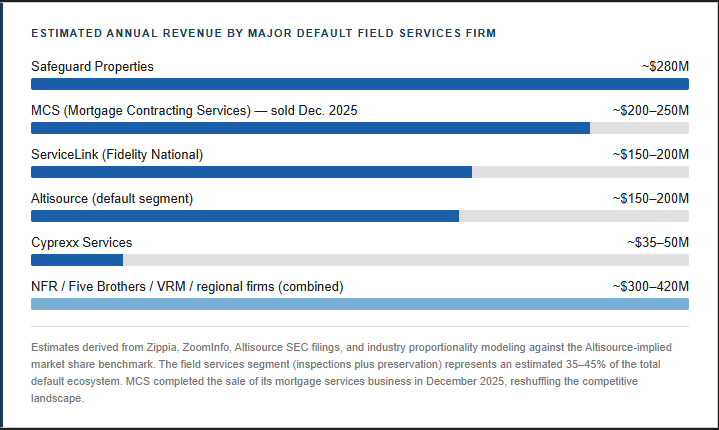
The consolidation currently reshaping the competitive landscape at the national level will make every structural problem described above worse before it makes anything better. MCS, one of the major national field services platforms that had operated for nearly four decades, completed the sale of its mortgage services business line in December 2025, a transaction that removes a significant competitive counterweight from the market and concentrates more of the serviceable default volume among an even smaller number of nationals. Cyprexx’s acquisition of Xome Field Services from Mr. Cooper Group in late 2021 similarly concentrated vendor network relationships and inspector panel assignments within a firm whose total annual revenue sits in the $35 to $50 million range, meaning it is absorbing infrastructure and client relationships without the capital depth to weather prolonged volume surges without squeezing its contractor base. Safeguard Properties, which carries estimated annual revenues around $280 million and remains the largest standalone field services firm in the industry, has invested in automation and workflow technology, but industry sources have noted that those investments are oriented toward servicer-facing efficiency and compliance reporting, not toward improving the economics of the Field Service Technicians and Inspectors who generate the underlying data those systems process.
ServiceLink, operating within the Fidelity National Financial ecosystem with estimated revenues in the $150 to $200 million range for its default field services operations, benefits from title and close integration that generates cross-sell revenue on the same asset, a margin structure unavailable to the independent workers in its vendor network who see only the work order fee. When the delinquency wave fully accelerates, which the ICE Mortgage Technology data suggests is already underway, the nationals will have consolidated their servicer relationships, their platform infrastructure, and their market positioning, while the Field Service Technicians and Inspectors who constitute the last mile of the entire operation will be offered the same degraded rates, the same unilateral contract terms, and the same absence of recourse that has defined their working conditions for two decades. The $40 billion addressable market figure is not a number that belongs to the people who will do the work. It is a number that belongs to the shareholders of companies that have engineered the most effective transfer of financial risk downward in any service industry currently operating in the United States.