



In the early morning hours of Tuesday, in the 600 block of Mountain View Road in Stafford County, Virginia, a tragic incident occurred that has sent shockwaves through the mortgage field services industry. According to the Stafford County Sheriff’s Office, a man arrived onsite for work with a mortgage company and was found by deputies lying unresponsive in the driveway, having been shot. The victim was later identified as Michael Dodge II, age 35, of Caroline County, and despite being on site to perform a property-service assignment, he was pronounced dead at the scene. The caller on the line reported hearing shots being fired over the phone and then lost contact with the coworker who had gone on the job. This incident raises difficult questions for an industry in which field-service technicians and inspectors walk into properties, both vacant and occupied, often with little direct oversight and major risk. It forces us to reconsider the labor-first implications, the responsibilities of servicers, and the legal protections—or lack thereof—afforded to the men and women who keep the mortgage asset chain moving.
In the world of mortgage field services there are clearly separate but interconnected roles. On one side are the Field Service Technicians, the workers who perform property preservation tasks: mowing lawns, removing debris, securing vacant properties, putting up fencing or boards, changing locks, winterizing plumbing, managing utilities, often after a homeowner has defaulted. On the other side are Inspectors, often independent contractors, tasked with occupancy checks, condition reports, “drive-by” evaluations, interior or exterior walkthroughs, submitting digital reports, photos and data to lenders and servicers. While Inspectors may spend only ten minutes at a site or simply drive by, as industry guides note, Technicians may enter properties, be on site for hours, work alone, and confront physical hazards, trespassers, dangerous conditions or uncooperative occupants. The fatality of Mr. Dodge thus demands an inquiry into how the industry classifies and protects these workers depending on role, status, compensation and oversight.
One of the first troubling elements this case highlights is the ambiguity around what “working for a mortgage company” means in practice. When the sheriff’s office reports that Dodge “was on the property to perform work for a mortgage company,” we must ask: was he directly employed by the mortgage servicer, or by a vendor, or subcontractor? Was he a technician or inspector, and what tasks was he performing at the moment of the shooting? The underground reality in the field services world is that many technicians and inspectors work as independent contractors, often 1099-vendors, paid per assignment, with little direct supervision. For Inspectors, the job involves little time onsite and is more data oriented, thus perhaps less hazardous. But for Technicians, the entry into vacant homes, lawns, and sometimes occupied properties represents tangible risk. Without precise job role identification and industry standards for safety, a fatal incident like this underscores how vulnerable workers are.
The International Association of Field Service Technicians (IAFST) had petitioned the Trump Administration to set an official NAICS for workers in our Industry which may have prevented just such an occasion. Management has fought long and hard to prevent such action due to the potential for increased pay and a clearly defined organizational structure for Labor.
The financial structure of the industry compounds the labor risks. For example, industry data shows that Inspectors are sometimes paid as little as $5-$10 per property inspection, and that many of these roles are billed as “drive-by” inspections. The compensation gap between Inspectors and Technicians is significant: a Technician may expend hours, perform labor-intensive tasks, deal with hazards, whereas an Inspector may take ten minutes, snap a photo, upload a report. Yet both roles may be under-resourced in terms of training, insurance, oversight, and physical safety protections. The incentive structure in the preservation/inspection field is heavily weighted toward cost minimization for the servicer or vendor, which means the individuals on the ground get the least margin for error—and the greatest margin for risk.
Beyond the question of pay lies that of protection and recognition. Technicians on vacant or distressed properties encounter squatters, break-ins, hazardous debris, bio-risk material, aggressive trespassers, structurally unsound homes, and in the worst case, armed confrontation. In this case, a mortgage company employee was shot and killed. More importantly, both the media and NAMFS Executive Director Eric Miller used the term, employee. That should prompt a hard look at whether the industry has reflected the risk profile of Technicians in policy: are they required to carry panic-alarm devices? Are they given personal protective equipment (PPE) or training for violence de-escalation? Are they allowed or encouraged to arm themselves? The push now mentioned in industry circles to allow Technicians and Inspectors to carry arms for defense signals how desperate some vendors and workers feel, but also suggests that the industry has failed to provide safe working environments or adequate remediation for obvious hazards.
The legal implications of this tragedy are also significant. If in fact Mr. Dodge was operating as an independent contractor, questions will arise about liability of the servicer, the vendor manager, the mortgage company, and the property owner. Workers’ compensation rules differ for employees vs. contractors, and the safeguards for contractors are often weaker. If the worker is unarmed, unprotected, unsupported, working in a vacant or semi-vacant property, the question of negligence may very well come up: did the property management company or servicer assess the risk of the location? Did they send someone alone? Was that address known to have security issues? Did they provide proper instructions or backup? The industry repeatedly points out that background checks are mandated for field service vendors and contractors, precisely to control risk in the supply chain. Yet background checks do not protect someone working alone with no backup in a remote driveway at night.
One of the recent safety features that the IAFST introduced was the NFC embedded Industry ID card. When worn from a lanyard around the neck, oft times it is that initial sight of official credentials that is the difference between conflict and de-escalation.
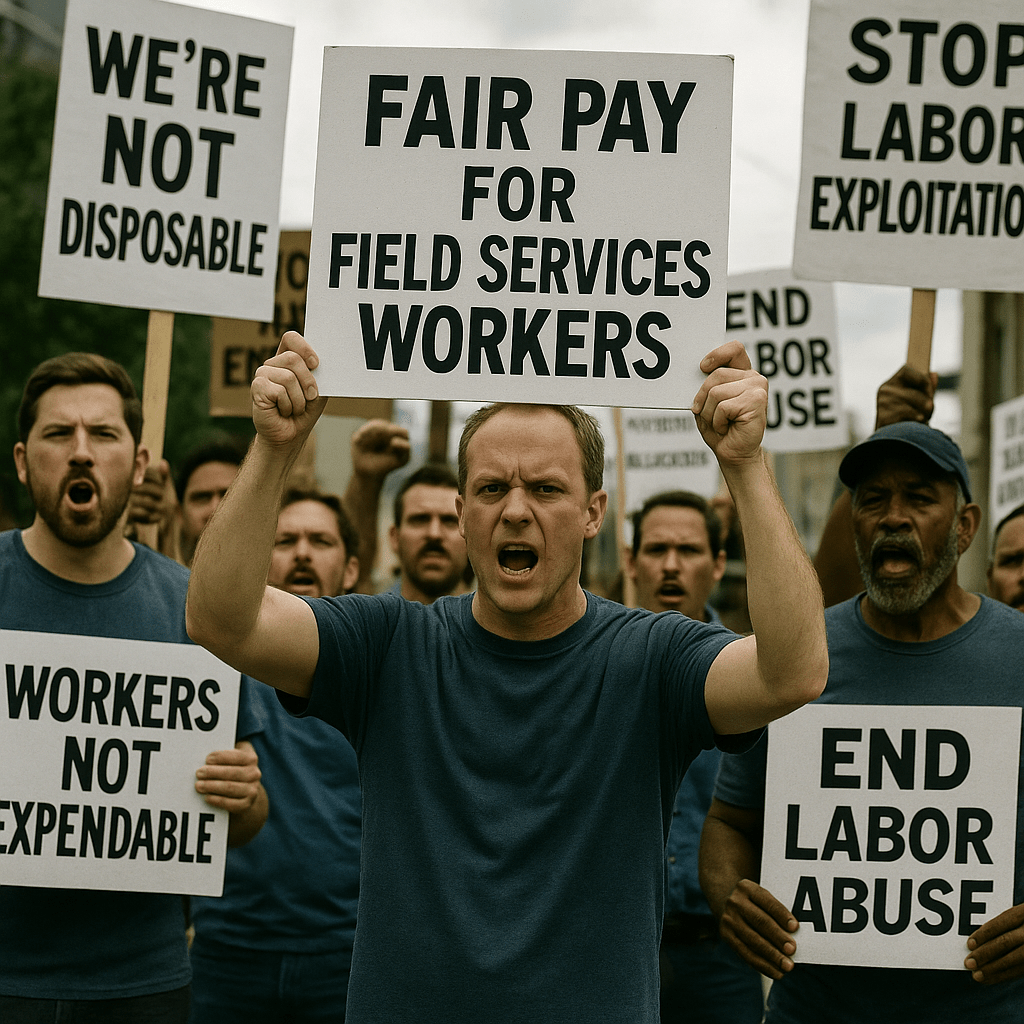
Ethically, the industry faces its own mirror: the people tasked with preserving assets for lenders and servicers often receive an implicit message that they are disposable. They perform tasks that keep the machine running—secure the property, maintain it, ensure compliance—but when something goes wrong, they are not always visible until tragedy occurs. Inspectors might be thought of as lower-risk and more “professional,” while the Technicians—the lawn cutters, debris removers, boarders-up—face the real world. Yet the industry narrative tends to lump them all together under “vendor network,” underpay them, under-insure them, and under-protect them. The fact that a push is now underway to raise pay and allow armed carry is a sign that workers feel the system has failed them.
From a labor-first perspective, we must ask whether increased compensation alone is sufficient. Pay increases may help—industry associations like National Association of Mortgage Field Services (NAMFS) have issued white papers about the need for increased pricing in property condition reports and bids; however, they never advocate for any of that money to be earmarked for Labor. But money cannot substitute for safety protocols, insurance coverages, backup response, and a truly risk-aware vendor management system. If the mortgage servicer or asset manager views a Technicians’ job as low margin and high risk, but fails to resource it accordingly, tragedies like the one in Stafford County become foreseeable. Turning the lens back on the industry, it must reconcile: we will send someone out to a distressed property—but we must do it with training, communication, oversight, and an exit strategy if danger arises.
A critical reform pathway is vendor management oversight. Education, such as IAFST University, is an option for Clients and Vendors to properly ensure full scope participation. As a third party provider, it insulates against employee misclassification while simultaneously ensuring that Labor has the tools necessary to ensure safety and professionalism. When a mortgage company issues a work order for preservation or inspection, it relies on several tiers of vendors, sub-vendors, contractors, and subcontractors. The field services industry is deeply layered; the further one gets from the original servicer, the weaker the oversight often becomes. The victim in this case may have been operating under multiple layers of subcontracting, which raises the question of how many degrees of separation stood between the servicer and the person in the driveway. The management process must demand incident-reporting, risk-scoring of assignments, real-time communications, and emergency protocols. If you are sending someone to a “problem” property, the contractual language must reflect the possibility of violence, and the worker must have an unequivocal route to call for backup. Without this, the risk is shifted onto the individual.
Finally, there is the public image and regulatory risk. When a story of a worker being shot on a “mortgage company job” reaches the press, the servicer, the investor, and the vendor chain all become exposed. There may be regulatory review, litigation, reputational damage, and increased allowance demands. The industry’s negligence in basic labor protections can lead not only to human tragedy but to financial liability. If Technicians and Inspectors are seen as “just contractors,” the moral imperative remains: they are doing essential work. The next step is not just reactive—raising pay or allowing arms—but proactive: acknowledging that field services labor is essential and dangerous, compensating it as such, and providing the protections workers deserve. One life lost should serve as a wake-up call.