




When SingleSource, on a Shellpoint inspection, converted a cited Inspector’s work order to “no contact” after a trespass ticket arrived, neither the servicer nor its national vendor cited a single line of mortgage law authorizing what they had ordered. Then the order mill agreed to pay the $150 fine. That payment is not a resolution. It is a confession — and the Inspector it was meant to silence now carries a permanent federal criminal record for doing exactly what he was told.
There is a $150 ticket sitting in a court file somewhere in America right now, and it will be paid according to internal emails exclusively read by Foreclosurepedia. An independent property Inspector knocked on a door because a work order told him to. A homeowner called the police. Law enforcement arrived and cited him for criminal trespass. The national vendor that issued the work order — acting as a conduit for a servicer that is part of one of the largest publicly traded mortgage companies in the country — agreed to cover the fine. Case closed, the industry presumably believed. Except the case is not closed. The fine payment did not expunge the citation. It did not remove the NCIC entry. It did not provide the Inspector with indemnification against future encounters. And it did not answer the question that the trespass citation first raised and that the payment now answers in the worst possible way: the order mill paid because it could not defend the order that generated the citation in the first place.
The MBA NDS Q4 2025 covers approximately 40 million first-lien loans with an overall delinquency rate of 4.26% MBA — that is 1,704,000 loans currently in default across all loan types. Every single one of those defaults triggers an initial door knock inspection as the first step in the servicer’s contact protocol. That is industry standard, not editorial assumption.
The $150 math, three ways:
| Scenario | Per Loan | Total Exposure |
|---|---|---|
| Ticket only | $150 | $255.6 million |
| Ticket + low defense | $950 | $1.62 billion |
| Ticket + full defense | $2,650 | $4.52 billion |
The order mill paid $150 to make one ticket go away. There are 1.7 million loans in default right now, each one starting with that same door knock. If that $150 ticket is the going rate for conducting an inspection the industry cannot legally defend, the industry’s aggregate exposure on the current default pipeline alone — tickets only, no defense costs — is $255 million. Add attorney fees and lost work time and it crosses $4.5 billion. They paid $150 to avoid establishing a precedent. The precedent they actually established is that the ticket is valid and payable. The math above is what that precedent costs at scale.
When a party pays a fine rather than contesting it, the payment is an admission. Not a formal legal admission in every jurisdiction, and not one that automatically resolves civil liability questions. But in the court of institutional logic, the sequence is unambiguous. If the work order carried lawful authority — if HUD Handbook 4000.1 or the underlying mortgage instrument or the Fannie Mae Servicing Guide specifically authorized the Inspector to approach that occupied property and photograph the door encounter — then the appropriate response to a trespass citation was a letter from general counsel citing that authority and contesting the citation on its merits. No such letter was sent. No such authority was cited. The work order was reclassified to “no contact” status and the fine was paid. In the vocabulary of institutional behavior, that sequence has one meaning: the order mill assessed its legal position, determined it could not defend it, and purchased silence for $150.
The silence it purchased, however, did not come cheap for the Inspector who was silenced. The National Crime Information Center (NCIC) database now contains a record of the citation. That record is accessible to every law enforcement agency in the country, to employers conducting background checks, to licensing boards reviewing contractor applications, and to the courts if he is ever cited again. The Police Department that issued the original ticket has made the consequences of a second citation explicit: the next time is automatic arrest and jail. The Inspector did not make a mistake. He did not exercise bad judgment. He followed a work order issued by a national vendor acting on behalf of a servicer operating under investor guidelines, and the result is a permanent entry in a federal criminal database and the prospect of incarceration if he returns to the same property or encounters a similar situation on any future assignment. The order mill paid $150 and walked away. The Inspector carries the record indefinitely.
THE CORPORATE WEB: WHO OWNS WHOM, AND WHY THAT MATTERS
The mortgage field services industry has consolidated around a small number of corporate families whose ownership connections create information-flow obligations that, in this instance, appear to have failed entirely. The most significant of these connections runs directly through Rithm Capital Corp. (NYSE: RITM), a publicly traded real estate finance company formerly known as New Residential Investment Corp. Rithm owns NewRez LLC, which operates its loan servicing business under the brand name Shellpoint Mortgage Servicing. It is a Shellpoint inspection that is in question today.
The Rithm ownership structure matters enormously for the legal analysis. When Shellpoint generates a work order directing an Inspector to approach an occupied property and photograph the door encounter, and an order mill routes that order to the Inspector, all become are parties to a directive that has now produced a criminal trespass citation and a fine payment that functions as an admission of indefensible authority. The legal knowledge that Shellpoint’s counsel possesses about the limits of servicer entry authority does not exist in a vacuum sealed off from their relationships with other order mills or operational policies. Both entities share a corporate parent with SEC disclosure obligations. The trespass citation, the “no contact” reclassification, and the fine payment together establish a documented sequence in which the corporate family directed a worker to do something, was unable to legally defend what it directed, and paid to make the immediate legal consequence disappear — while leaving the long-term consequence entirely with the worker.
Stewart Information Services Corporation (NYSE: STC) acquired MCS Mortgage Contracting Services in December 2025. MCS operates its inspector-facing platform at mcs360.com and runs a proprietary FHA tracking system called Convey360, through which it claims a 99 percent on-time FHA conveyance rate. Fidelity National Financial (NYSE: FNF) owns ServiceLink, which operates in the same national vendor space. Both Stewart and Fidelity are public entities with the same SEC disclosure obligations that apply to Rithm. All three own subsidiaries whose operating models depend on a legal theory of inspector entry authority that none of them has been willing to commit to in writing when law enforcement arrives at the door, and which the fine payment in this case implicitly confirms cannot be defended.
THE LEGAL VOID: WHAT HUD AND THE GSEs ACTUALLY SAY
The foundational legal problem is this: HUD Handbook 4000.1 establishes that mortgagees must conduct property inspections to determine occupancy status and support property preservation. That requirement exists. What does not exist anywhere in the federal regulatory corpus governing FHA-insured lending, the Fannie Mae Servicing Guide, or the Freddie Mac Single-Family Seller/Servicer Guide is a specific mandate requiring an Inspector to physically approach a potentially occupied property, knock on the door, and capture photographic evidence of that live encounter. The duty to inspect is in the record. The duty to knock and photograph is not. The door knock and photograph requirement is an internal industry mandate, created by nationals and servicers, layered on top of federal minimum inspection standards, and handed down to Inspectors as if it carried the same legal weight as the underlying regulatory obligation. It does not. The fine payment is now the industry’s own acknowledgment that it does not.
“If the work order were a legal document, and if the door knock process were legal, both SingleSource and Shellpoint would have cited the specific section of the mortgage document granting them the legal right to proceed. They did not. They paid the fine instead.” — Foreclosurepedia Editorial Analysis, April 23, 2026
The standard Fannie Mae/Freddie Mac Uniform Security Instrument grants the lender the right to make reasonable entries upon and inspections of the property — a conditional right contingent on reasonable cause to believe a covenant violation has occurred. It is not a blanket right. More critically, it is a right that exists as between the lender and the borrower as contracting parties. It is not a right that flows from the lender through a servicer through a national vendor to several order mills and then to an independent contractor, retaining the same legal force at each remove. The chain of assignment that would be required to grant a day-rate independent contractor the legal authority to approach an occupied property against a homeowner’s objection has never been legally tested in court. It has now been tested by law enforcement — and the industry’s response was to pay rather than contest.
THE ADMISSION: WHY PAYING THE FINE IS WORSE THAN FIGHTING IT
The decision to pay the $150 fine rather than contest it deserves careful analysis, because it represents the worst possible outcome for the industry’s long-term legal position — far worse than losing a contested citation in a local court would have been. A contested citation that resulted in a finding against the Inspector would have established a data point, but not necessarily a binding precedent. It would have put the industry on notice to address the legal question and would have created a record on which future arguments could be built or distinguished. Payment creates a different kind of record. It creates a documented instance in which an order mill, after consulting with the servicer whose instructions generated the citation, elected not to contest the underlying legal authority question and instead paid the fine. That election, repeated across the industry every time a citation is issued and quietly settled, is assembling a body of evidence that the door knock and photograph protocol has no defensible legal foundation.
The implications for the broader Inspector workforce are significant. Every Inspector currently working door knock assignments is operating under the same protocol that generated this citation and this payment. The order mill’s willingness to cover the fine in this case does not extend to NCIC records, does not extend to lost income during court proceedings, does not extend to professional licensing consequences, and explicitly does not extend to the next citation. The Police Department’s warning — that a second encounter is automatic arrest — is a statement about the legal reality the Inspector now faces on every future assignment. He does not get the benefit of the order mill’s legal assessment. He gets the criminal exposure that assessment produced, carried forward indefinitely in a federal database.
THE NCIC RECORD: WHAT $150 CANNOT BUY BACK
The National Crime Information Center is the FBI-administered database through which law enforcement agencies across the country share criminal justice records in real time. A trespass citation that results in a conviction or an uncontested finding creates an entry in that database that is accessible to every agency connected to the NCIC system — which is to say, every law enforcement agency in the country. Employers conducting federal background checks, professional licensing boards, housing authorities, and courts all have access to NCIC records through appropriate channels. For an independent contractor whose livelihood depends on maintaining clean background checks — a prerequisite for approval on most national vendor platforms, for access to HUD REO properties, and for bonding and insurance that field service work requires — an NCIC entry is not a $150 problem. It is a career-threatening problem that $150 does not address.
The order mill that paid the fine made a $150 business decision. The Inspector who received the citation made no decision at all — he followed instructions, received a citation, had a fine paid on his behalf without his meaningful participation in the legal strategy, and now carries a federal record while the entities whose instructions created the situation carry nothing. The disproportion between what the order mill absorbed and what the Inspector absorbed from the same event is not incidental to this story. It is the story. It is the same disproportion that appears every time an Inspector is cited, every time a work order is reclassified without explanation, and every time the legal risk generated at the top of the chain lands at the bottom of it.
THE NUMBERS: FHA DELINQUENCY, INSPECTION VOLUME, AND THE TRESPASS COST MODEL
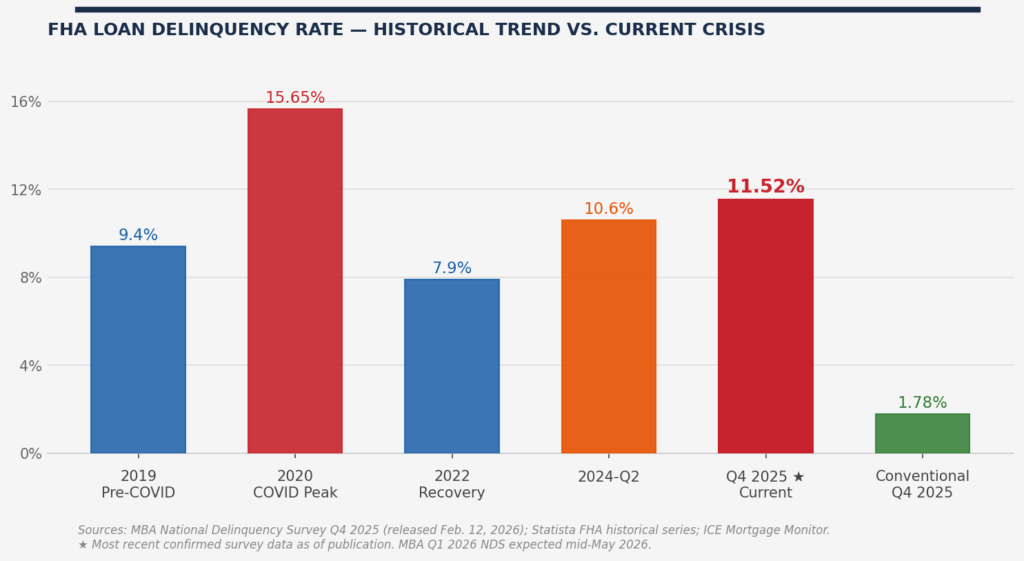
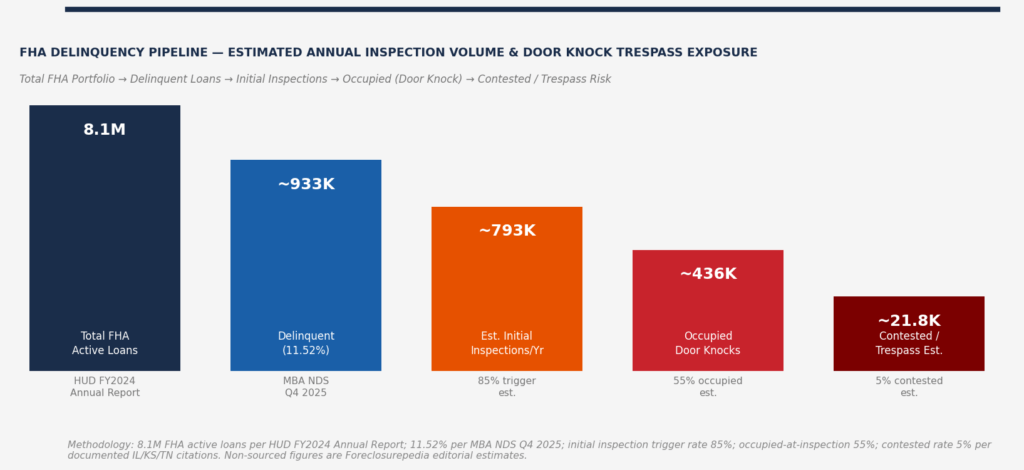
The FHA insured portfolio stood at approximately 8.1 million active mortgages as of the HUD FY2024 Annual Report to Congress, representing approximately $1.6 trillion in unpaid principal balance. The MBA National Delinquency Survey for Q4 2025, released February 12, 2026, confirmed an FHA delinquency rate of 11.52 percent — the highest since Q2 2021 and up 74 basis points from the prior quarter. At 11.52 percent against an 8.1-million-loan portfolio, approximately 933,000 FHA loans were delinquent as of Q4 2025. The NY Fed Consumer Credit Panel data established that FHA loans, despite representing only 12 percent of total mortgage balances, account for 38 percent of all 30-plus-day delinquent balances. The concentration of distress in the FHA segment is structural, not coincidental, and it is generating inspection order volume at a scale that makes the legal question raised by this single citation an industry-wide emergency.
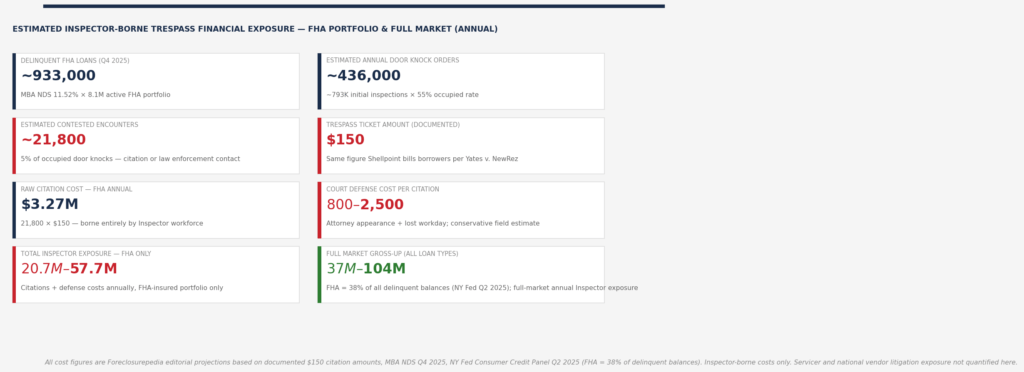
These numbers describe the financial cost of the trespass exposure as it is currently being borne by the Inspector workforce. They do not capture the NCIC dimension, which is not reducible to a dollar figure. An Inspector who loses platform access, bonding eligibility, or professional licensing as a result of a criminal record generated by following a work order has suffered a harm that exceeds any cost model built around citation amounts and defense fees. That harm was created by the industry’s legal void, sustained by the industry’s decision not to contest it, and transferred entirely to the Inspector by the industry’s decision to pay the fine and consider the matter resolved.
THE PRECEDENT THE INDUSTRY JUST SET
The order mill’s payment of the $150 fine does not resolve this matter. It establishes it. What has now entered the record is a documented sequence in which: a national vendor issued a door knock work order; a homeowner called police; law enforcement issued a criminal trespass citation; the national vendor and servicer were unable to produce legal authority for the work order; the work order was reclassified to “no contact”; and the fine was paid. That sequence is now a matter of public record in the jurisdiction where the citation was issued. It is available to plaintiff’s attorneys, to regulatory examiners, to journalists, and to the next Inspector who receives a similar citation and decides to contest it rather than accept a $150 payment that leaves him with a federal record.
The Police Department’s warning about automatic arrest on a second citation is equally significant. It means that law enforcement in this jurisdiction has assessed the legal situation, concluded that the Inspector had no lawful authority to be on the property, and put the Inspector on formal notice that future similar conduct will result in custodial arrest. That warning does not bind the Inspector alone. It binds every Inspector working door knock assignments in that jurisdiction, under every order mill routing work there. The $150 fine paid by the order mill did not change that legal reality. It confirmed it.
THE YATES CONNECTION: BILLING AUTHORITY VS. ENTRY AUTHORITY
The federal class action Yates v. NewRez LLC, Case No. 8:21-cv-03044-TJS (D. Md.), documented a pattern in which Shellpoint charged Maryland homeowners property inspection fees expressly prohibited under Maryland law. The 2023 Maryland Commissioner of Financial Regulation found that Shellpoint had charged Maryland borrowers more than $270,000 in illegal inspection fees. The same inspection apparatus that billed $150 per inspection to borrowers is the apparatus that has now had a $150 trespass fine paid on behalf of an Inspector who conducted one of those inspections. The number is not coincidental. It is the same $150 — once extracted from the borrower as a servicing fee, once paid out by the order mill as the cost of a criminal citation the underlying work order could not legally support.
The servicer-side argument for inspection fee billing rests on the claim that the inspection was legally required and authorized. The fine payment in this case implicitly concedes that the inspection, as conducted, was not legally authorized to the satisfaction of law enforcement. That concession, made by paying rather than contesting, creates a meaningful question for any attorney reviewing the Yates-type fee billing claims that remain unresolved across the industry. An inspection that generated a trespass citation that the order mill chose to pay rather than contest is not straightforwardly describable as a legally authorized inspection for which a $150 fee can properly be billed to the borrower. That argument has not been made in court. It is now available to be made.
WHAT NEEDS TO HAPPEN
The resolution of this problem has become more urgent, not less, since the fine was paid. HUD must issue a mortgagee letter specifically addressing the legal basis for the door knock and photograph protocol, either confirming or denying that such a protocol is required under FHA guidelines. The GSEs must issue a servicing guide update clarifying what physical contact, if any, their inspection requirements mandate. The nationals and servicers who have issued door knock work orders must provide written legal authority to their Inspector vendors before the next citation is issued — and they must commit, in writing and before the work order is accepted, to fully indemnifying the Inspector workforce against citations, criminal records, and all associated consequences including NCIC entries, professional licensing impacts, and lost income.
What must not be permitted to continue is the current arrangement, in which publicly traded companies direct an independent contractor workforce to approach occupied properties under an implied claim of legal authority, pay the financial penalty when that authority is challenged, and leave the non-financial consequences — the criminal record, the federal database entry, the threat of arrest — entirely with the worker who followed instructions. The $150 payment the order mill made is the cheapest admission in the history of this industry’s legal exposure. What it bought for $150 was the confirmation that the door knock and photograph protocol cannot be legally defended. What it cost the Inspector who received the citation is not $150. It is his federal record, his continued exposure on every future assignment, and the prospect of incarceration the next time he does what a work order tells him to do.
Editor’s Note: Changed the actual party name that opted to pay the fine which was SingleSource whom was working on behalf of Shellpoint.