




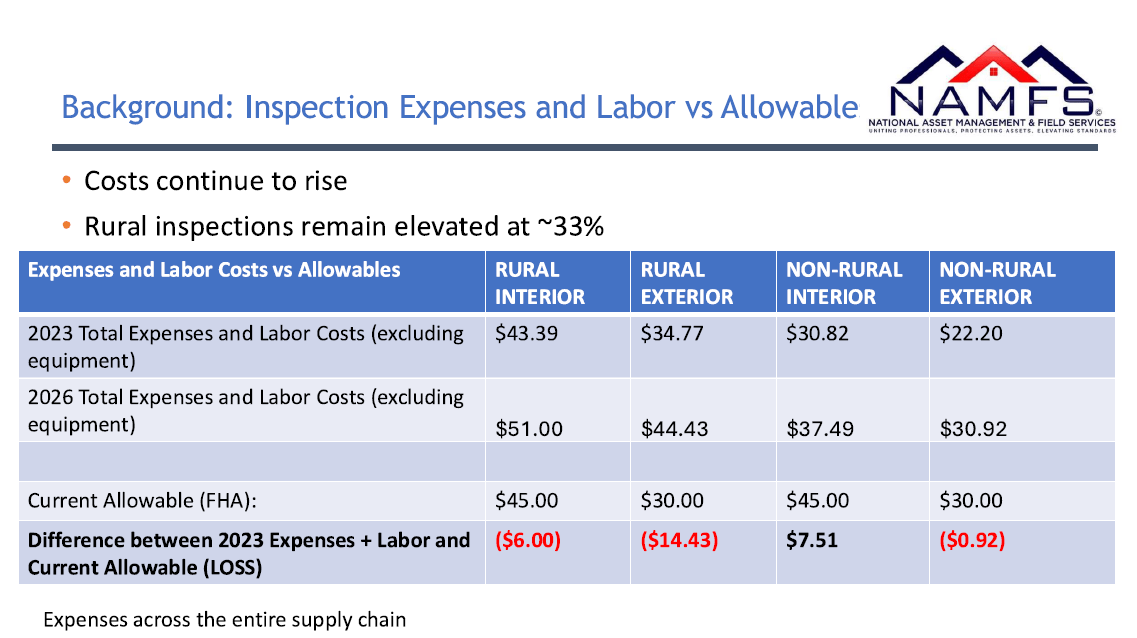
The January 2026 cost document circulated under the banner of Eric Miller’s NAMFS arrives wrapped in the language of stability, risk management, and operational necessity, yet the conditions it describes reveal a far more troubling landscape. The cover image comes from that document. The presentation, particularly the cost comparison imagery and estimator tables shown throughout the document, frames the industry as burdened by inflation, insurance pressures, and evolving compliance obligations. At first glance, the material appears designed to convey analytical rigor and financial discipline. Beneath that surface, however, the numbers quietly illustrate an economic environment where the compensation of labor has been pushed to thresholds that defy practical sustainability. The charts speak extensively about vendor expenses and allowable reimbursements, but they remain largely silent on the lived economics of the individuals performing the work. This silence is not an oversight but a structural feature of how pricing discussions are often conducted in mortgage field services. The reality confronting Inspectors and Field Service Technicians is one of escalating costs paired with declining financial viability. What appears in slides as cost management manifests in the field as persistent economic strain.
For Inspectors, the most jarring figure remains the market normalization of inspections averaging approximately nine dollars per inspection. This is not a compensation model that merely compresses margins but one that undermines the basic arithmetic of field operations. Inspectors must maintain vehicles, purchase fuel, carry insurance, pay InspectorADE, and sustain mobile connectivity, all while meeting strict reporting and documentation requirements. The expectation of accuracy in occupancy determinations carries genuine legal and financial implications for servicers and investors. Despite this responsibility, the valuation of the Inspector’s expertise often resembles a token payment rather than professional compensation. An Inspector cannot meaningfully amortize operating expenses against such revenue levels without incurring predictable losses. Over time, this pricing reality reshapes behavior, incentivizing speed and volume at the expense of diligence and precision. The economic signal delivered to the workforce is unmistakable. Expertise and risk-bearing judgment are treated as low-value inputs in a system that nonetheless depends upon their reliability.
Field Service Technicians encounter a parallel distortion, though their labor is physical rather than observational. Grass cuts clearing at twenty five dollars require transportation, equipment investment, maintenance, and labor time that far exceed the reimbursement envelope. Debris removal priced near twenty eight dollars per cubic yard must absorb disposal fees, loading labor, fuel consumption, and vehicle wear. Winterizations offered at fifty dollars carry potential liability exposure that can reach catastrophic levels if performed incorrectly. Lock changes priced at twenty five dollars, along with hardware reimbursements such as ten dollars for padlock and hasp combinations and twelve dollars for lock boxes, reflect a similar pattern of compression. These figures may appear manageable in isolation, yet they fail to account for the cumulative overhead borne by independent vendors. Trucks, tools, safety equipment, insurance, Verisk‘s Property Preservation Wizard, and administrative time impose fixed costs that persist regardless of individual job pricing. The Technician’s operational reality becomes one of juggling expenses against line items that leave little room for error. What the spreadsheets characterize as efficiency, many workers experience as financial suffocation.
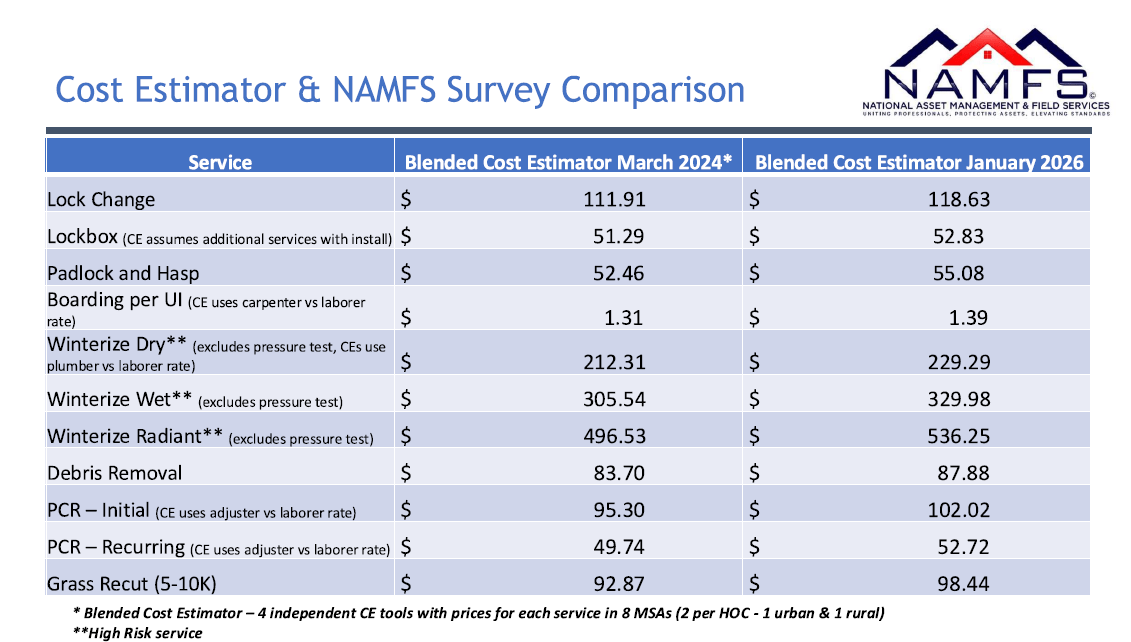
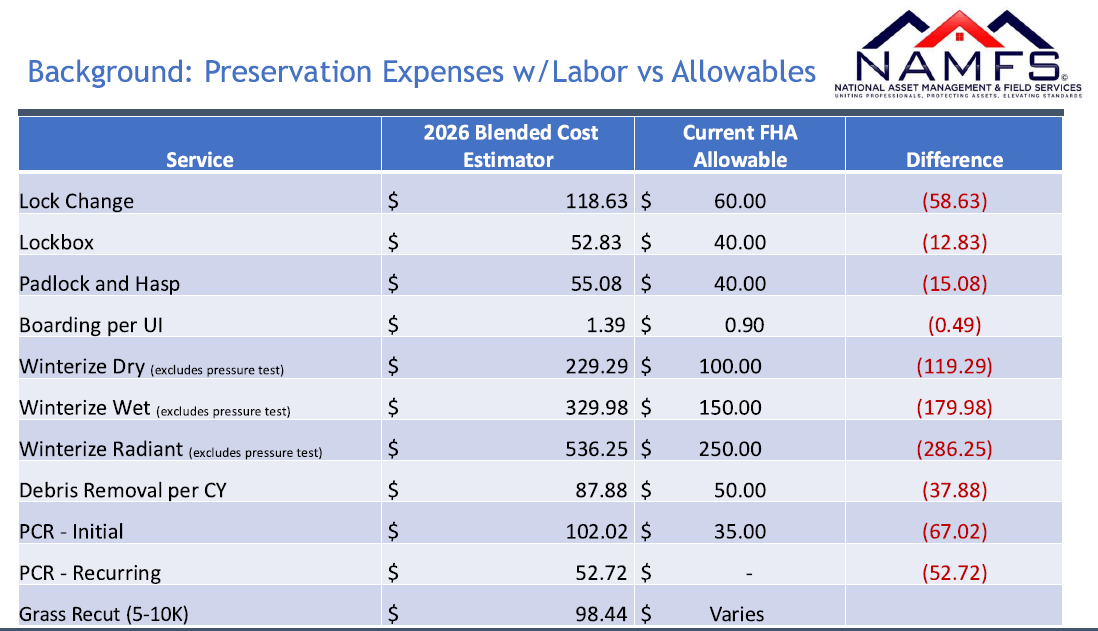
Insurance pressures intensify these challenges in ways that are both predictable and destabilizing. Vendors across the country report premium increases frequently approaching twenty five percent or more, often imposed without any assurance of work volume or rate adjustments. Insurance is not optional within mortgage field services but a prerequisite for participation, platform access, and client eligibility. The contractor must pay more simply to remain in the marketplace. This dynamic produces a paradox where rising operational risks are cited to justify tighter controls while labor compensation remains stagnant or declines. Insurance costs therefore operate less as protective mechanisms and more as economic barriers to entry and survival. Smaller vendors face disproportionate strain, as they lack the scale necessary to distribute premium increases across large assignment volumes. The resulting attrition is then interpreted as a capacity shortage rather than the logical outcome of financial pressure. Economic stress migrates downward, concentrating upon those least equipped to absorb it.
Layered atop insurance inflation is the expanding burden of proprietary technology platforms that impose fixed expenses disconnected from job profitability. Verisk’s Property Preservation Wizard, frequently positioned as indispensable infrastructure and whose recent 41% loss in value YTD, introduces recurring costs that can approximate one hundred seventy five dollars per month. For independent Field Service Technicians, this is not a trivial software subscription but a substantial operating liability. The fee is incurred regardless of seasonal fluctuations, assignment availability, or payment delays. The economic risk of low volume periods rests entirely with the contractor. Inspectors face a similar reality through InspectorADE, where the pricing structure often compounds already suppressed per-order compensation. In many cases, Inspectors are charged on a per work order basis, meaning that each nine dollar assignment may carry a direct technology expense before fuel or time are even considered. Technology, once marketed as a tool for efficiency and transparency, increasingly functions as a mechanism for transferring operational costs to the smallest participants. The financial asymmetry becomes difficult to ignore.
What further deepens frustration among field professionals is the perceived mismatch between platform costs and platform capabilities. Contractors frequently describe both InspectorADE and the Property Preservation Wizard as little more than digitized spreadsheets, systems that resemble archaic Excel workflows rather than modern, feature-rich software environments. The interfaces may facilitate data entry, but they often lack meaningful innovation, automation, or functionality that materially reduces field workload. And due to Eric Miller’s NAMFS obvious suppression of not allowing APIs to be shared for third party service parties to enter the anti-trust competition space, Vendors pay recurring fees not for transformative tools but for basic reporting conduits required to receive and submit assignments. The value proposition becomes increasingly difficult to defend when software expenses consume a significant portion of already compressed revenues. Inspectors paying per work order charges for what appears to be a spreadsheet wrapper confront a stark economic contradiction. Field Service Technicians absorbing monthly platform fees encounter the same imbalance. Technology costs, rather than enhancing margins, frequently erode them. The contractor effectively finances the digital infrastructure governing their participation.
NAMFS never has and never will require price increases for Labor and Eric Miller has admitted as much on his recent podcast. Fact of the matter is that both he and Chad Rulo, NAMFS President, both admit it will probably never happen. This, coming on the heels of NAMFS demands to increase the typical inspection to over 300+ datapoints!
Pricing narratives within the industry rarely center these contradictions, instead emphasizing vendor expenses, compliance demands, and client sensitivities. Documents and presentations often articulate why reimbursement ceilings cannot expand while seldom interrogating whether labor compensation itself has fallen below rational operational thresholds. Inflation, litigation risk, and regulatory complexity are invoked as constraints, yet the distribution of financial pain remains uneven. Platform owners, large national vendors, and institutional stakeholders preserve scalability and capital buffers. Independent Inspectors and Field Service Technicians absorb volatility directly through suppressed pricing and rising overhead. This rhetorical framing subtly reassigns responsibility from structural design to abstract market forces. The result is a discourse that appears analytical while sidestepping the economic fragility of labor. Field realities become background noise rather than central variables. The imbalance persists because it is normalized.
Payment uncertainty compounds these pressures, introducing another layer of instability into an already strained ecosystem. Contractors frequently report elongated payment cycles, disputed invoices, and chargeback practices that allow upstream entities to retroactively negate compensation. A completed grass cut, lock change, or inspection may remain financially unresolved for weeks or months. In extreme cases, reimbursement may be reversed entirely, transforming revenue expectations into losses. This cash flow volatility interacts destructively with compressed pricing and fixed software expenses. Vendors must maintain insurance, vehicles, and platform subscriptions regardless of payment reliability. Economic modeling that excludes payment risk fails to capture a central determinant of contractor viability. For many workers, the question is not simply how much a service pays but whether payment will materialize predictably. The distinction between theoretical income and realized income becomes existential. Financial strain becomes chronic rather than episodic.
The human consequences of these economic structures extend beyond abstract dissatisfaction into workforce attrition and quality degradation. Skilled Inspectors and experienced Field Service Technicians do not exit the industry solely due to frustration but due to unsustainable financial mathematics. Equipment replacement, vehicle maintenance, insurance premiums, and technology subscriptions impose hard constraints that cannot be negotiated through optimism. Each departure reduces geographic coverage and institutional knowledge. Recruitment challenges intensify as compensation models deter new entrants capable of sustaining professional standards. A marketplace anchored to nine dollar inspections struggles to attract individuals willing to shoulder reporting accuracy risks. NAMFS estimates that inspections should be around $51 in their report. Service quality erosion becomes an anticipated outcome rather than an anomaly. Labor shortages emerge as predictable symptoms of pricing design. Capacity constraints reflect economics more than demographics.
Risk implications for servicers and investors follow naturally from these labor dynamics, though they are rarely acknowledged with equal candor. Property inspections and preservation activities function as early detection mechanisms for occupancy changes, collateral deterioration, and hazard development. Undercompensated labor increases the likelihood of rushed work, skipped assignments, and documentation errors. Software systems that add cost without adding meaningful efficiency amplify these vulnerabilities rather than mitigate them. Cost suppression at the labor layer can propagate downstream losses far exceeding immediate savings. Yet pricing debates often remain confined to line item comparisons divorced from lifecycle consequences. Financial efficiency is measured narrowly rather than systemically. Risk displacement masquerades as cost control. Structural incentives shape outcomes.
Ultimately, the NAMFS January 2026 cost discourse highlights a familiar tension within mortgage field services that continues to intensify. Institutional stakeholders describe rising expenses and operational challenges, while field vendors confront declining viability and expanding overhead. Inspectors charged per work order by inspection platforms and Field Service Technicians burdened by recurring software fees navigate an economic environment defined by asymmetry. Technology costs, insurance inflation, and payment uncertainties converge upon the smallest participants with disproportionate force. Systems described as infrastructure are often experienced as toll booths. Platforms marketed as solutions are perceived as spreadsheet relics extracting revenue without delivering meaningful advancement. The sustainability of the industry rests not on presentation narratives but on whether skilled labor can operate without guaranteed losses. Until compensation structures, cost allocations, and platform economics are reconciled with field realities, the disconnect will persist. The spreadsheets will continue to describe stability while the workforce narrates erosion.